Facts
On 9 April 2017, Santosh Kumar was travelling as a passenger in an autorickshaw when it was hit by a negligently driven Tata Safari bearing registration no. HR-51A-H-7086. He sustained grievous injuries, including a permanent disability assessed at 40% in relation to his right lower limb, shortening of the limb by three centimetres, and malunion around the right knee joint
Source reference: p. 1; paras. 2, 13The Motor Accident Claims Tribunal, South-East District, Saket Courts, awarded compensation of ₹5,66,569 with interest at 9% per annum by award dated 6 May 2024 in MACT No. 1009/2017
Source reference: p. 1; para. 1The Tribunal assessed the claimant’s functional disability at 10%, adopted monthly income of ₹8,889 based on minimum wages for a skilled worker in Uttar Pradesh, and declined future prospects
Source reference: pp. 2–3; paras. 3, 5In appeal, the claimant sought enhancement on the grounds that his functional disability, income, future prospects, pain and suffering, loss of amenities, attendant charges, special diet, and conveyance expenses had been inadequately assessed. He asserted that he was a tutor running a coaching centre and earning ₹45,000–₹50,000 per month, but no documentary proof of his qualifications or earnings was produced
Source reference: pp. 2–3; paras. 3–4, 8–9Issues
Whether the claimant’s monthly income was correctly assessed on the basis of minimum wages, and whether the applicable minimum wage required correction?
Source reference: pp. 3–4; paras. 9–10Whether the claimant was entitled to future prospects despite the absence of proof of his actual earnings?
Source reference: p. 4; para. 11Whether the claimant’s functional disability should be assessed at 10% or at a higher percentage in light of his 40% permanent disability in the right lower limb and his occupation as a tutor/coaching-centre operator?
Source reference: pp. 4–5; paras. 12–14Whether the compensation awarded under the heads of pain and suffering, mental and physical shock, and loss of amenities was inadequate?
Source reference: p. 5; para. 15Law Applied
The Court applied the principles governing assessment of compensation under the Motor Vehicles Act, 1988, including the requirement that loss of future earning capacity be assessed by considering the claimant’s occupation and the impact of the injury on his actual earning ability.
Source reference: no citationRelying on National Insurance Co. Ltd. v. Pranay Sethi, (2017) 16 SCC 680, the Court held that a self-employed or salaried claimant below 40 years of age is ordinarily entitled to 40% addition towards future prospects
Source reference: p. 4; para. 11Relying on Raj Kumar v. Ajay Kumar, (2011) 1 SCC 343, the Court applied the distinction between physical/permanent disability and functional disability, requiring consideration of the claimant’s vocation, the functional consequences of the injury, and his ability to earn a livelihood after the accident
Source reference: p. 4; para. 12In the absence of reliable documentary proof of actual earnings or educational qualifications, minimum wages could be adopted as the basis for computation of income
Source reference: pp. 3–4; paras. 9–10Reasoning
The Court upheld the Tribunal’s use of minimum wages because the claimant had not produced documentary evidence of his alleged income, M.A. and B.Ed. qualifications, or earnings from the coaching centre. However, it corrected the applicable minimum wage from ₹8,889 to ₹9,119 per month
Source reference: pp. 3–4; paras. 9–10Since the claimant was 33 years old at the time of the accident, the Court added 40% towards future prospects in accordance with Pranay Sethi
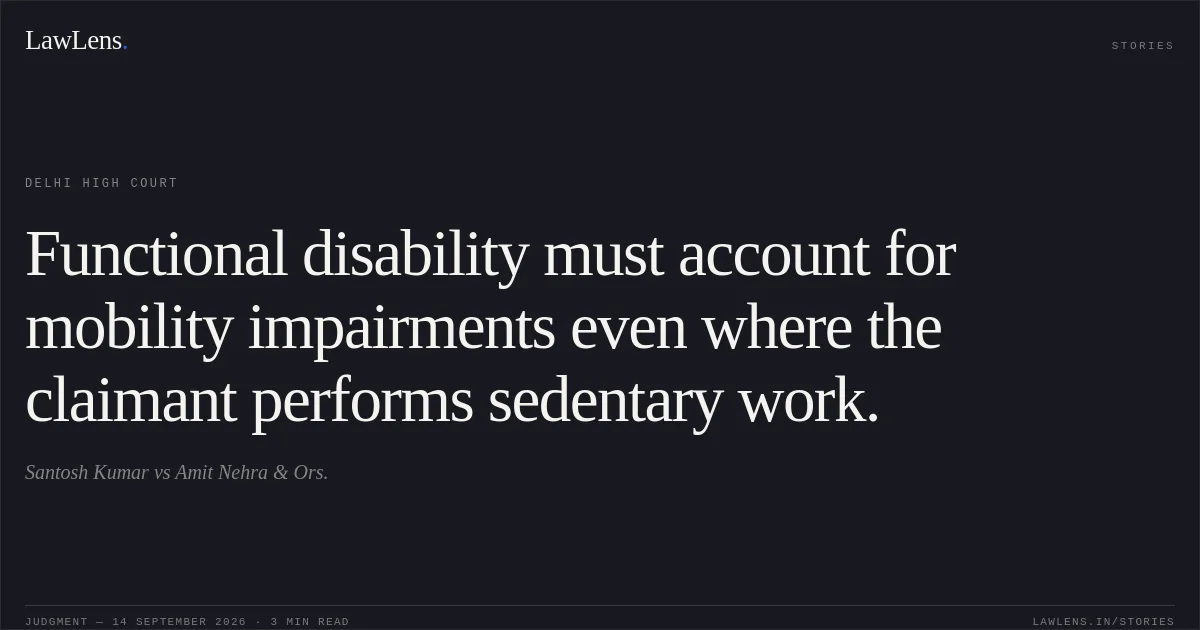
Source reference: p. 4; para. 11Applying Raj Kumar, the Court held that the claimant’s 40% disability in the right lower limb could not be mechanically reduced to 10% functional disability merely because he operated a coaching centre. The shortening of the limb, malunion around the knee, and resulting mobility impairment affected not only physical labour but also the claimant’s ability to move about and sustain his livelihood. The Court therefore assessed functional disability at 20%
Source reference: pp. 4–5; paras. 12–14It further found the amounts awarded for pain and suffering, mental and physical shock, and loss of amenities to be inadequate and enhanced them to ₹50,000 collectively and ₹25,000 respectively
Source reference: p. 5; para. 15On this basis, the total compensation was recalculated at ₹9,22,763
Source reference: pp. 5–6; para. 16Holding
The appeal was allowed in part. The Court enhanced the compensation from ₹5,66,569 to ₹9,22,763, resulting in an enhancement of ₹3,56,194, with interest at 9% per annum from the date of filing of the claim petition
The enhanced amount was directed to be deposited before the Tribunal within four weeks. ₹1,00,000 was to be released to the claimant within two weeks thereafter, while the balance was to be placed in staggered fixed deposits of ₹25,000 each, with accrued interest credited to the claimant’s savings account
Source reference: pp. 6–7; para. 19The appeal and pending applications were disposed of accordingly
Source reference: p. 7; paras. 21–22Original Court PDF
Santosh KumarvsAmit Nehra & Ors.
Click to open original judgment
Original judgment, available to read, download and summarize on LawLens.in
![Similarly situated Laboratory Attendants are entitled to equivalent pay-scale and ACP benefits, subject to eligibility.. Chaman Lall vs Education. CAT - ['Kolkata']. LawLens](/stories/thumbnails/similarly-situated-laboratory-attendants-are-entitled-to-equivalent-pay-scale-and-acp-bene-888ed0be7a204600a029e484ddf5176a.webp)