Facts
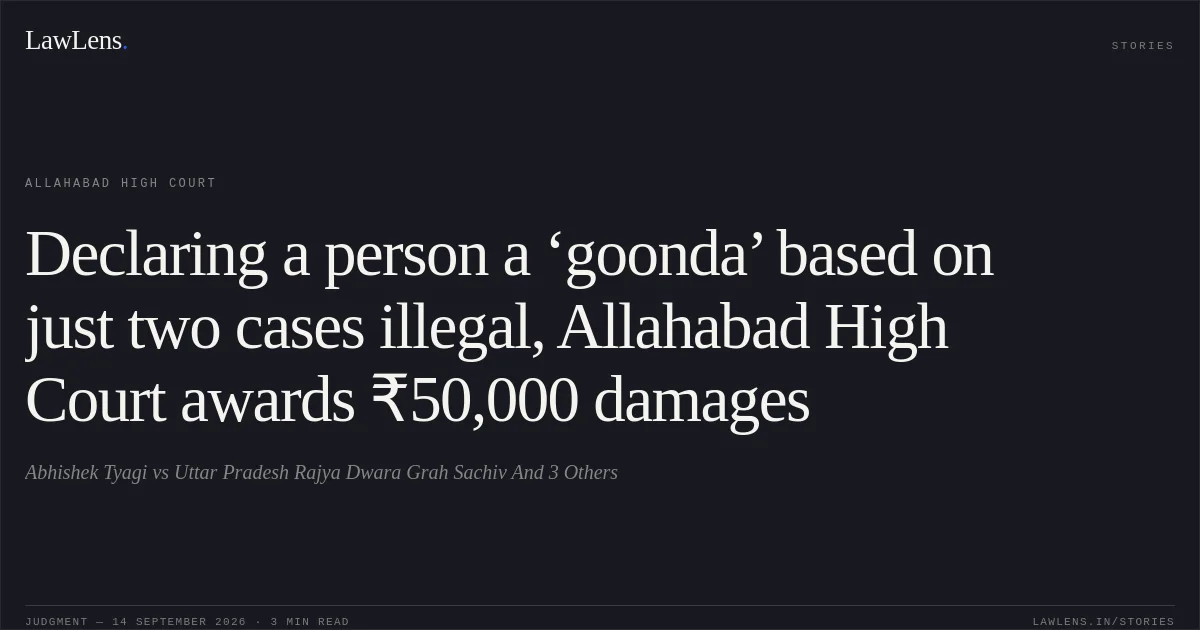
Proceedings under Sections 2/3 of the Uttar Pradesh Control of Goondas Act, 1970 were initiated against the petitioner on the basis of two criminal cases: Case Crime No. 326 of 2022 under Sections 323, 352, 504 and 506 IPC, and Case Crime No. 174 of 2025 under Sections 109(1), 115(2), 190, 191(2), 191(3), 351(3) and 352 BNS, both registered at Police Station Teela Mod, District Ghaziabad.
Source reference: para. 3; p. 2By order dated 18 September 2025, the Additional Commissioner of Police, Ghaziabad, directed the petitioner to reside at his permanent address and mark his attendance at the concerned police station on every second and fourth Saturday for six months.
Source reference: para. 3; p. 2The petitioner’s appeal under Section 6 of the Act was dismissed by the Commissioner, Meerut Division, on 10 December 2025.
Source reference: paras. 2–3; pp. 1–2The petitioner challenged both orders under Article 226 of the Constitution, contending that two criminal cases, separated by a gap of approximately three years, could not establish habitual criminality or justify branding him a “Goonda”.
Source reference: para. 10; p. 7Issues
1. Whether a person can be declared a “Goonda” under the Uttar Pradesh Control of Goondas Act, 1970 merely on the basis of two criminal cases?
Source reference: paras. 6–10; pp. 2–72. Whether the orders dated 18 September 2025 and 10 December 2025, requiring the petitioner to mark attendance and affirming that direction, were legally sustainable?
Source reference: paras. 3, 10–11; pp. 2, 7Law Applied
The Court applied Sections 2/3 and 6 of the Uttar Pradesh Control of Goondas Act, 1970, concerning the identification and preventive control of “Goondas” and appellate review of orders passed under the Act.
Source reference: paras. 2–3; pp. 1–2Under Section 2(b)(i), the expression “Goonda” requires habitual involvement in the commission of specified offences; “habitually” denotes repeated, persistent, similar and continuous conduct, not isolated or dissimilar acts.
Source reference: para. 6; pp. 2–3Relying on Lalani Pandey @ Vijay Shankar Pandey v. State of U.P., 2010 SCC OnLine All 2411, Shankar Ji Shukla v. Ayukt, Allahabad Mandal, and Imaran @ Abdul Qaddus Khan v. State of U.P., the Court held that one or two criminal cases ordinarily do not establish habitual offending.
Source reference: para. 6; pp. 2–3The Court further relied on Govardhan v. State of U.P., Neutral Citation No. 2023:AHC:169934-DB, and Saurabh @ Saurabh Kumar v. State of U.P., Neutral Citation No. 2025:AHC:131125-DB, which caution that trivial or limited criminal involvement cannot justify branding a person as a “Goonda”.
Source reference: paras. 7–8; pp. 4–5It also adopted the principles stated in Rahul v. State of U.P., 2026 SCC OnLine All 21744, that the Act is preventive rather than punitive, must be used sparingly, requires a nexus between the alleged conduct and threat to public order, and is intended for hardened or habitual criminals rather than persons implicated in isolated cases.
Source reference: para. 9; pp. 5–6Reasoning
The Court found that the authorities had relied only on two criminal cases, one registered in 2022 and the other in 2025, with a gap of approximately three years.
Source reference: para. 10; p. 7Applying the requirement of repeated, persistent and continuous conduct, the Court held that these cases did not demonstrate a settled habit or propensity to repeatedly commit similar offences.
Source reference: para. 10; p. 7The limited criminal history was therefore insufficient to establish that the petitioner fell within the statutory concept of a “Goonda.”
Source reference: para. 10; p. 7The Court further emphasized that branding a person as a “Goonda” causes serious reputational harm and that the Act cannot be used as an instrument of bureaucratic oppression or as a substitute for punishment under ordinary criminal law.
Source reference: paras. 10, 12–13; pp. 7–8Consequently, the proceedings and the consequential attendance direction were found unsustainable.
Source reference: paras. 10–11; p. 7Holding
The writ petition was allowed.
The Court quashed the order dated 18 September 2025 passed by the Additional Commissioner of Police, Ghaziabad, and the appellate order dated 10 December 2025 passed by the Commissioner, Meerut Division.
Source reference: para. 11; p. 7The proceedings initiated against the petitioner under the Uttar Pradesh Control of Goondas Act, 1970 were consequently set aside.
Source reference: para. 11; p. 7In addition, the petitioner was awarded ₹50,000 as damages for the suffering and reputational harm caused by the unlawful declaration; the State was permitted to recover the amount from the salaries of the concerned bureaucrats, with payment directed within one month.
Source reference: paras. 13–14; p. 8Acts & Sections Cited
13 provisions across 4 statutes referred to in this judgment. Each provision opens on LawLens.
Indian Penal Code, 18605
Bharatiya Nyaya Sanhita, 20236
Code of Criminal Procedure, 19731
Information Technology Act, 20001
Original Court PDF
Abhishek TyagivsUttar Pradesh Rajya Dwara Grah Sachiv And 3 Others
Click to open original judgment
Original judgment, available to read, download and summarize on LawLens.in