Facts
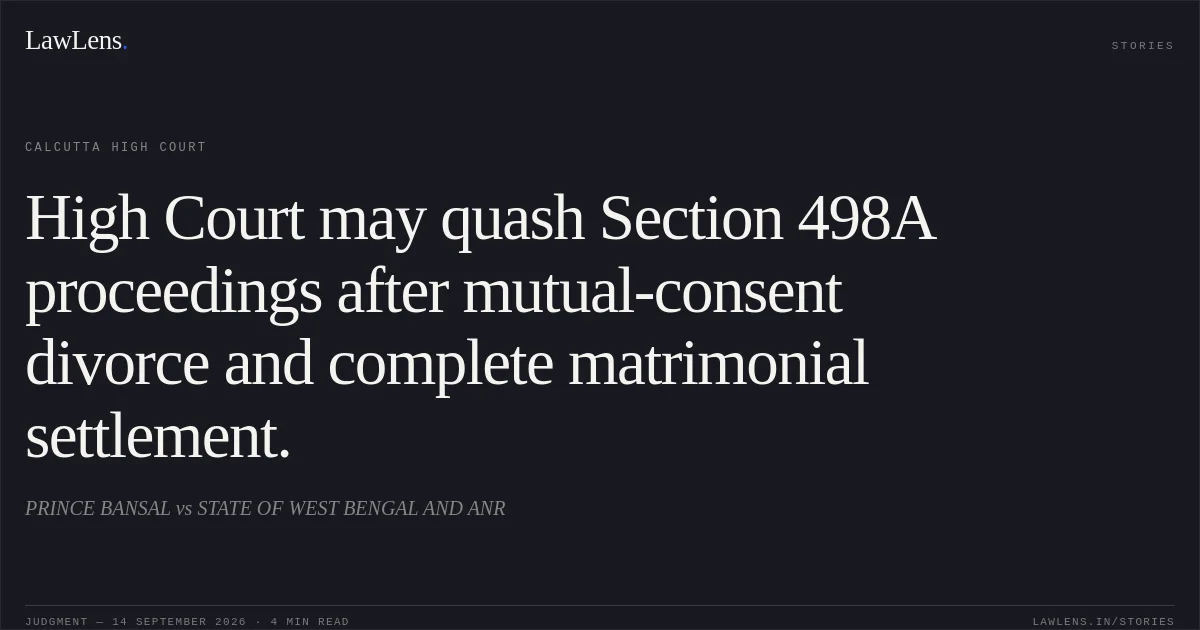
The petitioner and Opposite Party No. 2 entered into a court marriage on 19 July 2018 and a social marriage on 11 December 2019. After residing together in Meerut and subsequently in Dwarka, New Delhi, the parties separated on 22 March 2020 following matrimonial discord.
Source reference: paras. 2–3On an application under Section 156(3) of the Code of Criminal Procedure, Lake Town Police Station Case No. 200 of 2020 was registered on 17 November 2020 under Section 498A of the Indian Penal Code. The police submitted Charge Sheet No. 14 of 2021, and the petitioner was released on bail.
Source reference: para. 4Thereafter, the parties jointly instituted proceedings for divorce by mutual consent under Section 13-B of the Hindu Marriage Act, 1955. Their joint statements recorded settlement of claims relating to maintenance, dowry, permanent alimony and stridhan, and included Opposite Party No. 2’s undertaking to withdraw the pending Section 498A proceeding after the divorce decree.
Source reference: paras. 5, 21The Family Court granted the First Motion on 29 March 2023 and dissolved the marriage by mutual consent on 18 April 2023 after waiving the cooling-off period. Despite the undertaking, Opposite Party No. 2 did not cooperate in withdrawing the criminal case. The petitioner therefore invoked the High Court’s inherent jurisdiction under Section 482 Cr.P.C. to quash the proceedings.
Source reference: paras. 6–7Issues
Whether an amicable settlement of matrimonial disputes followed by a decree of divorce by mutual consent under Section 13-B of the Hindu Marriage Act constitutes a sufficient ground for quashing a Section 498A IPC proceeding under Section 482 Cr.P.C.
Source reference: para. 10; paras. 11–19Whether a complainant spouse’s undertaking before a Family Court to withdraw pending criminal proceedings, followed by her refusal to do so after obtaining the divorce decree, is legally relevant and binding in proceedings under Section 482 Cr.P.C.
Source reference: para. 10; paras. 20–25Whether continuation of the Section 498A IPC prosecution after dissolution of the marriage, settlement of all claims and the complainant’s subsequent independent life constitutes an abuse of the process of law warranting quashing.
Source reference: para. 10; paras. 26–31Law Applied
The Court applied Section 482 Cr.P.C., which preserves the High Court’s inherent power to prevent abuse of the process of any court and secure the ends of justice; the Court noted that this power corresponds to Section 528 of the Bharatiya Nagarik Suraksha Sanhita, 2023.
Source reference: para. 13Although Section 498A IPC is non-compoundable under Section 320 Cr.P.C., B.S. Joshi v. State of Haryana, (2003) 4 SCC 675, establishes that the non-compoundable nature of an offence does not bar quashing under Section 482 in appropriate matrimonial cases.
Source reference: paras. 14–15Gian Singh v. State of Punjab, (2012) 10 SCC 303, permits quashing where a matrimonial dispute is predominantly private, the parties have completely settled their differences and continuation of prosecution would amount to abuse of process.
Source reference: para. 16State of Madhya Pradesh v. Laxmi Narayan, (2019) 5 SCC 688, requires the Court to distinguish private matrimonial disputes from offences involving serious societal impact and to consider the nature of the offence, the settlement and the antecedent conduct of the parties.
Source reference: para. 17The Court also relied on Ruchi Agarwal v. Amit Kumar Agrawal, (2005) 3 SCC 299, and Shlok Bharadwaj v. Runika Bharadwaj, (2015) 2 SCC 721, concerning the binding effect of settlement undertakings connected with mutual-consent divorce and the impermissibility of continuing criminal proceedings after accepting the benefit of such settlement.
Source reference: paras. 23–24Section 13-B of the Hindu Marriage Act was relevant as the statutory basis for the parties’ mutual-consent divorce.
Source reference: paras. 5–6Reasoning
The Court found that the Section 498A proceeding arose from a matrimonial dispute that had subsequently been fully settled and terminated by a competent Family Court through a decree of mutual-consent divorce. The parties had resolved their financial, dowry, alimony and stridhan claims, and the complainant had expressly undertaken before the Family Court to withdraw the criminal case.
Source reference: paras. 18, 21Applying B.S. Joshi, Gian Singh and Laxmi Narayan, the Court held that the non-compoundable character of Section 498A did not prevent quashing where the dispute had become purely personal and continuation of the prosecution served no legitimate public purpose.
Source reference: paras. 13–19The complainant’s refusal to honour her recorded undertaking, after obtaining the benefit of the divorce decree, was treated as conduct attracting the principles of equitable estoppel and approbation and reprobation.
Source reference: paras. 22–25In view of the parties’ complete separation, settlement of all claims and the complainant’s subsequent independent life, the Court concluded that continuing the prosecution would serve no useful purpose and would amount to an abuse of the process of law.
Source reference: paras. 27–31Holding
The Court answered all three issues in favour of the petitioner. It held that the mutual-consent divorce, comprehensive settlement and the complainant’s undertaking to withdraw the criminal case constituted sufficient grounds for exercising inherent jurisdiction under Section 482 Cr.P.C.
C.R.R. 2063 of 2024 was allowed, and General Register Case No. 815 of 2020 arising from Lake Town Police Station Case No. 200 of 2020, together with Charge Sheet No. 14 of 2021 and all consequential proceedings, was quashed and set aside.
Source reference: paras. 34–35The Court directed transmission of the judgment to the Additional Chief Metropolitan Magistrate, Bidhannagar, and the Officer-in-Charge of Lake Town Police Station for compliance; there was no order as to costs.
Source reference: paras. 37–38Acts & Sections Cited
4 provisions across 2 statutes referred to in this judgment. Each provision opens on LawLens.
Code of Criminal Procedure, 19733
Bharatiya Nagarik Suraksha Sanhita, 20231
Original Court PDF
PRINCE BANSALvsSTATE OF WEST BENGAL AND ANR
Click to open original judgment
Original judgment, available to read, download and summarize on LawLens.in