Facts
Gulnar Begum claimed ownership of Property No. 10496–98, Chowk Hari Chand, Manakpura, Karol Bagh, Delhi, under a registered sale deed dated 25 March 1992.
Source reference: paras. 3–5, 15–18Late Chander Bhan, predecessor of the appellants, had been inducted as a tenant in one room and one veranda on the ground floor at a monthly rent of Rs.10/-. He allegedly made unauthorised construction of a room, veranda and staircase on the first floor.
Source reference: paras. 3–5, 15–18The respondent had earlier terminated Chander Bhan’s tenancy by legal notice dated 22 July 1994.
Source reference: paras. 5, 7, 26, 51–52The eviction petition filed under Section 14(1)(e) read with Section 25-B of the Delhi Rent Control Act was dismissed on the ground that bona fide requirement had not been established.
Source reference: paras. 5, 7, 26, 51–52Chander Bhan died on 21 June 2006, according to the judgment. The appellants—his wife Sarita and children Kuldeep and Kiran—continued in possession.
Source reference: paras. 8–11, 53, 82–84The respondent instituted a civil suit in 2016 for possession, mesne profits/damages of Rs.1,36,800 at Rs.3,800 per month, continuing damages, and permanent injunction.
Source reference: paras. 8–11, 53, 82–84The Civil Judge decreed the suit, holding that the notice had terminated the contractual tenancy, that Chander Bhan died as a statutory tenant, and that the appellants did not establish Sarita’s financial dependence upon him. The Additional District Judge affirmed the decree on 7 December 2023.
Source reference: paras. 30–34Issues
1. Whether the jurisdiction of the civil court was barred under Section 50 of the Delhi Rent Control Act?
Source reference: para. 48(i)2. Whether the appellants were protected by Explanation II to Section 2(l) of the Delhi Rent Control Act and, consequently, liable to eviction only under the Rent Act?
Source reference: para. 48(ii)3. Whether the respondent’s suit for possession was barred by limitation?
Source reference: paras. 48(iii), 80–84Law Applied
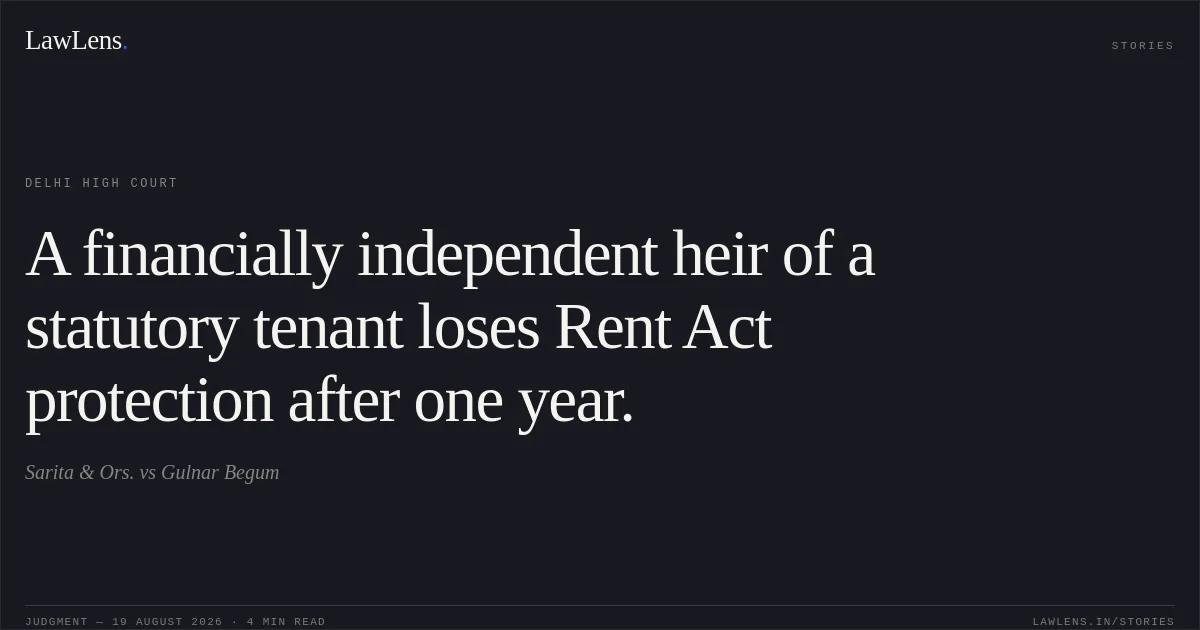
The Court applied Section 2(l) of the Delhi Rent Control Act, under which a “tenant” includes a person continuing in possession after termination of tenancy, read with Explanations I and II: upon the death of a statutory tenant, the surviving spouse succeeds first, but a successor who was not financially dependent upon the deceased obtains protection only for one year, after which the right to continue in possession is extinguished.
Source reference: paras. 54–55, 80–83Section 50 of the Act bars the jurisdiction of civil courts only where the occupant continues to enjoy statutory protection under the Rent Act.
Source reference: paras. 57–59, 78–79Under Sections 101 and 102 of the Indian Evidence Act, 1872, the legal burden remains on the party asserting the relevant fact, while the evidentiary onus may shift; Section 106 places upon a person the burden of proving facts especially within that person’s knowledge.
Source reference: paras. 60–64, 67The Court relied on Addagada Raghavamma v. Addagada Chenchamma , AIR 1964 SC 136, Anil Rishi v. Gurbaksh Singh , (2006) 5 SCC 558, R.V.E. Venkatachala Gounder v. Arulmigu Viswesaraswami , (2003) 8 SCC 752, Smriti Debbarma v. Prabha Ranjan Debbarma , (2023) 19 SCC 782, and Krishna Prakash v. Shanta Sinha Chenoy , 1980 2 ILR Del 854, on burden and onus of proof and financial dependence.
Source reference: paras. 63–73Section 108(d) of the Transfer of Property Act was applied to hold that an accession made to leased property during the continuance of the lease forms part of the lease and cannot ordinarily be claimed separately by the tenant.
Source reference: para. 30The Court further relied on Mukesh Kumar (deceased) through LRs v. Saini Cooperative Thrift and Credit Society Ltd. , 156 (2009) DLT 550, for the rule that limitation begins when the statutory successor’s protection expires, not merely upon issuance of a notice.
Source reference: paras. 81–84Reasoning
The Court treated the service of the legal notice dated 22 July 1994 as a concurrent finding of fact supported by the registered acknowledgment card. Consequently, Chander Bhan’s contractual tenancy stood terminated, and he continued only as a statutory tenant under Section 2(l) of the Delhi Rent Control Act.
Source reference: paras. 51–53Upon his death, only his surviving wife Sarita succeeded initially under Explanation I. Since the evidence showed that Chander Bhan had left his employment in 2005, had no proved income at the time of his death in June 2006, and that Sarita herself had pleaded dependence upon her son, the Court held that she failed to prove financial dependence upon her deceased husband.
Source reference: paras. 70–78The respondent’s evidence created a sufficient prima facie probability of non-dependence, shifting the evidentiary onus to Sarita under Sections 102 and 106 of the Evidence Act, which she failed to discharge.
Source reference: paras. 70–78Her statutory protection therefore expired one year after Chander Bhan’s death, making her occupation unauthorised and rendering the civil suit maintainable; Section 50 consequently did not bar the suit.
Source reference: paras. 78–79The adverse-possession claim concerning the first-floor construction also failed because the construction, having been made during the tenancy, constituted an accession to the leased premises under Section 108(d) of the Transfer of Property Act.
Source reference: para. 30Finally, the cause of action for possession arose upon expiry of the one-year statutory protection after Chander Bhan’s death. The 2016 suit was filed within twelve years and was therefore not barred by limitation.
Source reference: paras. 80–84Holding
The High Court answered the substantial questions against the appellants. It held that the civil court’s jurisdiction was not barred by Section 50 of the Delhi Rent Control Act; Sarita’s statutory protection was limited to one year after Chander Bhan’s death because she was not shown to be financially dependent upon him; and the suit filed in 2016 was within limitation.
The concurrent judgments of the Civil Judge and the Additional District Judge were upheld.
Source reference: paras. 31–33, 79, 85–86The appeal was dismissed, and the decrees for possession, mesne profits/damages at Rs.3,800 per month—including Rs.1,36,800 for the preceding three years and continuing damages until delivery of possession—and permanent injunction were maintained.
Source reference: paras. 31–33, 79, 85–86Acts & Sections Cited
5 provisions across 3 statutes referred to in this judgment. Each provision opens on LawLens.
Code of Civil Procedure, 19081
delhi rent control act, 19583
Transfer of Property Act, 18821
Original Court PDF
Sarita & Ors.vsGulnar Begum
Click to open original judgment
Original judgment, available to read, download and summarize on LawLens.in