Facts
The Petitioner challenged, under Section 25-B(8) of the Delhi Rent Control Act, 1958 (“DRC Act”), the order dated 9 September 2019 passed by the learned ACJ-cum-ARC, Central District, Delhi.
Source reference: para. 1In execution proceedings arising from an eviction order obtained by the Petitioner against Vijay Kumar and another judgment-debtor, the legal heirs of deceased Respondent No. 1 filed an application under Section 25 of the DRC Act seeking protection from dispossession and restoration of possession.
Source reference: paras. 2, 16The ARC held that Respondents Nos. 1 and 2 were tenants-in-common who had independently entered into tenancy arrangements with the Petitioner.
Source reference: paras. 4, 16–18Since possession had already been obtained by the Petitioner, the ARC directed restoration of possession to the legal heirs of deceased Respondent No. 1.
Source reference: paras. 2, 16The Petitioner contended that the finding regarding tenancy-in-common was unsupported by any tenancy agreement or other material.
Source reference: paras. 3–4Issues
Whether the ARC was justified in holding that Respondents Nos. 1 and 2 were tenants-in-common, despite identifying no tenancy agreement or other material supporting that conclusion?
Source reference: paras. 17–23Whether, on the basis of that finding, the legal heirs of deceased Respondent No. 1 were necessary parties to the eviction proceedings and were entitled to restoration of possession under Section 25 of the DRC Act?
Source reference: paras. 18, 21–24Whether the ARC’s order disclosed a jurisdictional error, manifest illegality, material irregularity, or an error apparent on the face of the record warranting interference under the proviso to Section 25-B(8) of the DRC Act?
Source reference: paras. 9–15, 23–24Law Applied
Section 25-B(8) of the DRC Act confers a supervisory and revisional, not appellate, jurisdiction on the High Court; interference is warranted where the decision-making process suffers from a jurisdictional error, manifest illegality, material irregularity, perversity, or an error apparent on the face of the record, but not merely because another factual view is possible.
Source reference: paras. 9–15The Court relied on Sarla Ahuja v. United India Insurance Co. Ltd., Hindustan Petroleum Corporation Ltd. v. Dilbahar Singh, and Abid-Ul-Islam v. Inder Sain Dua, as well as Pankaj Pahwa v. Prem Wati and Sanjeev Hiranandani v. Sunny Grover, for the limited scope of revision under Section 25-B(8).
Source reference: paras. 10–13The distinction between joint tenancy and tenancy-in-common is material: joint tenancy involves unity of title and other incidents including survivorship, whereas tenancy-in-common involves unity of possession but separately held interests or shares.
Source reference: para. 16However, the character of a tenancy must be determined from the material governing its creation and holding; the general legal distinction between the two forms of tenancy cannot itself establish the factual nature of the tenancy.
Source reference: paras. 19–21Reasoning
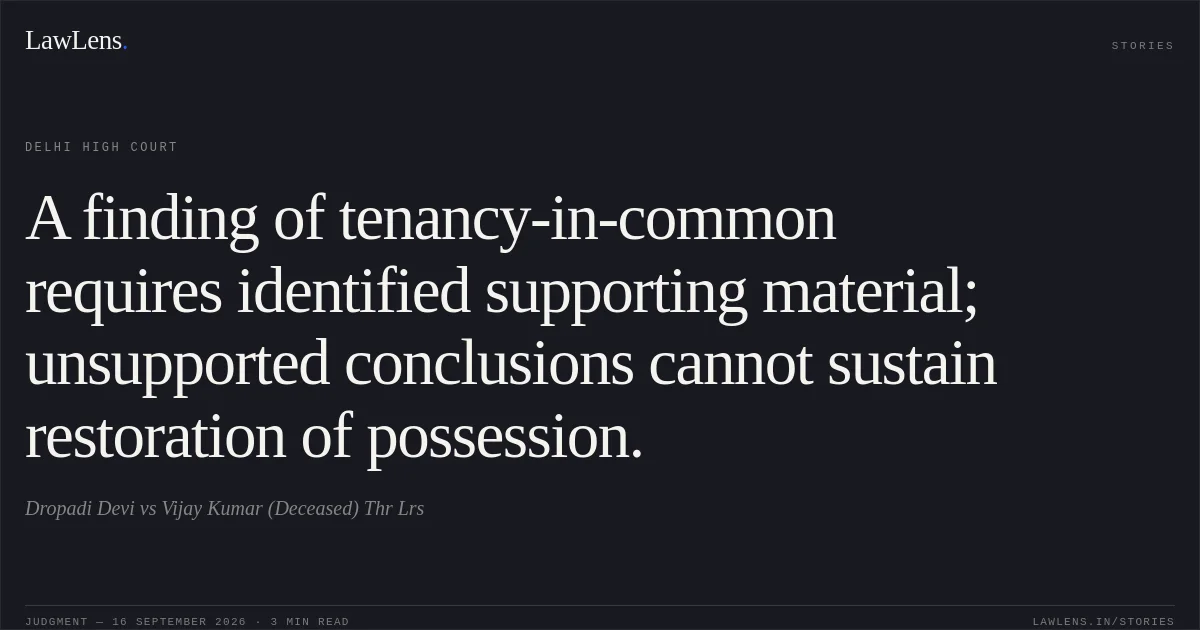
The ARC correctly recognised the conceptual distinction between joint tenancy and tenancy-in-common but failed to identify any tenancy agreement or other document showing that Respondents Nos. 1 and 2 had independently entered into the tenancy or held separate interests.
Source reference: paras. 16–20The conclusion that they were tenants-in-common was therefore derived from a general legal distinction rather than from evidence or material specific to the tenancy in question.
Source reference: paras. 19–22Since the finding of tenancy-in-common formed the entire basis for holding that the legal heirs of deceased Respondent No. 1 were necessary parties and were not bound by the eviction order, the unsupported foundational finding vitiated the consequential directions for restoration of possession.
Source reference: paras. 21–24The defect was apparent from the ARC’s order itself and required no fresh appreciation of evidence, thereby falling within the permissible scope of revisional interference under Section 25-B(8).
Source reference: para. 23Holding
The High Court held that the ARC had not established, on the basis of any identified document or material, that Respondents Nos. 1 and 2 were tenants-in-common.
Consequently, the findings that the legal heirs of deceased Respondent No. 1 were not bound by the eviction order and were entitled to restoration of possession could not be sustained.
Source reference: paras. 23–24The Revision Petition was allowed, the ARC’s order dated 9 September 2019 was set aside, and the petition along with the pending application was disposed of accordingly.
Source reference: paras. 25–26Acts & Sections Cited
1 provisions across 1 statute referred to in this judgment. Each provision opens on LawLens.
delhi rent control act, 19581
Original Court PDF
Dropadi DevivsVijay Kumar (Deceased) Thr Lrs
Click to open original judgment
Original judgment, available to read, download and summarize on LawLens.in