01Facts
The complainant alleged that the accused borrowed ₹2,00,000 in June 2021 and issued a cheque for that amount, which was dishonoured for insufficient funds.
¶ 3–4After notice and non-payment, the complainant filed a complaint under Section 138 of the Negotiable Instruments Act, 1881 (“NI Act”).
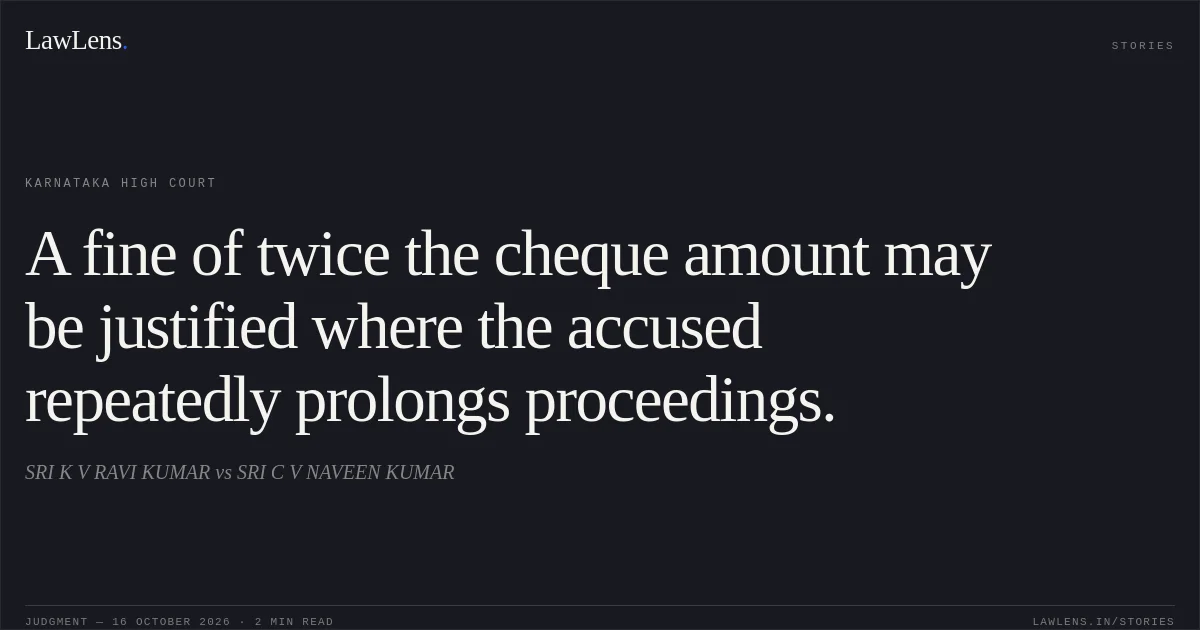
¶ 3–4The accused was convicted and sentenced to pay a fine of ₹4,00,000, of which ₹3,90,000 was ordered as compensation; the conviction and sentence were affirmed on appeal.
¶ 7–9In revision, the accused challenged both the finding of guilt and the imposition of a fine twice the cheque amount, relying principally on an alleged prior dispute and denying that there was an occasion for the loan.
¶ 1102Issues
i.Whether the concurrent judgments of conviction disclosed perversity, gross error, or another ground warranting interference in revisional jurisdiction.
¶ 14ii.Whether the trial court’s imposition of a fine twice the cheque amount required interference.
¶ 11, 3003Law Applied
Under Sections 118 and 139 of the NI Act, once the relevant foundational facts are established, presumptions arise that the cheque was issued for consideration and towards a legally enforceable debt or liability; those presumptions are rebuttable.
¶ 18–19Section 138 applies where the statutory requirements concerning the cheque, its dishonour, notice, and failure to pay are satisfied.
¶ 18Revisional jurisdiction under Sections 397 and 401 of the Code of Criminal Procedure, 1973 is supervisory, not a second appeal: ordinarily, the High Court should not reappreciate evidence already considered by the trial and appellate courts unless a glaring feature indicates a miscarriage of justice.
¶ 16–17The court also relied on the revisional-interference principles set out in Kuntegowda v. Thurubaiah, Criminal Appeal No. 3654 of 2026, reported at 2026 SCC OnLine SC 1485.
¶ 16Provisions in the judgment · 8 · Linked ones open on LawLens
Code of Criminal Procedure, 1973 Section 397Section 401Section 200
Bharatiya Nagarik Suraksha Sanhita, 2023 Section 438Section 442
Negotiable Instruments Act, 1881 Section 138Section 139Section 118
04Reasoning
The accused did not dispute that the cheque bore his signature or was drawn on his bank account, and the court found the statutory requirements for attracting the presumptions under Sections 118 and 139 satisfied.
¶ 22–23The accused’s theft defence was not established; his separate private complaint alleging theft had been dismissed and had attained finality.
¶ 26His contention that the prior civil dispute made a loan unlikely was weakened by his testimony that he continued visiting the complainant’s shop and remained on speaking terms with him; the court also noted evidence of receipt of money and prior transactions.
¶ 27–29Finding no basis to disturb the concurrent factual findings in revision, the court held that the sentence of twice the cheque amount was not erroneous, noting the repeated proceedings and delay attributed to the accused.
¶ 29–3105Holding
The High Court answered the principal revisional question in the negative and found no ground to interfere with either the conviction or the sentence.
¶ 15, 31It dismissed the criminal revision petition, leaving in force the conviction under Section 138 of the NI Act and the fine of ₹4,00,000, including ₹3,90,000 as compensation.
¶ 7, 32Original Court PDF
SRI K V RAVI KUMARvsSRI C V NAVEEN KUMAR
Click to open original judgment
Original judgment, available to read, download and summarize on LawLens.in