Facts
The plaintiffs sued for partition and separate possession, claiming that the suit property belonged to their father, Imam Sab, and that they were entitled to inherit shares in it under Mohammedan law.
Source reference: p. 3–6The defendants disputed the plaintiffs’ entitlement and claimed that the property belonged to the deceased Maheboob Sab.
Source reference: p. 3–6The trial court decreed the suit, holding that the plaintiffs were entitled to a two-thirds share.
Source reference: p. 3–6The defendants’ first appeal was allowed and the suit dismissed.
Source reference: p. 7The plaintiffs then brought this second appeal, which was admitted on the question of whether the first appellate court had reversed the trial court without reappraising the evidence.
Source reference: p. 8, 11Issues
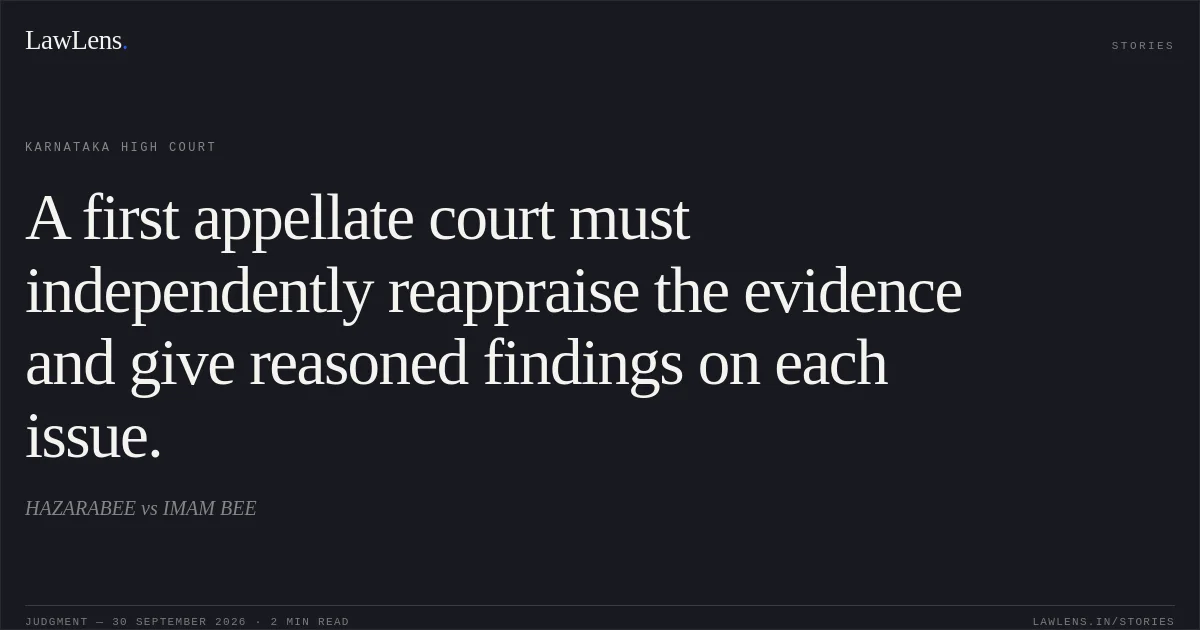
1. Whether the first appellate court was justified in reversing the trial court’s judgment without reappraising the evidence, contrary to the requirements of Order XLI Rule 31 CPC and the cited Supreme Court decisions?
Source reference: p. 11, 13–162. Whether the plaintiffs were entitled to shares in the suit property under Mohammedan law?
Source reference: p. 6–7, 12–14Law Applied
Section 100 CPC governs second appeals on substantial questions of law.
Source reference: p. 2Under Order XLI Rule 31 CPC, a first appellate court must formulate the points for determination, independently assess the evidence, and give reasons on the issues it decides; a general expression of agreement or disagreement with the trial court is insufficient.
Source reference: p. 14–16The Court relied on H. Siddiqui (D) by LRs v. A. Ramalingam, AIR 2011 SC 1492, for these requirements.
Source reference: p. 14–16The Court relied on Lakshmi v. Gopi, cited in the judgment as 2026 SCC OnLine SC 1338, concerning the first appellate court’s duty to reappraise the evidence.
Source reference: p. 9–10, 12, 14Reasoning
The High Court found that the first appellate court had not properly reassessed the evidence or adequately addressed whether the plaintiffs were entitled to a share.
Source reference: p. 13–14Instead, it had discussed the validity of Maheboob Sab’s marriage to defendant No. 2, although that validity had not been challenged by the parties.
Source reference: p. 13–14Because the first appellate court reversed the trial court’s decree without the independent evidentiary assessment and reasoned findings required by Order XLI Rule 31 CPC, its judgment could not stand.
Source reference: p. 14–17The High Court therefore addressed the appellate process, not the merits of the plaintiffs’ claimed shares.
Source reference: p. 14–17Holding
The Court answered the substantial question of law in the negative and allowed the second appeal.
It set aside the first appellate judgment and restored R.A. No. 65 of 2005 for a fresh decision on the merits after reappraisal of the evidence.
Source reference: p. 16–17The plaintiffs were permitted to apply to adduce additional documents, and all parties’ contentions were kept open.
Source reference: p. 16–17Acts & Sections Cited
1 provisions across 1 statute referred to in this judgment. Each provision opens on LawLens.
Code of Civil Procedure, 19081
Original Court PDF
HAZARABEEvsIMAM BEE
Click to open original judgment
Original judgment, available to read, download and summarize on LawLens.in