Facts
The petitioner claimed that he was engaged as a Sewer Gang Beldar on daily wages by the Delhi Water Supply and Sewage Disposal Undertaking in June 1997 and worked until his alleged illegal termination in June 2000.
Source reference: p.2The Undertaking was initially under the MCD and was reconstituted as the Delhi Jal Board (“DJB”) in March 1998.
Source reference: p.2He alleged that daily-wage workers were employed against perennial work, artificial breaks were given to defeat completion of 240 days, and juniors continued in service after his termination, violating Sections 25F, 25G and 25H of the Industrial Disputes Act, 1947 (“ID Act”).
Source reference: p.2He also claimed brief re-engagements between March–May 2001 and April–June 2002.
Source reference: p.2The DJB contended that he had been engaged by the MCD for limited periods and specific pre-monsoon and desilting work, without selection, and had not completed 240 days of continuous service immediately before termination.
Source reference: p.3The MCD denied responsibility for the termination and asserted that the petitioner was working with the DJB at the relevant time.
Source reference: p.3The Labour Court decided all issues in favour of the workman except Issues 6 and 8, concerning non-service of a demand notice and entitlement to relief, and denied relief solely because no demand notice had been issued before raising the industrial dispute.
Source reference: p.4The petitioner challenged the award to that extent.
Source reference: p.1Issues
Whether the Labour Court was justified in denying relief on the ground that the petitioner had not served a prior formal demand notice on the management.
Source reference: pp.4–5Whether, in view of the findings that the petitioner’s termination was illegal and the absence of any challenge to those findings, he was entitled to reinstatement and back wages.
Source reference: pp.5–6Whether reinstatement, rather than monetary compensation, was appropriate in the case of the illegally terminated daily-wage workman, particularly where the termination involved unfair labour practice or violation of the “last come, first go” principle.
Source reference: p.6Law Applied
The Court applied the Industrial Disputes Act, 1947, including Section 2(k), under which an industrial dispute may arise from a real and substantial dispute or difference between employers and workmen; Sections 25F, 25G and 25H, which protect workmen against retrenchment without statutory safeguards, disregard of the “last come, first go” principle, and replacement by fresh labour, respectively; and Section 10(1), under which the appropriate Government may refer an existing or apprehended industrial dispute for adjudication.
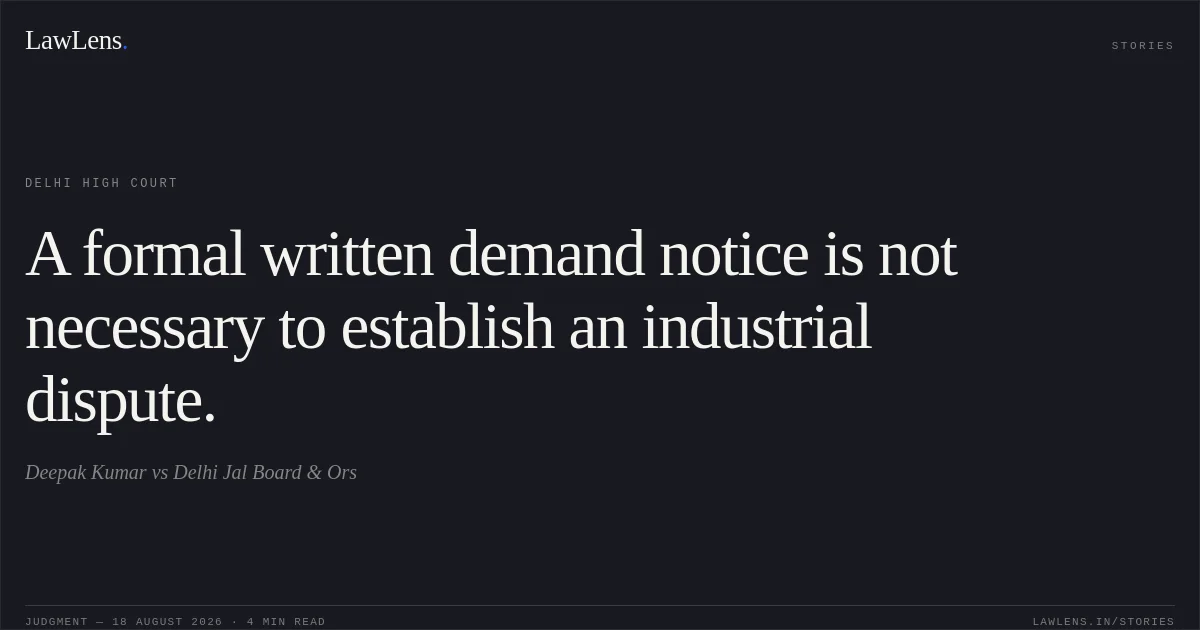
Source reference: pp.2, 4–5Relying on *M/s Premium Transmission Private Limited v. State of Maharashtra & Ors.*, (2026) 5 SCC 633, the Court held that a formal written demand notice is not a sine qua non for the existence of an industrial dispute; a real and substantial difference between the parties is sufficient, and the Government’s reference under Section 10(1) is an administrative act.
Source reference: pp.4–5The Court also relied on *Bharat Sanchar Nigam Limited v. Bhurumal*, (2014) 7 SCC 177, which holds that reinstatement with back wages is not automatic where illegality is merely procedural in the case of a daily-wage worker, but reinstatement should ordinarily follow where termination resulted from an unfair labour practice or violation of the “last come, first go” rule, unless weighty reasons justify compensation instead.
Source reference: pp.5–6Reasoning
The Court found that the Labour Court had denied relief solely because the petitioner had not served a demand notice.
Source reference: pp.4–5That reasoning was inconsistent with the principle in *Premium Transmission*, which rejects a formal written demand as a mandatory precondition to an industrial dispute where the record discloses a real and substantial dispute.
Source reference: pp.4–5The Court further noted that all other issues—including the issues concerning the petitioner’s engagement, completion of service, relationship with the management, and illegal termination—had been decided in his favour, and those findings had not been challenged by the DJB.
Source reference: p.4; p.6The petitioner’s assertion that he had remained unemployed after termination was also unchallenged.
Source reference: p.5Applying *Bhurumal*, the Court held that the case was not one warranting mere compensation for a technical breach, particularly in light of the findings supporting illegal termination and the petitioner’s allegations regarding retention of juniors.
Source reference: pp.5–6In the peculiar circumstances, reinstatement was therefore considered appropriate.
Source reference: pp.5–6Holding
The High Court allowed the challenge to the Labour Court’s denial of relief.
It held that the absence of a formal demand notice did not defeat the industrial dispute and that the petitioner was entitled to reinstatement.
Source reference: p.6The DJB was directed to reinstate the petitioner forthwith, with continuity of service and 50% back wages.
Source reference: p.6The writ petition was accordingly disposed of in those terms.
Source reference: p.7Acts & Sections Cited
6 provisions across 1 statute referred to in this judgment. Linked provisions open on LawLens.
Industrial Disputes Act, 19476
Original Court PDF
Deepak KumarvsDelhi Jal Board & Ors
Click to open original judgment
Original judgment, available to read, download and summarize on LawLens.in