Facts
Saryugia Devi, aged about 70 years, was residing with her daughter Parvati Devi.
Source reference: paras. 2–4, pp. 1–3The prosecution alleged that the appellant, her grandson, forcibly took her away on 5 May 2007 in connection with a dispute over her land and money.
Source reference: paras. 2–4, pp. 1–3Witnesses stated that the appellant was last seen taking or dragging Saryugia Devi away, after which she remained missing.
Source reference: paras. 2–4, pp. 1–3On 9 May 2007, her dead body was recovered from a room in the appellant’s house.
Source reference: paras. 2–4, pp. 1–3The appellant and other accused were charged under Sections 364/34 and 302/34 of the Indian Penal Code (IPC).
Source reference: paras. 2–4, pp. 1–3The trial court convicted the appellant under Section 302 IPC, principally relying on the last-seen circumstance, and also convicted him under Section 364 IPC.
Source reference: paras. 23, 30–33, pp. 12, 19–20The post-mortem doctor could not determine the cause of death, although the death was estimated to have occurred 72–96 hours before the examination.
Source reference: para. 14, p. 7Issues
Whether the evidence that the appellant forcibly took Saryugia Devi away, followed by the recovery of her dead body from his house, was sufficient to establish the offence under Section 364 IPC.
Source reference: paras. 16–20, pp. 9–11Whether the appellant could be convicted for murder under Section 302 IPC on the basis of the last-seen theory and the recovery of the dead body from his house.
Source reference: paras. 21–30, pp. 11–19Law Applied
The court applied Section 364 IPC, which penalises kidnapping or abducting a person with the intention that the person may be secretly and wrongfully confined or murdered, and Section 302 IPC concerning the offence of murder.
Source reference: paras. 3–4, pp. 2–3It considered the last-seen theory as a rule of circumstantial evidence: under State of U.P. v. Satish, (2005) 3 SCC 114, the time gap between the accused and deceased being last seen together and the discovery of death must be so narrow that the possibility of intervention by another person becomes practically impossible.
Source reference: para. 24, p. 12Relying also on Papan Sarkar @ Pranab v. State of West Bengal, 2026 SCC OnLine SC 917, and Didar Singh @ Dari v. State of Haryana, 2026 SCC OnLine SC 1361, the court held that a substantial time gap and absence of corroborative circumstances make reliance on the last-seen theory unsafe.
Source reference: paras. 25–26, pp. 12–18A conviction for murder requires proof beyond reasonable doubt not only of the accused’s association with the deceased but also of homicidal death and the accused’s responsibility for it.
Source reference: paras. 21–22, pp. 11–12Reasoning
The evidence of P.Ws. 2 and 6 consistently established that the appellant forcibly took Saryugia Devi away on 5 May 2007, and the recovery of her dead body from a room in the appellant’s house supported the prosecution’s case of abduction.
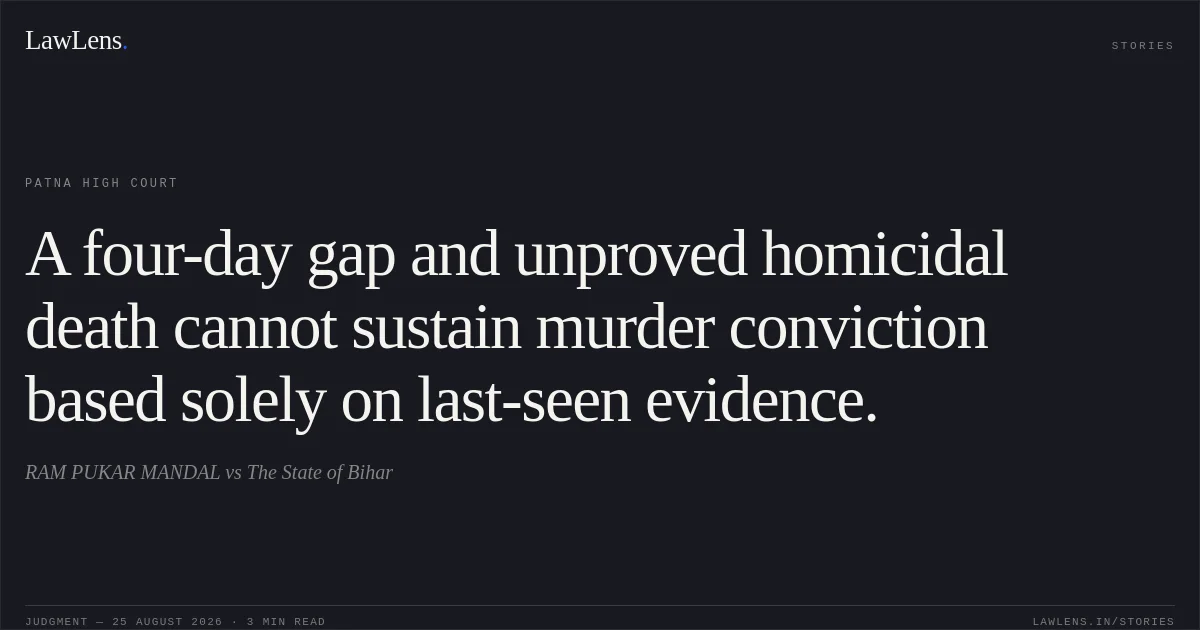
Source reference: paras. 16–20, pp. 9–11However, the body was recovered only on 9 May 2007, creating a four-day interval during which there was no evidence that the deceased remained continuously in the appellant’s company or that no other person could have intervened.
Source reference: paras. 21–22, 28, pp. 11–12, 19Further, the medical officer could not opine that the death was homicidal or establish its precise cause.
Source reference: paras. 21, 29, pp. 11, 19Consequently, the last-seen circumstance was insufficient to complete the chain of circumstances required for a conviction under Section 302 IPC.
Source reference: paras. 21–30, pp. 11–19The same evidence, however, was adequate to prove that the appellant had forcibly abducted Saryugia Devi, thereby sustaining the Section 364 conviction.
Source reference: paras. 20, 30–32, pp. 11, 19Holding
The appeal was partly allowed.
The appellant’s conviction and sentence under Section 302 IPC were set aside because the prosecution failed to prove homicidal death and failed to establish an unbroken last-seen circumstance beyond reasonable doubt.
Source reference: paras. 29–30, p. 19His conviction and sentence under Section 364 IPC were affirmed on the basis of the evidence proving his forcible abduction of Saryugia Devi.
Source reference: paras. 31–33, pp. 19–20The court directed that, if the appellant had already served the sentence imposed under Section 364 IPC and was not required in any other case, he should be released forthwith.
Source reference: para. 34, p. 20Acts & Sections Cited
5 provisions across 2 statutes referred to in this judgment. Linked provisions open on LawLens.
Indian Penal Code, 18604
Code of Criminal Procedure, 19731
Original Court PDF
RAM PUKAR MANDALvsThe State of Bihar
Click to open original judgment
Original judgment, available to read, download and summarize on LawLens.in
![Courts will not interfere with transfers absent mala fides or violation of statutory rules.. M Ramya vs EMPLOYEES STATE INSURANCE CORPORATION (ESIC). CAT - ['Chennai']. LawLens](/stories/thumbnails/courts-will-not-interfere-with-transfers-absent-mala-fides-or-violation-of-statutory-rules-a6845e9ca6f548fca284c51c8351957f.webp)
![Courts cannot direct one-time recruitment age relaxation absent authority in the governing rules or advertisement.. UT OF PUDUCHERRY vs M ANDAL. CAT - ['Chennai']. LawLens](/stories/thumbnails/courts-cannot-direct-one-time-recruitment-age-relaxation-absent-authority-in-the-governing-895d78fde47143e2a8ed0207c4b6a44f.webp)
![A review cannot correct an allegedly erroneous decision absent an error apparent on the record.. Ajit Kumar Jha vs RAILWAY BOARD. CAT - ['Delhi']. LawLens](/stories/thumbnails/a-review-cannot-correct-an-allegedly-erroneous-decision-absent-an-error-apparent-on-the-re-8ac952fd4eba470c92f7da20af72a220.webp)