Facts
The petitioner, plaintiff in O.S. No. 337 of 2009, sought redemption of a mortgage, declarations that certain documents were null and void, and a permanent injunction.
Source reference: no citationDuring trial, he sought to reopen the case, recall PW1, and receive additional documents, including a notarised Encumbrance Certificate (EC) dated 26 March 2009, after an earlier photocopy of that certificate had been filed.
Source reference: no citationThe District Munsif dismissed the applications on 23 February 2026 and later dismissed applications to reopen them at the SR stage on 15 April 2026.
Source reference: p.7, para. 3In the revisions, the petitioner confined his request to the EC dated 26 March 2009; the respondents opposed further evidence at the final-arguments stage and disputed the basis for adducing secondary evidence.
Source reference: pp.7–8, paras. 4–5Issues
1. Whether the trial court’s refusal to reopen the case and recall PW1 to enable the petitioner to produce the EC warranted interference under Article 227 of the Constitution.
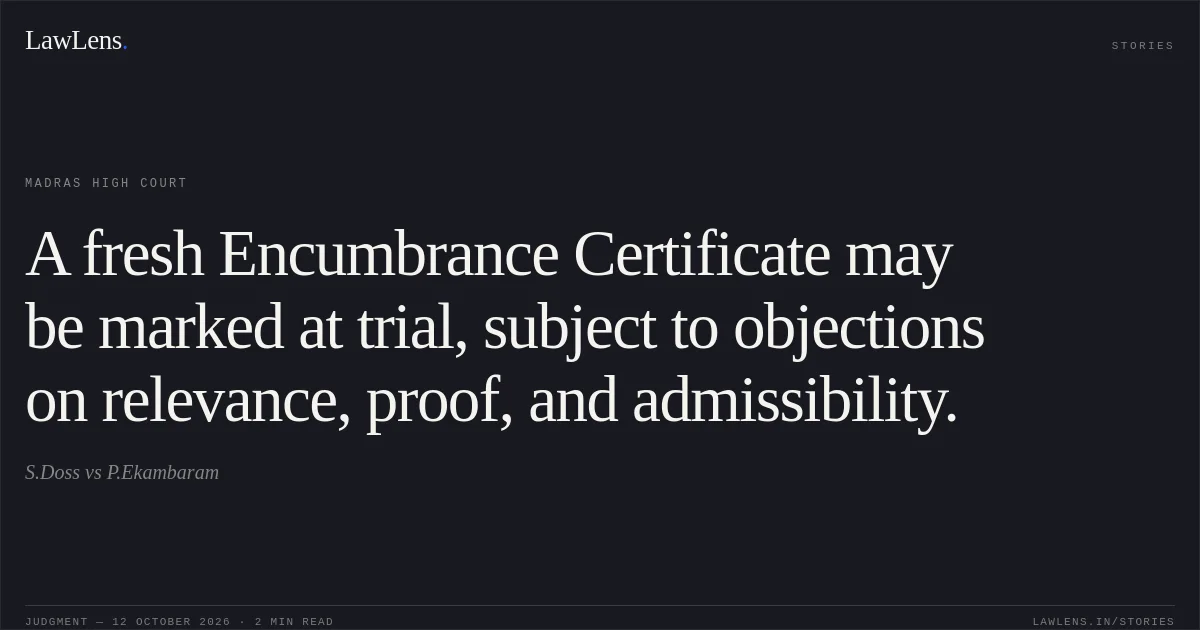
Source reference: pp.5–7, paras. 1, 3–42. Whether the petitioner could be permitted to place the EC evidence on record in a manner that preserved the respondents’ objections to its relevance, proof, and admissibility.
Source reference: pp.8–9, paras. 5–7Law Applied
The revisions were brought under Article 227 of the Constitution of India, which was the stated basis for invoking the High Court’s supervisory jurisdiction.
Source reference: pp.5–6The judgment cited no specific provision of the Evidence Act or other statute, and no precedent.
Source reference: no citationIt directed that objections concerning the relevance, proof, and admissibility of the proposed evidence remain open for consideration by the trial court.
Source reference: p.9, para. 7Reasoning
The High Court noted that the dispute had been narrowed to the EC dated 26 March 2009 and that a photocopy was already before the trial court.
Source reference: pp.7–8, paras. 4, 6Rather than require the petitioner to pursue the notarised copy as secondary evidence, the Court considered that a fresh EC covering the period from 2003 onwards could be obtained and marked alongside the existing photocopy.
Source reference: p.8, para. 6Given that approach, it permitted the limited reopening and recall of PW1, while protecting the respondents’ position by allowing them to raise objections on relevance, proof, and admissibility and to cross-examine PW1.
Source reference: p.9, para. 7Holding
The High Court set aside the trial court’s order and directed it to reopen the case and recall PW1 solely for the purpose of marking the EC in the manner indicated, with the respondents’ objections and right to cross-examine preserved.
It directed the District Munsif, Chengalpattu, to dispose of O.S. No. 337 of 2009 on its merits and in accordance with law within three months of receiving the order.
Source reference: p.9, para. 8The revisions were disposed of without costs, and the connected miscellaneous petitions were closed.
Source reference: p.9, para. 9Original Court PDF
S.DossvsP.Ekambaram
Click to open original judgment
Original judgment, available to read, download and summarize on LawLens.in