Facts
The parties entered into a consultancy agreement dated 10 December 2007 for design and project consultancy services for an AIIMS-like institution at Jodhpur.
Source reference: pp. 1–2The agreed fee was ₹6 crore.
Source reference: pp. 1–2The project’s built-up area allegedly increased from approximately 83,920 sq. metres to 1,42,527 sq. metres, alongside increases in project cost, specifications and duration.
Source reference: pp. 1–2The respondent sought enhanced consultancy fees and other amounts; the petitioner disputed its entitlement and raised counterclaims.
Source reference: pp. 1–2The arbitral tribunal awarded the respondent ₹15,48,75,000 under its principal fee claim, along with other sums, and rejected the petitioner’s counterclaims.
Source reference: pp. 6–8The Union of India challenged the award under Section 34 of the Arbitration and Conciliation Act, 1996.
Source reference: pp. 6–8Issues
1. Whether the tribunal’s award of additional consultancy fees, despite the contract’s fixed-fee clause, rewrote the contract or otherwise warranted interference under Section 34.
Source reference: pp. 10–11, 15–182. Whether the tribunal’s method of quantifying additional fees, and its awards on the respondent’s other claims, disclosed grounds for setting aside the award.
Source reference: pp. 22–243. Whether the tribunal’s rejection of the petitioner’s counterclaims warranted interference.
Source reference: pp. 24–25Law Applied
Under Section 34 of the Arbitration and Conciliation Act, 1996, a court may not set aside an award merely because it would have interpreted the contract or assessed the evidence differently; interference for patent illegality is confined to exceptional cases, including where a material finding rests on no evidence, ignores vital evidence, or is one no reasonable decision-maker could reach.
Source reference: pp. 16–20Relying on Ramesh Kumar Jain v. BALCO, 2025 INSC 1457, the Court stated that an arbitrator may interpret implied terms or fill a contractual gap, including by awarding reasonable compensation for extra work, provided the award does not contradict an express contractual prohibition or restriction.
Source reference: pp. 16–20Section 70 of the Indian Contract Act, 1872 provides for compensation where a person lawfully does something for another, without intending it to be gratuitous, and the other person enjoys the benefit.
Source reference: p. 17Reasoning
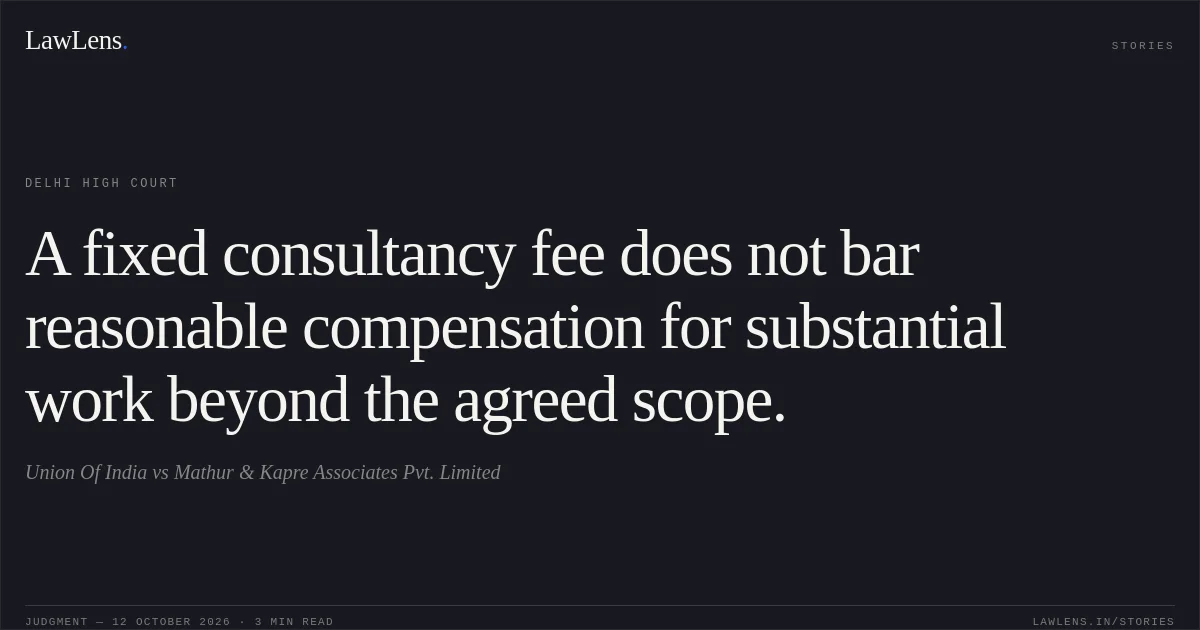
The tribunal’s reading of Clauses 3.4 and 14—that the ₹6 crore fee related to the scope originally contemplated, while materially increased work was not priced—was a permissible interpretation, not a rewriting of the contract.
Source reference: pp. 18–22The record included the substantial increase in area and project cost, extended timelines, a pre-contract clarification that no major change was envisaged, and changes to project requirements; this was sufficient evidence to support the tribunal’s conclusion that the work had materially expanded.
Source reference: pp. 18–22The tribunal’s use of a 4.14% rate against the final project cost, informed by the Council of Architecture scale and comparable projects, was not a figure without evidentiary basis.
Source reference: pp. 22–24The Court held that disagreement with the chosen valuation method did not establish patent illegality.
Source reference: pp. 22–24The awards on the performance security and tender-document costs were supported by identified evidence, while the challenge to the counterclaims failed to identify particular documents allegedly ignored or explain how they established breach, causation or loss.
Source reference: pp. 24–25Holding
The Court held that the tribunal’s interpretation and fee award did not warrant interference under Section 34.
It also found no sustainable ground to set aside the awards on the respondent’s other claims or the rejection of the petitioner’s counterclaims.
Source reference: pp. 25–26The petition was dismissed, and pending applications were disposed of.
Source reference: pp. 25–26Acts & Sections Cited
3 provisions across 2 statutes referred to in this judgment. Each provision opens on LawLens.
Indian Contract Act, 18721
Arbitration and Conciliation Act, 19962
Original Court PDF
Union Of IndiavsMathur & Kapre Associates Pvt. Limited
Click to open original judgment
Original judgment, available to read, download and summarize on LawLens.in