Facts
The petitioners were elected as Pramukh and Up-Pramukh of the Block Panchayat Samiti, Pakaridayal, on 30 December 2021.
Source reference: p.5, para.3A special meeting was convened on 13 January 2024 to consider a no-confidence motion against them. Although seven of the fourteen elected members attended, the motion was not put to vote because the attendees did not constitute a majority of the total elected members.
Source reference: p.5, para.3; p.11, para.13Seven elected members thereafter approached the High Court in CWJC No. 3237 of 2024. By order dated 25 November 2024, they were permitted to submit a fresh requisition for convening a no-confidence meeting, subject to the outcome of SLP No. 12490 of 2024 pending before the Supreme Court.
Source reference: p.6, para.4; p.11, para.15The requisitionists submitted a fresh requisition dated 29 November 2024. The Pramukh allegedly refused to receive it, following which it was sent by post on 6 December 2024. Since the Pramukh did not convene the meeting within fifteen days, the seven requisitionists met on 23 December 2024, elected Vinod Kumar to preside, and fixed 4 January 2025 as the date for the special meeting.
Source reference: p.12, paras.16, 18–19At the meeting held on 4 January 2025, nine elected members participated, and the no-confidence motions against both petitioners were passed by a vote of 9–0.
Source reference: p.13, para.20Issues
Whether a fresh no-confidence motion was barred under Section 44(3)(ii) of the Bihar Panchayat Raj Act, 2006 merely because an earlier meeting had been convened, though no voting had taken place at that meeting?
Source reference: p.11, para.14Whether the requisitionists could validly fix the date of the special meeting after the Pramukh failed to convene it within the statutory period prescribed under Section 44(3)(i) of the Act?
Source reference: p.12, para.18; p.13, para.22Whether the meeting was invalid because the record did not expressly state the procedure by which Vinod Kumar was elected to preside over it?
Source reference: p.7, para.7; p.14, paras.23–24Whether the no-confidence motion passed on 4 January 2025 by 9 of the 14 elected members was legally valid?
Source reference: p.13, paras.20–21Law Applied
The Court applied Section 44(3)(i) of the Bihar Panchayat Raj Act, 2006, under which the Pramukh must convene a special meeting within the prescribed period after receiving a requisition and, upon failure, one-third of the directly elected members may fix the date of the meeting.
Source reference: p.7, para.7; p.13, para.22Section 44(3)(vii) requires that, where the no-confidence motion is against both the Pramukh and Up-Pramukh, the meeting must be presided over by a member elected from among the Panchayat Samiti members.
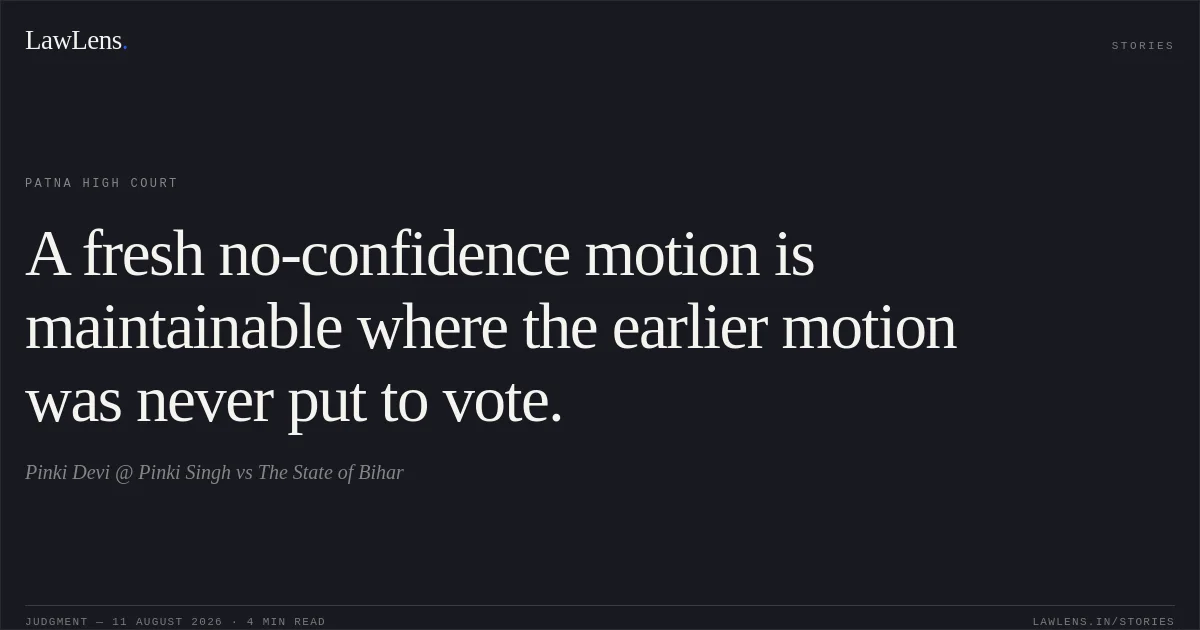
Source reference: p.14, para.23The Court relied on Dharamshila Kumari v. Hemant Kumar, 2021 (3) PLJR 346, for the principle that a fresh no-confidence motion is not barred where an earlier meeting was held but the motion was never put to vote.
Source reference: p.11, para.14The principle in Bharat Singh v. State of Haryana, AIR 1988 SC 2181, requiring facts pleaded in writ proceedings to be supported by appropriate material, was found satisfied because the relevant requisitions, postal receipt, minutes, notices, and meeting proceedings were on record.
Source reference: pp.14–15, paras.25–26Reasoning
The Court held that the first meeting of 13 January 2024 did not result in any voting or adjudication on the no-confidence motion; therefore, under Dharamshila Kumari, the statutory bar against a subsequent motion was not attracted.
Source reference: p.11, para.14The fresh requisition was also permissible because it followed the liberty expressly granted in the earlier writ proceedings, whose order had attained finality after withdrawal of the petitioners’ appeal.
Source reference: p.12, paras.15–17Since the Pramukh failed to convene the meeting within fifteen days, the seven requisitionists—more than one-third of the fourteen elected members—were competent to convene the meeting and fix its date under Section 44(3)(i).
Source reference: pp.12–13, paras.18, 22The objection concerning Vinod Kumar’s election as presiding officer was rejected because the minutes described him as the Presiding Officer, all participating members signed the proceedings, none challenged his authority, and Section 44(3)(vii) prescribes the eligibility of the presiding member but does not prescribe a particular election procedure.
Source reference: p.14, paras.23–24Finally, the motion was passed by nine votes out of fourteen, constituting a majority of the total elected membership.
Source reference: p.13, para.21Holding
The Court answered all issues against the petitioners. It held that the fresh no-confidence motion was not barred, the requisitionists validly fixed the date of the meeting after the Pramukh’s failure to act, Vinod Kumar validly presided over the meeting, and the motion passed by 9–0 on 4 January 2025 was legally effective against both the Pramukh and Up-Pramukh.
Finding no illegality in the requisitions, notices, convening of the meeting, or its proceedings, the Court dismissed the writ petition.
Source reference: p.16, paras.26–28Acts & Sections Cited
1 provisions across 1 statute referred to in this judgment. Each provision opens on LawLens.
BIHAR PANCHAYAT RAJ ACT, 20061
Original Court PDF
Pinki Devi @ Pinki SinghvsThe State of Bihar
Click to open original judgment
Original judgment, available to read, download and summarize on LawLens.in