Facts
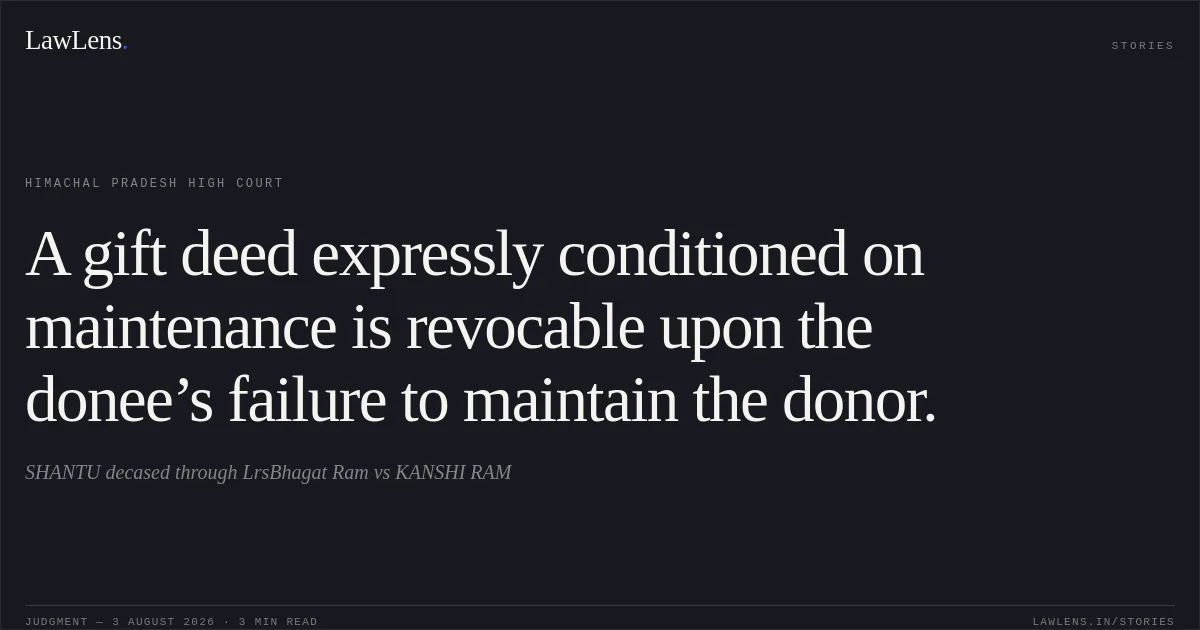
The plaintiff, Shantu, executed a registered gift deed dated 21 March 1997 in favour of the defendant, Kanshi Ram, concerning his half share in the suit land. The deed stipulated that the defendant would maintain the plaintiff and his wife and that the gift could be revoked upon failure to do so.
Source reference: para. 2The plaintiff alleged that the defendant and his family failed to maintain them, maltreated them, and compelled them to leave the house; he therefore sought declaration that the gift stood revoked, along with possession and permanent injunction.
Source reference: para. 2The defendant admitted execution of the gift deed but contended that he had maintained the plaintiff for several years, that the plaintiff voluntarily left after his marriage, and that money orders sent towards maintenance were refused.
Source reference: para. 3The Trial Court held that the gift was conditional and that the defendant had failed to maintain the plaintiff and his wife, and decreed the suit.
Source reference: para. 7The District Judge reversed that decree, holding that future services were merely the motive for the gift and that no breach had been established.
Source reference: para. 8The plaintiff filed the present regular second appeal, which was admitted on three substantial questions of law.
Source reference: para. 9Issues
Whether the Lower Appellate Court misconstrued the Transfer of Property Act by ignoring the express stipulation that the gift would be revoked upon the defendant’s failure to render maintenance and services?
Source reference: para. 9, substantial question No. 1Whether the Lower Appellate Court’s finding that there was no breach of the gift conditions, and that the plaintiff had voluntarily left the defendant’s house and refused maintenance, was erroneous or perverse?
Source reference: para. 9, substantial question No. 2Whether the Lower Appellate Court erred in holding that the gift deed was irrevocable by misapplying the legal principles governing conditional gifts?
Source reference: para. 9, substantial question No. 3Law Applied
Under Sections 31 and 126 of the Transfer of Property Act, 1882, an interest may be created subject to a condition that it will cease upon the happening or non-happening of a specified uncertain event, and a gift may be revoked where the parties have agreed to such a condition, provided it is not dependent solely on the donor’s will.
Source reference: paras. 18, 22Although Section 122 defines a gift as a voluntary transfer without consideration, maintenance or future services may nevertheless constitute a valid condition attached to the gift rather than impermissible consideration.
Source reference: paras. 8, 18, 32The Court relied on Mt. Purnia Kurmi v. Manindra Nath Mahanti, AIR 1968 Assam & Nagaland 50, Gehru Ram v. Rohlu, 1998 (1) Shim. L.C. 360, Bhagwan Dass v. Tulu, 2019 SCC OnLine HP 3381, and Amar Chand v. Pushpa, RSA No. 91 of 2021, for the proposition that a gift expressly conditioned upon maintaining the donor may be revoked upon breach.
Source reference: paras. 18–21Naresh Kumari v. Chameli, 2024 INSC 965, was distinguished because it prohibited perpetual service obligations but permitted maintenance during the lifetime of the donor and donee.
Source reference: para. 24Reasoning
The High Court found that the gift deed expressly required the defendant to maintain the plaintiff and his wife and permitted revocation upon failure to do so; hence, the gift was conditional and not irrevocable merely because it was a gift without consideration.
Source reference: paras. 17–18, 22The defendant’s denial of the maintenance condition was inconsistent with the contents of the gift deed and undermined his credibility.
Source reference: paras. 16–17, 28His own evidence showed that the plaintiff left the defendant’s house shortly after marriage, despite allegedly having lived there for several years, while the defendant’s witnesses failed to satisfactorily explain that circumstance.
Source reference: paras. 27–31The Court further held that sending money orders did not satisfy the contractual obligation to “maintain” the plaintiff and his wife, which required care and support rather than merely monetary payment.
Source reference: paras. 29, 31Accordingly, the Appellate Court had misdirected itself by treating maintenance only as the motive for the gift and by disregarding the express revocation clause.
Source reference: paras. 32–33Holding
The High Court answered all three substantial questions of law in favour of the plaintiff.
It held that the gift deed contained a valid condition requiring maintenance and that the defendant’s failure to fulfil that condition entitled the plaintiff to revoke the gift.
Source reference: paras. 22, 33The appeal was allowed; the District Judge’s judgment and decree dated 26 April 2005 were set aside, and the Trial Court’s decree dated 12 November 2002 granting declaration, possession, and permanent prohibitory injunction was restored.
Source reference: para. 34Acts & Sections Cited
5 provisions across 1 statute referred to in this judgment. Each provision opens on LawLens.
Transfer of Property Act, 18825
Original Court PDF
SHANTU decased through LrsBhagat RamvsKANSHI RAM
Click to open original judgment
Original judgment, available to read, download and summarize on LawLens.in
![Relief is made contingent on the Supreme Court’s eventual determination in the analogous pending case.. Ashok Tolani vs REVENUE. CAT - ['Jaipur']. LawLens](/stories/thumbnails/relief-is-made-contingent-on-the-supreme-courts-eventual-determination-in-the-analogous-pe-0a05b6600e0644cf9facfda571d15955.webp)