Facts
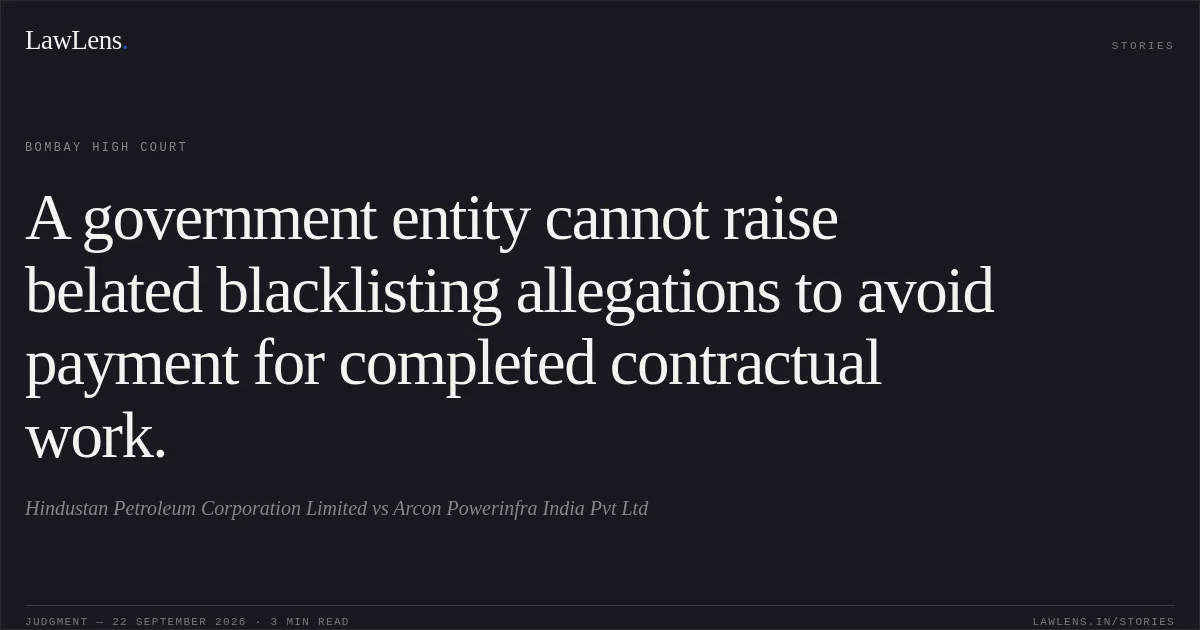
The Respondent-contractor had executed a contract with the Appellant, Hindustan Petroleum Corporation Ltd. (“HPCL”), and subsequently raised its first running account bill for ₹25,73,262 for work allegedly completed before termination of the contract. The bill was submitted on 27 June 2017. The contractual terms required certification of running account bills by HPCL and payment within 15 days; they also contemplated joint measurements, with the contractor required to remain present when called by the Engineer-in-Charge or Site-in-Charge.
Source reference: p.3, para. 3.1The Respondent claimed that HPCL neither disputed the bill nor called upon it to participate in joint measurements. The sole Arbitrator accepted the claim and passed an award dated 26 July 2022. HPCL challenged the award under Section 34 of the Arbitration and Conciliation Act, 1996, but the learned Single Judge dismissed the petition on 1 March 2024. HPCL thereafter preferred the present appeal under Section 37, contending, inter alia, that the Respondent had failed to disclose that it was on NHPC’s holiday or banned list, had not performed the contractual work properly, and that the award was contrary to public policy. HPCL also alleged bias and misconduct against the Arbitrator.
Source reference: p.2, para. 1; p.2, para. 3; p.4, para. 5.1; p.5, para. 5.2Issues
Whether the arbitral award granting the Respondent’s claim for work allegedly completed before termination was liable to be interfered with under Sections 34 and 37 of the Arbitration and Conciliation Act, 1996, on the ground that the contractual requirements concerning certification and joint measurements were not satisfied.
Source reference: p.3, para. 3.1Whether the Respondent’s alleged failure to disclose its blacklisting or holiday-list status with NHPC constituted a valid defence to HPCL’s liability to pay for the work performed.
Source reference: p.4, para. 4Whether the award was contrary to public policy because the underlying contract involved a public-sector undertaking.
Source reference: p.5, para. 5.1Whether the Arbitrator suffered from disqualifying bias or misconduct under Sections 12(1), 12(2), and 12(5) read with the Seventh Schedule of the Arbitration and Conciliation Act, 1996.
Source reference: p.5, para. 5.2Law Applied
The Court applied the limited scope of appellate interference under Section 37 of the Arbitration and Conciliation Act, 1996, under which the Court cannot reassess evidence or substitute its own view where the arbitral award and the Section 34 decision are legally sustainable. Sections 34 and 37 permit interference only on the recognised statutory grounds, including conflict with public policy or legal perversity.
Source reference: p.5, para. 5The Court also applied the contractual provisions requiring certification and payment of running account bills and providing for joint measurements, particularly Clauses 7.1 and 7.a.2. Relying on Shri Kishan v. Kurukshetra University, Kurukshetra, (1976) 1 SCC 311, the Court held that fraud is not established where the allegedly defrauded party could have discovered the truth through due diligence. Sections 12(1), 12(2), and 12(5), read with the Seventh Schedule, govern disclosures, impartiality, and statutory ineligibility of arbitrators.
Source reference: p.3, para. 3.1; p.4, para. 4; p.5, para. 5.2Reasoning
The Court found that Clause 7 did not absolve HPCL of its obligation to process and certify the running account bill. Clause 7.1 required certification and payment within 15 days, while Clause 7.a.2 required the contractor’s presence for joint measurements only when called upon by the Engineer-in-Charge or Site-in-Charge. Since HPCL admittedly did not call upon the Respondent to participate in joint measurements, the Respondent could not be faulted for their absence.
Source reference: p.3, para. 3.1The Court further held that HPCL’s blacklisting or holiday-list contention was belated and unsupported because HPCL could have verified the Respondent’s status before awarding or permitting performance of the contract. Having allowed the work to proceed and then raising the objection when payment became due was characterised as a failure of due diligence. The contractual dispute was a private civil transaction and did not become a public-policy issue merely because HPCL was a government undertaking. Finally, the Court upheld the Single Judge’s conclusion that the allegation concerning the Arbitrator’s appearance in an unrelated matter did not establish any violation of Sections 12(1), 12(2), or 12(5) read with the Seventh Schedule.
Source reference: p.4, para. 4; p.5, para. 5.1; p.5, para. 5.2Holding
The Division Bench held that the arbitral award did not suffer from legal perversity, violation of public policy, or any other ground warranting interference under Sections 34 or 37 of the Arbitration and Conciliation Act, 1996.
The appeal was dismissed for lack of merit. Consequently, Interim Application (L) No. 11667 of 2024 was disposed of as infructuous.
Source reference: p.6, para. 7.1; p.6, para. 8Acts & Sections Cited
4 provisions across 1 statute referred to in this judgment. Each provision opens on LawLens.
Arbitration and Conciliation Act, 19964
Original Court PDF
Hindustan Petroleum Corporation LimitedvsArcon Powerinfra India Pvt Ltd
Click to open original judgment
Original judgment, available to read, download and summarize on LawLens.in