Facts
The respondents had worked through contractors engaged by the appellant, Oil and Natural Gas Corporation Ltd. (“ONGC”), and claimed gratuity from ONGC.
Source reference: para. 5–8The Controlling Authority under the Payment of Gratuity Act fastened liability on ONGC, notwithstanding ONGC’s objection that the respondents were employees of the contractors and that no employer–employee relationship existed between the respondents and ONGC.
Source reference: para. 5–8The Appellate Authority allowed ONGC’s challenge, but the High Court of Bombay reversed that decision and restored the liability against ONGC by a common order dated 23 August 2023.
Source reference: para. 4ONGC challenged the High Court’s order in the connected appeals.
Source reference: no citationDuring the proceedings, gratuity had already been paid to the respondents pursuant to this Court’s order dated 15 December 2023.
Source reference: para. 15Issues
Whether the Controlling Authority under the Payment of Gratuity Act could adjudicate and fasten liability for payment of gratuity on ONGC when the respondents had worked through contractors and ONGC disputed the existence of an employer–employee relationship?
Source reference: para. 5–8, 12, 14Whether the respondents, not being employees of ONGC, could claim gratuity from ONGC under Section 4 of the Payment of Gratuity Act, 1972?
Source reference: para. 6–7, 11–12Whether the High Court was justified in reversing the Appellate Authority’s order that had rejected the claim against ONGC?
Source reference: para. 12, 14Whether recovery could be directed from the respondents after gratuity had already been paid to them pursuant to this Court’s interim order?
Source reference: para. 15Law Applied
Section 4 of the Payment of Gratuity Act, 1972 applies to gratuity payable to an “employee”; therefore, the existence of an employer–employee relationship is foundational to a claim against the alleged employer.
Source reference: para. 6The Controlling Authority’s statutory function is limited to determining or computing the amount of gratuity payable to a qualifying employee and does not extend to deciding, in the circumstances of these cases, the underlying liability of a principal employer whose status as employer is disputed.
Source reference: para. 12Section 21(4) of the Contract Labour (Regulation and Abolition) Act, 1970 concerns responsibility for payment of wages by the principal employer and does not, by itself, impose liability for gratuity, which is treated separately under the Payment of Wages Act, 1936.
Source reference: para. 6–7, 13The contractual arrangement between ONGC and the contractors expressly described the engagement as a job contract, created no employer–employee relationship between ONGC and the contractors’ employees, and operated at arm’s length.
Source reference: para. 7The Court also noted the principle stated in Municipal Council, represented by its Commissioner, Nandyal Municipality, Kurnool District, A.P. v. K. Jayaram, although it found it unnecessary to rely on that decision for disposal of the appeals.
Source reference: para. 9, 13Reasoning
The respondents’ claims arose from work performed through contractors, while ONGC expressly disputed that they were its employees and relied on the job-contract terms excluding any employer–employee relationship.
Source reference: para. 6–7Since the foundational issue of ONGC’s liability and status as employer was disputed, the Controlling Authority could not validly assume jurisdiction to determine and fasten that liability under proceedings concerned with computation of gratuity payable to an employee.
Source reference: para. 12The respondents’ assertion that they had worked for a long period did not answer ONGC’s legal objection that they had been engaged through contractors, and no effective counter was made to that objection.
Source reference: para. 11The Appellate Authority had therefore correctly interfered with the Controlling Authority’s order, and the High Court erred in reversing it.
Source reference: para. 12, 14Although the gratuity amounts had already been paid pursuant to this Court’s order, the Court considered it inequitable to direct recovery from the respondents.
Source reference: para. 15Holding
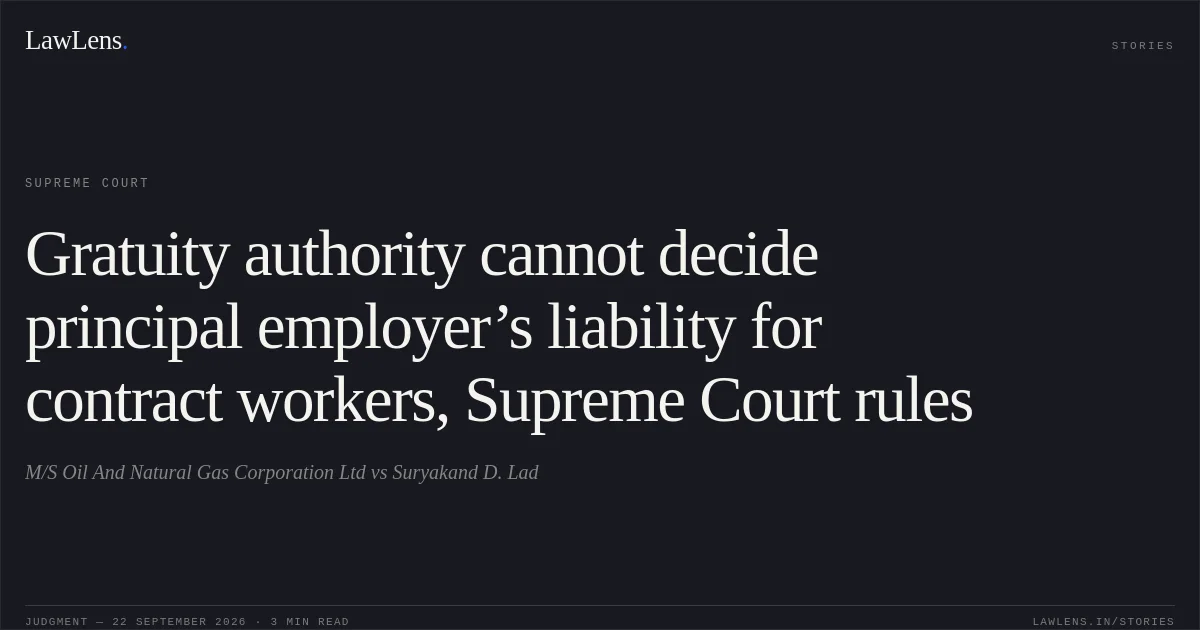
The Court held that the Controlling Authority was not competent to adjudicate the disputed liability of ONGC for gratuity claimed by persons who had worked through contractors.
The appeals were allowed; the Bombay High Court’s common order dated 23 August 2023 was set aside, and the Appellate Authority’s orders were restored.
Source reference: para. 14However, because the gratuity amounts had already been paid to the respondents pursuant to this Court’s order dated 15 December 2023, no recovery was to be made from them.
Source reference: para. 15All pending applications were disposed of.
Source reference: para. 16Acts & Sections Cited
3 provisions across 3 statutes referred to in this judgment. Linked provisions open on LawLens.
PAYMENT OF GRATUITY ACT, 19721
Contract Labour (Regulation and Abolition) Act, 19701
Payment Of Wages Act, 19361
Original Court PDF
M/S Oil And Natural Gas Corporation LtdvsSuryakand D. Lad
Click to open original judgment
Original judgment, available to read, download and summarize on LawLens.in