Facts
On 27 June 2024, three children—Madhav @ Gunga, Aditya @ Tilla and Mangal—were found dead by drowning near the bridge over the Sengur River, Auraiya.
Source reference: paras. 3–5The Gram Pradhan initially informed the police through an application and the information was recorded in the General Diary; panchayatnamas and post-mortems were conducted before registration of the formal FIR.
Source reference: paras. 3–5The FIR was subsequently lodged by Manish, uncle of the deceased children, alleging that Priyanka, the children’s mother, and Ashish @ Daini had taken four children to the river pursuant to an illicit relationship and attempted to drown them; the eldest child, Sonu, allegedly survived and witnessed the incident.
Source reference: paras. 4–6The trial court convicted both accused under Sections 302 read with 120-B IPC, sentenced Ashish to life imprisonment, and imposed the death penalty on Priyanka for murder.
Source reference: paras. 2, 13Issues
Whether the testimony of PW-2, an approximately eight-year-old child witness, was sufficiently reliable and free from tutoring or material contradictions to sustain the convictions?
Source reference: paras. 17–25Whether the inconsistent testimony of PW-1 and the surrounding circumstances rendered the prosecution case unreliable?
Source reference: para. 27Whether the prosecution’s failure to examine the Gram Pradhan, a material witness who first informed the police, warranted an adverse inference under the best-evidence principle?
Source reference: paras. 28–29Whether the investigative lapses—including delayed recording of the child’s statement, uncertainty regarding preparation of the site plan, and failure to register an FIR on the initial information—created reasonable doubt?
Source reference: para. 30Whether the convictions and the death sentence imposed upon Priyanka could be sustained beyond reasonable doubt?
Source reference: paras. 31–32Law Applied
The Court applied Section 118 of the Indian Evidence Act, 1872, under which a child is competent to testify if capable of understanding questions and giving rational answers.
Source reference: para. 18Relying on Rameshwar v. State of Rajasthan, AIR 1952 SC 54, and Pradeep v. State of Haryana, (2023) 19 SCC 221, it held that the trial court should assess and preferably record the child’s capacity to understand and answer questions.
Source reference: paras. 19–20Under Mangoo v. State of M.P., AIR 1995 SC 959, Panchhi v. State of U.P., (1998) 7 SCC 177, and State of M.P. v. Ramesh, (2011) 4 SCC 786, a child’s testimony may be relied upon if it inspires confidence, but must be evaluated with heightened caution because of the risk of tutoring; corroboration is a rule of prudence rather than an absolute rule of law.
Source reference: paras. 21–24The Court also applied the adverse-inference principle concerning withholding of a material witness, relying on Tomaso Bruno v. State of U.P., (2015) 7 SCC 178, and Takhaji Hiraji v. Thakore Kubersing Chamansing, (2001) 6 SCC 145.
Source reference: paras. 14(iv), 28The substantive charges arose under Sections 302, 307 and 120-B IPC.
Source reference: para. 5Reasoning
The Court found PW-2’s testimony unsafe for reliance because it conflicted with the prosecution’s own account regarding his communication with the Gram Pradhan and Manish, his presence at the police station and the timing of his statement, which was recorded only on 5 July 2024 despite the alleged incident occurring on 27 June 2024.
Source reference: para. 25The Court considered the intervening involvement of the child’s bua and fufa and the structured nature of his account to indicate a real possibility of tutoring.
Source reference: para. 25It also found PW-1 unreliable because he gave shifting versions about the source of his information, reached the scene several hours before lodging the FIR, denied assisting in preparation of the site plan despite the Investigating Officer’s contrary statement, and was not a witness to any panchayatnama although claiming to have been present.
Source reference: para. 27The Gram Pradhan was the person who initially informed the police and whose application preceded the panchayatnamas and post-mortems.
Source reference: paras. 28–29Since the prosecution case substantially depended on the sole child witness, the Court held that the Pradhan was a material witness capable of explaining the genesis of the occurrence.
Source reference: paras. 28–29His non-examination justified an adverse inference against the prosecution.
Source reference: paras. 28–29The Court further held that the delayed recording of PW-2’s statement, contradictory accounts concerning the site plan, and failure to register an FIR when the initial information disclosed a cognizable offence were fundamental defects, not merely minor investigative irregularities.
Source reference: para. 30These circumstances cumulatively created reasonable doubt as to the prosecution narrative and made the convictions unsustainable.
Source reference: para. 31Holding
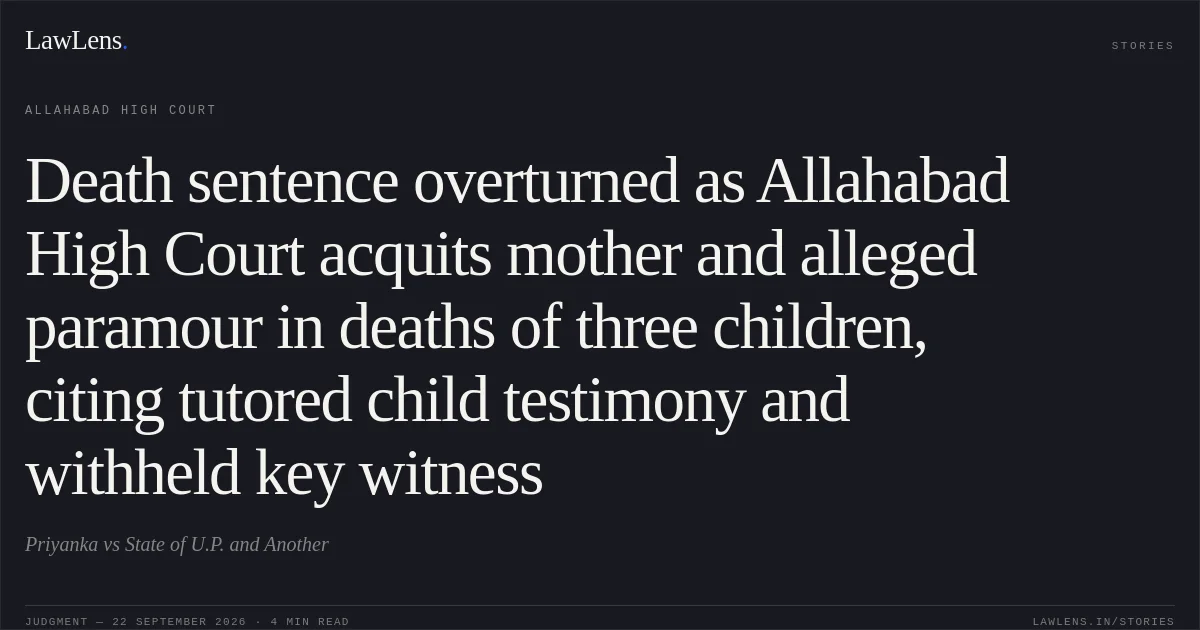
The High Court held that the prosecution failed to prove the guilt of Priyanka and Ashish @ Daini beyond reasonable doubt.
The testimony of PW-2 was treated as contradictory and potentially tutored; PW-1 was found unreliable; the non-examination of the Gram Pradhan attracted an adverse inference; and the investigative lapses materially undermined the prosecution case.
Source reference: paras. 31–32The capital appeal and jail appeal were allowed, the reference for confirmation of Priyanka’s death sentence was answered against the prosecution, and the trial court’s judgment and order dated 5/10 July 2025 were set aside.
Source reference: para. 32Both appellants were acquitted of all charges and directed to be released forthwith unless required in any other case.
Source reference: para. 32The Court also directed payment of professional fees of Rs. 50,000 to the appointed Amicus Curiae.
Source reference: para. 34Acts & Sections Cited
5 provisions across 3 statutes referred to in this judgment. Each provision opens on LawLens.
Indian Penal Code, 18602
Code of Criminal Procedure, 19732
Oaths Act, 19691
Original Court PDF
PriyankavsState of U.P. and Another
Click to open original judgment
Original judgment, available to read, download and summarize on LawLens.in