Facts
Karan Joshi was alleged to have travelled from Ludhiana to Delhi on the intervening night of 13/14 July 2016.
Source reference: para. 2His brother, Varun Joshi, stated that he purchased a railway ticket for Karan, accompanied him to Ludhiana Railway Station, and saw him board the Jammu Mail at approximately 11:30 p.m.
Source reference: para. 2Karan subsequently fell from the moving train between Dhandari Kalan and Block Hut and sustained fatal injuries; his body was later recovered near the railway track.
Source reference: para. 2His widow and son filed a claim before the Railway Claims Tribunal seeking compensation under the Railways Act, 1989.
Source reference: paras. 3–4The Tribunal dismissed the claim, principally because no ticket was recovered from the deceased, there was insufficient proof of his journey, the train driver and guard denied knowledge of any incident, and no railway memo regarding the occurrence was produced.
Source reference: paras. 3–4The claimants challenged that decision in the present appeal.
Source reference: para. 1Issues
Whether the evidence established that the deceased was a bona fide railway passenger, notwithstanding the non-recovery of a journey ticket.
Source reference: paras. 6, 11–12Whether the deceased’s death resulted from an “untoward incident” under Sections 123(c)(2) and 124A of the Railways Act, 1989.
Source reference: paras. 15–16Whether the appellants were entitled to statutory compensation as dependants of the deceased.
Source reference: para. 17Whether compensation should be calculated at ₹4,00,000 or ₹8,00,000, having regard to the date of the accident and the subsequent amendment to the compensation rules.
Source reference: para. 18Law Applied
Section 123(c)(2) of the Railways Act, 1989 includes the accidental falling of a passenger from a passenger train within the expression “untoward incident”.
Source reference: para. 15Section 124A imposes no-fault liability on the railway administration for death caused by an untoward incident, subject to the statutory exceptions; proof of railway negligence is unnecessary.
Source reference: para. 15Under Section 123(b)(i), the wife and son of a deceased passenger are recognised as dependants.
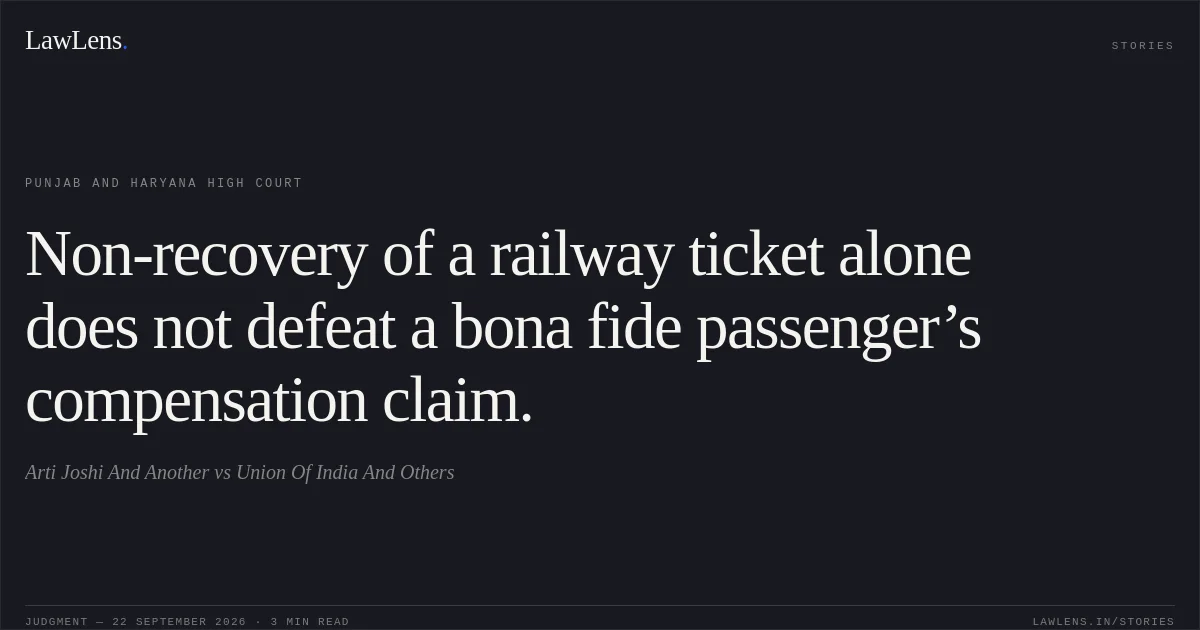
Source reference: para. 17Applying Union of India v. Rina Devi, (2019) 3 SCC 572, the mere absence or non-recovery of a ticket does not by itself disprove bona fide passenger status; the issue must be determined on the totality of the evidence.
Source reference: para. 11Under Rina Devi and Union of India v. Radha Yadav, (2019) 3 SCC 410, for accidents occurring before the enhancement of compensation, the amount applicable on the accident date is considered with reasonable interest, but the claimant is entitled to the higher amount if the resulting sum is lower than the amount prescribed on the date of the award.
Source reference: para. 18Reasoning
The High Court found that Varun Joshi’s testimony regarding the purchase of the ticket and Karan’s boarding of the Jammu Mail was not discredited in cross-examination, and there was no contrary evidence from the Railways.
Source reference: para. 6That oral evidence was corroborated by the inquest report, GRP statements recorded under Section 174 Cr.P.C., the death report, and the post-mortem and medical material, which recorded death in a railway accident.
Source reference: paras. 7–10, 12The non-recovery of the ticket was therefore insufficient to reject the claim.
Source reference: no citationSimilarly, the statements of the driver and guard denying knowledge of an incident could not be considered in isolation or override the police and medical evidence concerning the recovery of the body and cause of death.
Source reference: para. 13The absence of evidence regarding the deceased’s employment was immaterial because compensation under Section 124A depends on the statutory untoward incident and not on proof of employment.
Source reference: para. 14No evidence established suicide, self-inflicted injury, criminal activity, intoxication, or any other exception under the proviso to Section 124A.
Source reference: para. 16Since the appellants were the deceased’s widow and son, they qualified as dependants under the Act.
Source reference: para. 17Holding
The appeal was allowed and the Tribunal’s judgment dated 8 August 2019 in OA-II/70/2017 was set aside.
The Court held that Karan Joshi was a bona fide passenger and that his death resulted from an untoward railway incident attracting the Railways’ no-fault liability under Section 124A.
Source reference: para. 18The appellants were awarded ₹4,00,000 with interest at 9% per annum from the date of filing of the claim petition until realisation, or ₹8,00,000, whichever was higher.
Source reference: para. 18The Railway administration was directed to pay the amount within four weeks of receiving a certified copy of the judgment; in default, further interest at 12% per annum would accrue from expiry of that period until actual realisation.
Source reference: para. 18The compensation was to be disbursed to the appellants in accordance with law.
Source reference: para. 18Acts & Sections Cited
2 provisions across 2 statutes referred to in this judgment. Each provision opens on LawLens.
Code of Criminal Procedure, 19731
Railways Act, 19891
Original Court PDF
Arti Joshi And AnothervsUnion Of India And Others
Click to open original judgment
Original judgment, available to read, download and summarize on LawLens.in