Facts
Anita, daughter of informant Mahesh Chandra, was married to Karu, son of Gendalal, approximately two years before the incident.
Source reference: no citationThe prosecution alleged that, after the marriage, Karu and Gendalal demanded a motorcycle and subjected Anita to physical cruelty when the demand was not fulfilled.
Source reference: no citationOn 4 July 2011, the informant allegedly received information that the accused had killed Anita by setting her on fire; upon reaching the village, he found her funeral pyre burning and alleged that the accused fled from the spot.
Source reference: para. 3 / p. 2An FIR was registered on 14 July 2011 under Sections 304-B, 498-A and 201 IPC and Section 4 of the Dowry Prohibition Act.
Source reference: para. 4–5 / p. 2After investigation, a charge-sheet was filed and the accused were tried by the Sessions Court.
Source reference: para. 4–5 / p. 2The Trial Court convicted both appellants and sentenced them to life imprisonment under Section 304-B IPC, along with sentences under Sections 498-A and 201 IPC and Section 4 of the Dowry Prohibition Act, all to run concurrently.
Source reference: para. 1 / p. 1Before the High Court, the appellants did not challenge their convictions and confined their appeal to the quantum of sentence.
Source reference: para. 10, 13 / pp. 3–4Issues
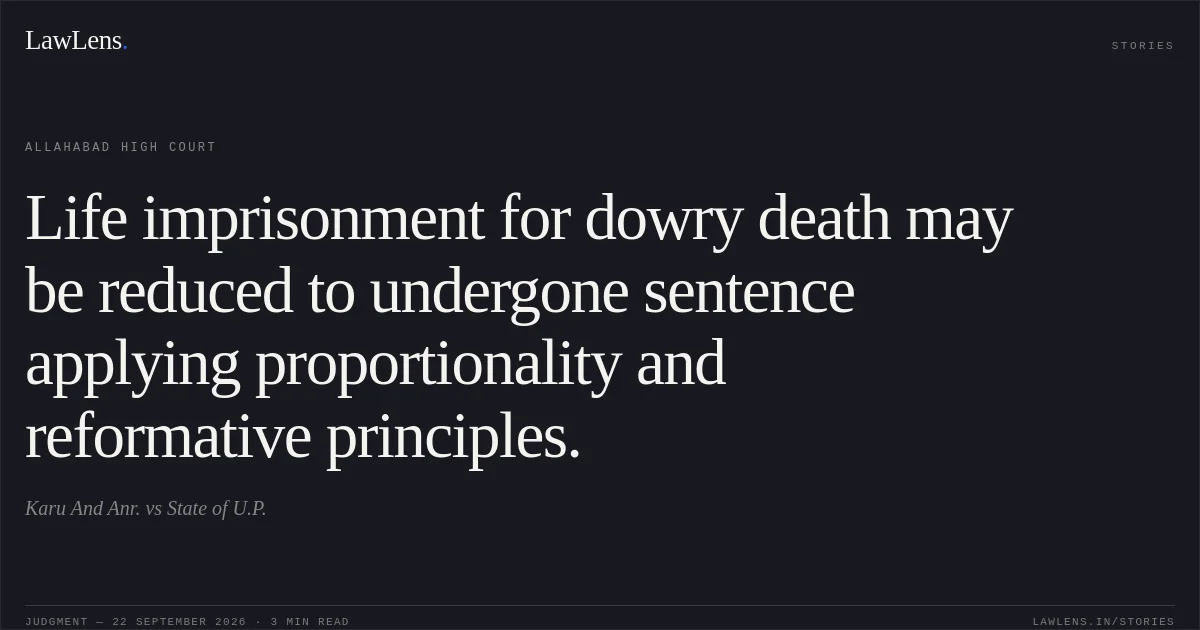
Whether the appellants’ life sentences under Section 304-B IPC were excessive and liable to be reduced in light of the statutory minimum sentence, the period of incarceration already undergone, and the mitigating circumstances?
Source reference: para. 15, 21–23 / pp. 4–6Whether the convictions recorded under Sections 498-A, 304-B and 201 IPC and Section 4 of the Dowry Prohibition Act required interference?
Source reference: para. 13 / p. 4Law Applied
The Court applied Sections 498-A, 304-B and 201 IPC and Section 4 of the Dowry Prohibition Act, which respectively concern cruelty by the husband or relatives, dowry death, causing disappearance of evidence, and punishment for giving or taking dowry.
Source reference: para. 1, 13 / pp. 1, 4Section 304-B IPC prescribes a minimum sentence of seven years’ imprisonment, with imprisonment for life as the maximum.
Source reference: para. 21 / p. 5On sentencing, the Court relied on the reformative theory explained in Mohd. Giasuddin v. State of A.P., AIR 1977 SC 1926, under which punishment should seek rehabilitation rather than retribution.
Source reference: para. 16 / p. 4It also applied the principle of proportionality from Deo Narain Mandal v. State of U.P., (2004) 7 SCC 257, requiring the sentence to correspond to the gravity of the offence and the circumstances of the offender.
Source reference: para. 17 / p. 4The Court further relied on G.V. Siddaramesh v. State of Karnataka, 2010 (87) AIC 43 (SC), where a life sentence for dowry death was reduced to ten years considering the circumstances and period of imprisonment undergone.
Source reference: para. 20 / p. 5The sentencing authorities cited by the Court emphasise that punishment must balance deterrence, societal interests, the rights of the victim, proportionality, and the possibility of reform.
Source reference: para. 18–19 / pp. 4–5Reasoning
The High Court upheld the Trial Court’s findings of guilt because the appellants expressly abandoned any challenge to the convictions and the record disclosed that the prosecution had established the offences beyond reasonable doubt.
Source reference: para. 13 / p. 4In determining sentence, however, the Court found the imposition of life imprisonment under Section 304-B IPC unduly harsh in the circumstances.
Source reference: no citationKaru had undergone more than fifteen years of imprisonment, while Gendalal, described as elderly and suffering from age-related ailments, had undergone more than seven years.
Source reference: para. 14, 22 / pp. 4, 6Applying the reformative theory and proportionality principle, and noting that seven years is the statutory minimum under Section 304-B IPC, the Court concluded that continued life imprisonment was not necessary to meet the ends of justice.
Source reference: para. 21–23 / pp. 5–6Holding
The Court affirmed the convictions under Sections 498-A, 304-B and 201 IPC and Section 4 of the Dowry Prohibition Act.
It partly allowed the appeal by converting the life sentences under Section 304-B IPC into sentences limited to the periods already undergone—more than fifteen years for Karu and more than seven years for Gendalal.
Source reference: para. 23–24 / p. 6The fines imposed by the Trial Court were maintained and directed to be deposited within two months of release; failure to deposit them would entail two months’ imprisonment in default.
Source reference: para. 23 / p. 6The appellants were directed to be released forthwith unless required in any other case, and the record was ordered to be transmitted to the Trial Court for compliance.
Source reference: para. 25–26 / p. 7Acts & Sections Cited
3 provisions across 3 statutes referred to in this judgment. Each provision opens on LawLens.
Indian Penal Code, 18601
Dowry Prohibition Act, 19611
Code of Criminal Procedure, 19731
Original Court PDF
Karu And Anr.vsState of U.P.
Click to open original judgment
Original judgment, available to read, download and summarize on LawLens.in