Facts
The claimant, Ashokkumar Amarnath Dubey, was employed as a driver by Ideal Movers Pvt. Ltd. and was driving Truck No. GJ-5-AT-1550.
Source reference: p.2; para. 7On 24 August 2012, while checking the height of pipes loaded on the truck at Welspun Company, Anjar, a wooden log broke and trapped his right leg between the pipes, ultimately resulting in amputation and multiple surgeries involving rods, plates and other implants.
Source reference: p.2; para. 7The Commissioner for Workmen’s Compensation awarded Rs.7,49,658 as compensation, calculated on the basis of a monthly income of Rs.7,000, 100% functional disability and the relevant factor of 178.49, together with interest at 12% per annum from the date of the accident.
Source reference: pp.1–2The insurer challenged the award under Section 30 of the Employees’ Compensation Act, 1923, principally disputing the assessment of the claimant’s monthly income.
Source reference: p.1; para. 6Issues
Whether the Commissioner erred in assessing the claimant’s monthly income at Rs.7,000 in the absence of documentary evidence of actual wages?
Source reference: p.4; para. 6Whether the claimant’s income ought to have been restricted to the minimum wages applicable to a skilled labourer?
Source reference: pp.3–4; paras. 4–4.1, 9Whether the finding of 100% functional disability and the resulting compensation required interference in appeal?
Source reference: pp.2, 5; paras. 2.2, 7, 10Law Applied
The Court applied Section 30 of the Employees’ Compensation Act, 1923, governing appeals against awards of the Commissioner on the permissible statutory grounds.
Source reference: p.1; para. 1In assessing compensation, the Court accepted the principle that functional disability must be evaluated with reference to the claimant’s actual occupation and earning capacity, rather than merely by reference to physical impairment; permanent incapacity to perform the claimant’s occupation as a professional heavy-vehicle driver could justify 100% functional disability.
Source reference: pp.2, 5; paras. 2.2, 7, 10The Court also applied the principle that income need not automatically be confined to minimum wages where the evidence establishes skilled employment and the employer has not specifically disputed the pleaded wages.
Source reference: p.5; paras. 8–9The beneficial-object principle underlying the Employees’ Compensation Act was also relied upon in upholding a reasonable assessment of compensation.
Source reference: p.6; para. 10Reasoning
The Court found it undisputed that the claimant was employed as a heavy-transport vehicle driver and held a valid driving licence.
Source reference: p.5; para. 8His right-leg amputation and associated injuries permanently prevented him from driving a transport vehicle, thereby supporting the Commissioner’s finding of 100% functional disability.
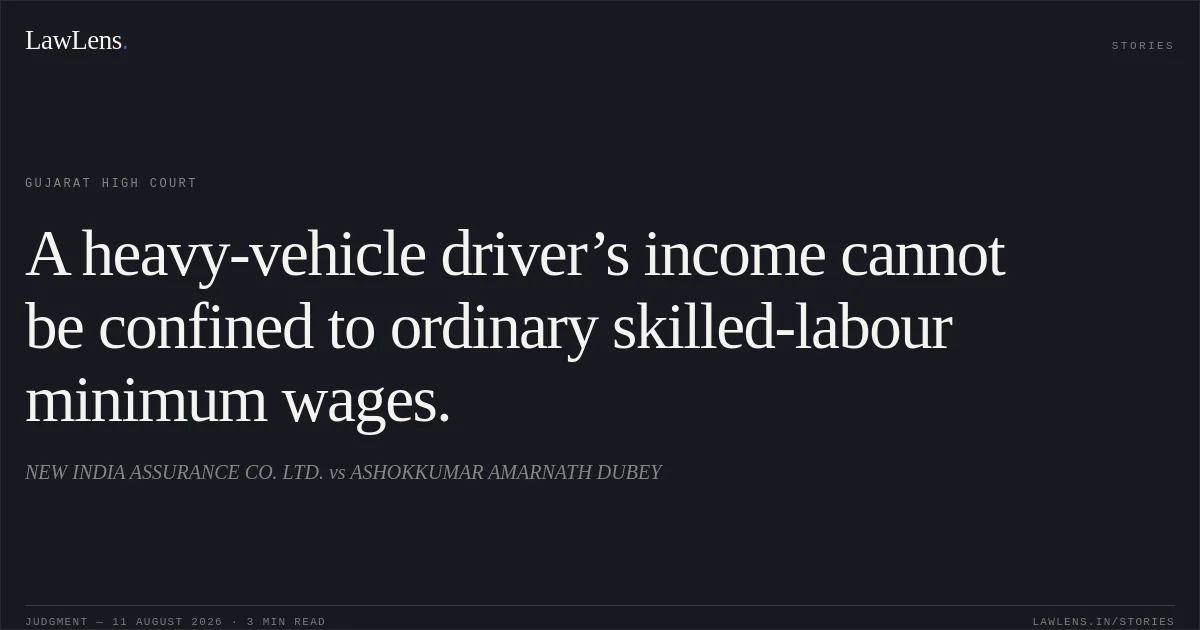
Source reference: pp.2, 5–6; paras. 7, 10Although the insurer argued that the claimant’s income should be assessed at approximately Rs.5,000 per month—the minimum wage for a skilled labourer—the Court held that a professional heavy-vehicle driver possessed a skill level that could not be equated with that of an ordinary skilled labourer.
Source reference: pp.3–4, 5; paras. 4, 9The claimant had specifically pleaded monthly wages of Rs.7,000, and the employer, who was best placed to dispute that assertion, had not denied it.
Source reference: p.5; para. 8Accordingly, the absence of documentary evidence did not establish that the income claim was unproved.
Source reference: p.5; para. 8The Court therefore found no error in applying the monthly income of Rs.7,000, the factor of 178.49 and 100% functional disability.
Source reference: p.2; paras. 2.2, 10Holding
The Court answered the issues against the insurer and held that the Commissioner had rightly assessed the claimant’s monthly income at Rs.7,000 and his functional disability at 100%.
The compensation award of Rs.7,49,658, with interest at 12% per annum, along with the other directions concerning penalty, medical expenses and costs, was not interfered with.
Source reference: p.1; paras. 1–2The First Appeal was dismissed, interim relief, if any, was vacated, and the amount deposited before the Commissioner was directed to be disbursed to the claimant after proper verification and in accordance with law.
Source reference: p.6; paras. 11–12Acts & Sections Cited
1 provisions across 1 statute referred to in this judgment. Linked provisions open on LawLens.
Employee1
Original Court PDF
NEW INDIA ASSURANCE CO. LTD.vsASHOKKUMAR AMARNATH DUBEY
Click to open original judgment
Original judgment, available to read, download and summarize on LawLens.in