Facts
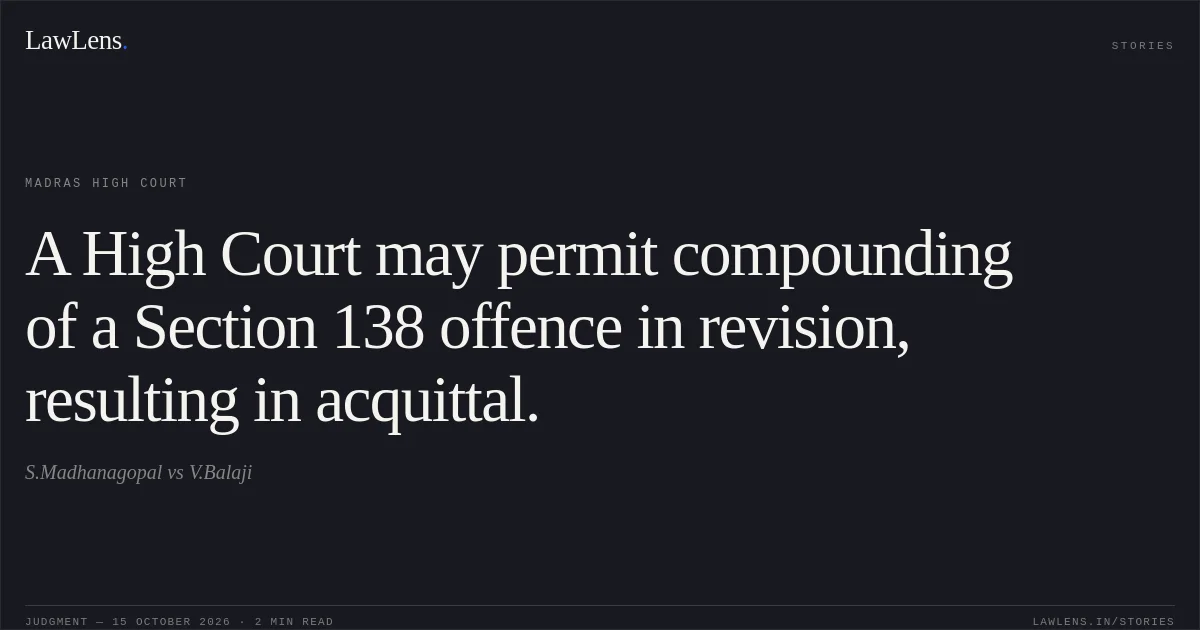
The petitioner was convicted under Section 138 of the Negotiable Instruments Act, 1881, for dishonour of a cheque for ₹6,30,000 and sentenced to six months’ simple imprisonment and a fine of ₹6,50,000, of which ₹6,30,000 was ordered as compensation.
Source reference: pp. 2–3, paras. 3(a)–(b)The appellate court affirmed the conviction and sentence.
Source reference: pp. 2–3, paras. 3(a)–(b)While the criminal revision was pending, the parties entered into a full and final settlement dated 30 September 2026. The complainant confirmed receipt of the settlement amount and stated that he had no further claim and did not oppose the revision being allowed.
Source reference: pp. 3–6, paras. 4–7Issues
1. Whether the High Court could permit compounding of a Section 138 NI Act offence, and set aside the conviction affirmed on appeal, on the basis of a subsequent compromise between the parties.
Source reference: p. 12, para. 182. Whether the circumstances justified the Court’s intervention in revision after the appellate court had affirmed the conviction and sentence.
Source reference: pp. 14–15, paras. 20–23Law Applied
Section 147 of the Negotiable Instruments Act makes every offence under that Act compoundable, notwithstanding the Code of Criminal Procedure.
Source reference: p. 13, para. 19Section 359(5)–(6) of the Bharatiya Nagarik Suraksha Sanhita, 2023, permits composition with the requisite leave after conviction where applicable and empowers a High Court or Court of Session exercising revision jurisdiction to allow compounding; under Section 359(8), composition has the effect of acquittal.
Source reference: pp. 12–13, para. 19The Court also referred to Damodar S. Prabhu v. Sayed Babalal H., which sets out a graded costs scheme for delayed compounding, including a 15% cost guideline where compounding is sought before a Sessions Court or High Court in appeal or revision.
Source reference: pp. 6–7, para. 9It further considered authorities recognising the compensatory object of Section 138 and permitting settlement-based disposal, including M/s Meters and Instruments (P) Ltd. v. Kanchan Mehta and Vinay Devanna Nayak v. Ryot Seva Sahakari Bank Ltd.
Source reference: pp. 7–10, paras. 10–12Reasoning
The Court accepted that the appellate court had already affirmed the conviction but held that the subsequent settlement and the parties’ expressed intention to end the dispute justified intervention to secure the ends of justice.
Source reference: pp. 14–15, paras. 21–24The complainant confirmed that the cheque amount had been paid in full and that he had no further claim; the Court therefore considered the compromise genuine and appropriate for compounding the offence.
Source reference: p. 5–6, para. 7; p. 15, para. 24Relying on Section 147 and its consideration of the cited authorities, the Court permitted compounding notwithstanding the stage of the proceedings.
Source reference: pp. 13–15, paras. 19–24Holding
The High Court disposed of the revision in terms of the Joint Compromise Memo, annulled the conviction and sentence imposed by the trial court and affirmed by the appellate court, and treated the petitioner as acquitted by reason of compounding.
It directed that the petitioner be released from jail forthwith without conditions and closed the connected miscellaneous petition.
Source reference: p. 16, para. 26Acts & Sections Cited
15 provisions across 5 statutes referred to in this judgment. Each provision opens on LawLens.
Negotiable Instruments Act, 18814
Code of Criminal Procedure, 19736
Bharatiya Nagarik Suraksha Sanhita, 20232
Bharatiya Nyaya Sanhita, 20232
Indian Penal Code, 18601
Original Court PDF
S.MadhanagopalvsV.Balaji
Click to open original judgment
Original judgment, available to read, download and summarize on LawLens.in