Facts
The petitioner, then an Inspector of Police, was charged in 2009 over his registration of cases and arrests made in 2004 under the Juvenile Justice (Care and Protection of Children) Act, 2000.
Source reference: p. 3–8Although the Enquiry Officer did not find the charges proved, the disciplinary authority disagreed and imposed stoppage of increment for two years with cumulative effect in 2010.
Source reference: p. 3–8The punishment was modified on appeal to stoppage of increment without cumulative effect and, on review, to censure.
Source reference: p. 3–8The petitioner challenged the disciplinary orders, arguing, among other things, that the disciplinary authority lacked jurisdiction after his transfer to the Social Justice and Human Rights Unit, and sought promotion to Deputy Superintendent of Police from the 2007–08 panel year, claiming that his juniors had been promoted.
Source reference: p. 4–6The respondents disputed the promotion claim, relying on the panel and seniority records.
Source reference: p. 8–9, 12–13Issues
Whether the third respondent had jurisdiction to impose the disciplinary punishment after the petitioner’s transfer to the Social Justice and Human Rights Unit.
Source reference: p. 4–5, 10–11Whether the disciplinary orders, as modified on appeal and review, warranted judicial interference.
Source reference: p. 9–12Whether the petitioner was entitled to inclusion in the 2007–08 promotion panel on the basis that his juniors had been promoted.
Source reference: p. 12–14Law Applied
The Court applied Rule 4 and the Schedule to the Tamil Nadu Police Subordinate Service (Discipline and Appeal) Rules, 1955, as amended by G.O.Ms. No. 1159 dated 23 November 2001.
Source reference: p. 10–11Although the Schedule identifies the Deputy Commissioner concerned as the authority competent to impose penalties on an Inspector of Police, the explanation to Rule 4 empowers a higher authority to impose a penalty.
Source reference: p. 10–11The Court also stated that judicial review of disciplinary proceedings is limited to, among other grounds, lack of jurisdiction, breach of natural justice, procedural irregularity, or a punishment so disproportionate as to shock the conscience of the Court; a writ court does not reappreciate the evidence as an appellate court.
Source reference: p. 10It relied on Gunasekaran and B.C. Chaturvedi for these principles.
Source reference: p. 10, 12In assessing the promotion claim, the Court considered the approved 2007–08 panel and the petitioner’s position in the seniority list.
Source reference: p. 12–13Reasoning
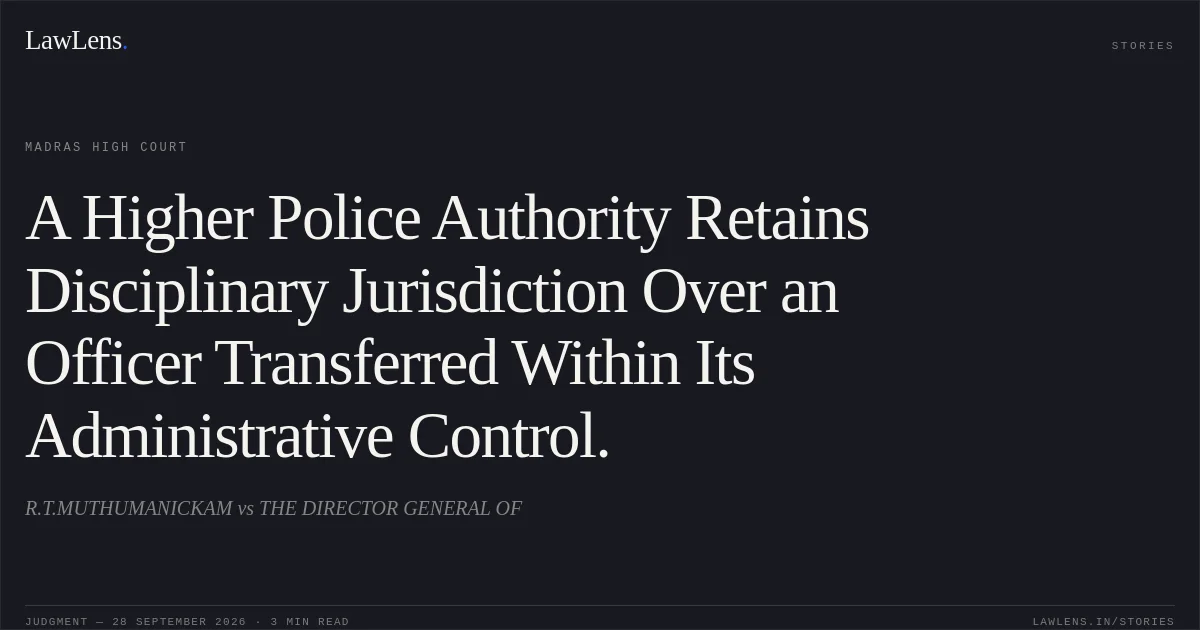
The third respondent, as Inspector General of Police-cum-Commissioner of Police, was a higher authority empowered under Rule 4 to impose a penalty.
Source reference: p. 10–11The petitioner’s transfer did not remove that authority’s jurisdiction because the unit to which he was transferred remained under the third respondent’s administrative control.
Source reference: p. 10–11The Court found no basis to interfere with the disciplinary orders within the limited scope of judicial review; the petitioner had not established a reviewable defect or shown that the final punishment of censure shocked the Court’s conscience.
Source reference: p. 11–12As to promotion, the 2007–08 panel ended with an officer at seniority number 175, whereas the petitioner was at number 234; the record did not show that any junior to him had been promoted in that panel year.
Source reference: p. 12–13Holding
The Court rejected the jurisdictional challenge and found no ground to interfere with the disciplinary orders.
It also held that the petitioner had not established entitlement to inclusion in the 2007–08 promotion panel, as the panel did not reach his seniority position and no junior was shown to have been promoted ahead of him.
Source reference: p. 11–14The writ petition was dismissed, with no order as to costs; any pending miscellaneous petitions were closed.
Source reference: p. 14Acts & Sections Cited
2 provisions across 1 statute referred to in this judgment. Linked provisions open on LawLens.
Juvenile Justice (Care and Protection of Children) Act, 20002
Original Court PDF
R.T.MUTHUMANICKAMvsTHE DIRECTOR GENERAL OF
Click to open original judgment
Original judgment, available to read, download and summarize on LawLens.in