Facts
The deceased married the second respondent on 14 September 2008.
Source reference: p. 1–3The prosecution alleged that he demanded dowry, had an illicit relationship, and subjected her to cruelty; on 3 November 2010, she died by suicide with their one-and-a-half-year-old child.
Source reference: p. 1–3The trial court acquitted the second respondent of offences under Sections 498A and 306 IPC, finding the alleged dowry demand and illicit relationship unproved and concluding that the evidence did not establish cruelty sufficient to drive the deceased to suicide.
Source reference: p. 1–3The State did not appeal.
Source reference: p. 3The deceased’s brother, who was the de facto complainant, appealed against the acquittal.
Source reference: p. 3Issues
1. Whether the prosecution established that the second respondent subjected the deceased to cruelty under Section 498A IPC, including by an alleged dowry demand or illicit relationship
Source reference: p. 5–82. Whether the evidence established the cruelty and abetment necessary to sustain the charge under Section 306 IPC, including whether a presumption under Section 113A of the Evidence Act could arise
Source reference: p. 2–3, 5–83. Whether the trial court’s reasons for acquittal warranted setting aside the acquittal, notwithstanding the High Court’s independent assessment of the evidence
Source reference: p. 7–8Law Applied
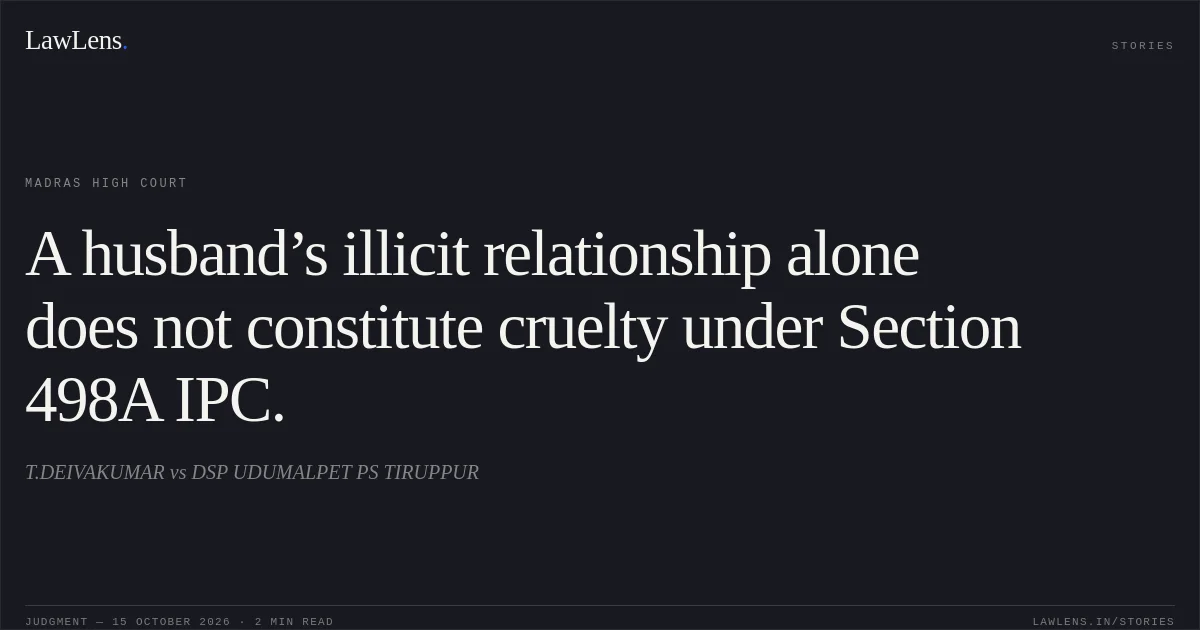
Section 498A IPC requires proof of legally qualifying cruelty; an extramarital relationship, by itself, does not amount to such cruelty unless its nature and circumstances are likely to drive the spouse to suicide.
Source reference: p. 7, para. 14The Court relied on Pinakin Mahipatray Rawal v. State of Gujarat, which held that marital intimacy with another person, without more, does not constitute cruelty under Section 498A; mental harassment may qualify, but the circumstances must meet the statutory threshold.
Source reference: p. 7, para. 14Section 113A of the Indian Evidence Act, 1872, permits a presumption of abetment of suicide in specified circumstances, including where the wife’s suicide occurs within seven years of marriage and she was subjected to cruelty; the judgment noted that the presumption could not be drawn absent proof of cruelty.
Source reference: p. 3, para. 5The charges also included Section 306 IPC, but the Court’s stated basis for decision was that the evidence did not establish the requisite cruelty or a sufficient connection between the alleged conduct and the suicide.
Source reference: p. 7–8Reasoning
The Court considered the brother’s and mother’s evidence concerning a recent demand for five sovereigns of gold and Rs. 75,000, but found that the allegation was vague, absent from the brother’s initial complaint, and introduced later; their explanations for that omission were not convincing.
Source reference: p. 5–6, 8Although the trial court’s reason for rejecting the alleged illicit relationship—failure to examine the other woman—was perverse, the Court found that the relationship had been proved but was not, on these facts, of a nature likely to drive the deceased to suicide.
Source reference: p. 7–8It therefore could not, without more, establish cruelty under Section 498A.
Source reference: p. 7–8With neither qualifying cruelty nor a reliable dowry-demand allegation established, the prosecution had not proved its case or laid a basis for the Section 113A presumption.
Source reference: p. 3, 8Holding
The Court held that the trial court’s reasons for acquittal were not all sustainable, but, on its own assessment, the prosecution had failed to prove the charges.
It dismissed the appeal and left the second respondent’s acquittal in place.
Source reference: p. 8, para. 17Acts & Sections Cited
2 provisions across 2 statutes referred to in this judgment. Each provision opens on LawLens.
Code of Criminal Procedure, 19731
Indian Penal Code, 18601
Original Court PDF
T.DEIVAKUMARvsDSP UDUMALPET PS TIRUPPUR
Click to open original judgment
Original judgment, available to read, download and summarize on LawLens.in