01Facts
The opposite parties filed a consumer complaint in 2016 alleging deficiency in service.
¶ 4The District Consumer Disputes Redressal Commission allowed the complaint on 21 September 2022 and directed the petitioner to execute a conveyance, deliver possession of a car-parking space, and pay compensation and costs.
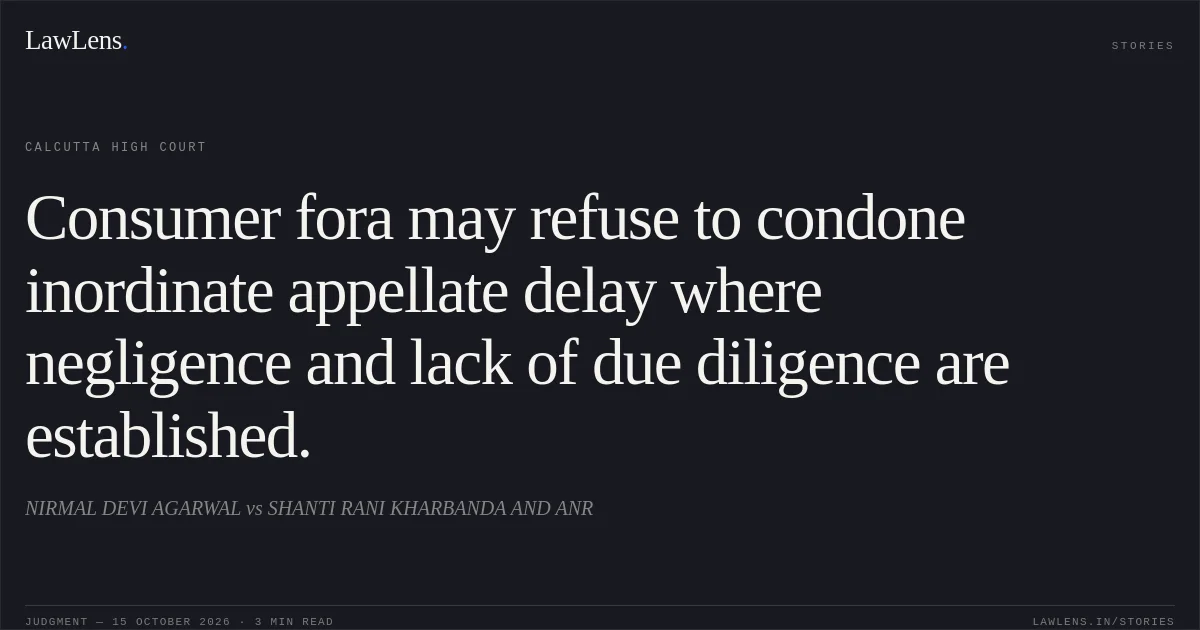
¶ 4–5The petitioner appealed to the State Commission on 20 July 2023, seeking condonation of a 257-day delay.
¶ 6–9The State Commission rejected the application and dismissed the appeal as time-barred; the National Commission dismissed the petitioner’s revision petition.
¶ 6–9The petitioner then sought relief under Article 227, arguing, among other things, that the delay should have been condoned, the complaint was itself barred by limitation, and the revision before the National Commission was not maintainable.
¶ 7–902Issues
i.1. Whether the State Commission’s refusal to condone the 257-day delay, and the National Commission’s dismissal of the revision petition, warranted interference under Article 227
¶ 21–29ii.2. Whether a revision petition under Section 21(b) of the Consumer Protection Act, 1986, was maintainable before the National Commission against the State Commission’s appellate order in a consumer dispute
¶ 8, 30–32, 38iii.3. Whether the original consumer complaint was barred by limitation under Section 24A of the 1986 Act, rendering the proceedings a nullity
¶ 7, 33–3703Law Applied
Section 5 of the Limitation Act requires proof of “sufficient cause” before delay may be condoned; even where sufficient cause is shown, condonation is discretionary, and negligence, lack of bona fides, or want of due diligence may justify refusal.
¶ 15–18Under Anshul Aggarwal v. New Okhla Industrial Development Authority, courts considering delay in consumer proceedings must also account for the statutory objective of expeditious dispute resolution.
¶ 19–20Section 21(b) of the Consumer Protection Act, 1986, empowers the National Commission to revise orders of a State Commission in a consumer dispute where jurisdictional error or material irregularity is shown; that power is not confined to original orders.
¶ 30–31Section 24A requires consumer complaints to be filed within the prescribed limitation period.
¶ 7, 33–37Under Article 227, interference is not warranted merely because another view is possible; the challenged decision must disclose, for example, perversity, arbitrariness, illegality, or material irregularity.
¶ 28–29Provisions in the judgment · 1 · Linked ones open on LawLens
Limitation Act, 1963 Section 5
04Reasoning
The High Court found no basis to disturb the State Commission’s assessment of the delay.
¶ 23–25The petitioner’s claim that she had been bed-ridden was not supported by the medical records, and her own written version before the District Commission stated that she was conversant with the case facts and identified her occupation as business.
¶ 23–25In view of the 257-day delay and the absence of adequate explanation and due diligence, the refusal to condone delay was neither perverse nor legally irregular.
¶ 26–29The Court also held that Section 21(b) permitted revision against the State Commission’s appellate order in a consumer dispute, distinguishing Karnataka Housing Board v. K.A. Nagamani, which concerned an order in execution proceedings.
¶ 31, 38On limitation, the complaint alleged a refusal to perform in July 2016 and was filed on 19 August 2016; on those pleaded facts, it could not be treated as time-barred under Section 24A.
¶ 33–3705Holding
The High Court held that the State Commission had properly refused to condone the delay, the revision petition before the National Commission was maintainable, and the consumer complaint was not shown to be barred by limitation.
¶ 32, 34–40Finding no ground for intervention under Article 227, it dismissed C.O. 1885 of 2025 without an order as to costs.
¶ 32, 34–40Original Court PDF
NIRMAL DEVI AGARWALvsSHANTI RANI KHARBANDA AND ANR
Click to open original judgment
Original judgment, available to read, download and summarize on LawLens.in