Facts
The parties married in 2011 and had a daughter.
Source reference: para. 3–7, 27The husband obtained an ex parte divorce decree under Section 13(1) of the Hindu Marriage Act, 1955, in 2022; the Family Court made no order for permanent alimony.
Source reference: para. 3–7, 27The wife appealed, challenging the ex parte proceedings and seeking support for herself and the daughter.
Source reference: para. 15–24, 36, 13–14During the appeal, the husband stated that he would not resume cohabitation, and mediation failed.
Source reference: para. 15–24, 36, 13–14Both parties filed financial affidavits pursuant to Rajnesh v. Neha.
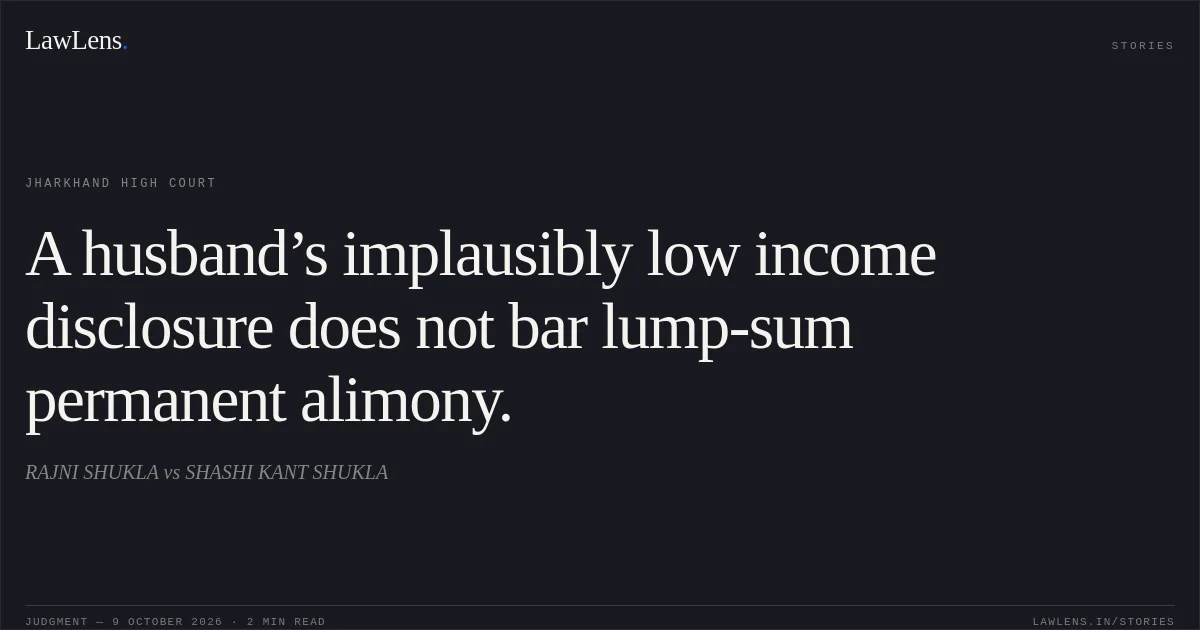
Source reference: para. 56–64The husband disclosed monthly income of ₹10,500 from his mobile sales and repair business; the wife disputed this and asserted that he earned over ₹1.5 lakh monthly and owned property generating additional income.
Source reference: para. 56–64Issues
1. Whether, in light of the parties’ circumstances and financial disclosures, the wife and minor daughter were entitled to permanent alimony and, if so, what amount would be just and reasonable
Source reference: para. 37–382. Whether the husband’s disclosed income of ₹10,500 per month could be accepted when determining his capacity to pay
Source reference: para. 56–65Law Applied
Section 25 of the Hindu Marriage Act, 1955 empowers a court exercising jurisdiction under the Act to award permanent alimony, having regard to the parties’ income and property, their conduct, and the circumstances of the case.
Source reference: para. 38Under Kalyan Dey Chowdhury v. Rita Dey Chowdhury, an order for permanent alimony may be varied where circumstances change.
Source reference: para. 42Vinny Parmvir Parmar v. Parmvir Parmar and U. Sree v. U. Srinivas establish that there is no fixed formula: the court must consider the parties’ status and needs, the applicant’s resources, the paying spouse’s capacity and obligations, and the standard of living during the marriage.
Source reference: para. 44–45Under Rajnesh v. Neha, maintenance should prevent destitution, and courts must assess the parties’ status, the needs of the spouse and dependent children, available income, and the respondent’s actual income, expenses and liabilities.
Source reference: para. 46Reasoning
The Court did not resolve the wife’s challenge to service of notice or set aside the divorce decree; after the husband unequivocally declined reconciliation, it proceeded to determine alimony.
Source reference: para. 35–37It found the husband’s declared income implausible given his established, air-conditioned shop in a market area, its staff and equipment, and the undisputed photographs.
Source reference: para. 60–64Although those materials did not establish an exact income, the husband had not supplied tax returns, bank statements or stock invoices to substantiate his disclosure.
Source reference: para. 60–64Taking account of the wife’s lack of independent income, the daughter’s needs and the husband’s apparent capacity to pay, the Court considered a lump-sum award appropriate.
Source reference: para. 65–68Holding
The Court modified the Family Court’s judgment and decree only to the extent of awarding ₹25 lakh as one-time permanent alimony for the wife and the minor daughter.
The amount was payable in four equal instalments within one year, with the first instalment due within two months of the judgment.
Source reference: para. 69–73The wife was granted liberty to seek recourse in accordance with law if payment was not made.
Source reference: para. 69–73The appeal was disposed of on those terms; the divorce decree was otherwise left undisturbed.
Source reference: para. 70Acts & Sections Cited
7 provisions across 4 statutes referred to in this judgment. Each provision opens on LawLens.
Family Courts Act, 19841
Hindu Marriage Act, 19554
Special Marriage Act, 19541
Code of Criminal Procedure, 19731
Original Court PDF
RAJNI SHUKLAvsSHASHI KANT SHUKLA
Click to open original judgment
Original judgment, available to read, download and summarize on LawLens.in