Facts
Rinku Devi was alleged to have been travelling by train with a valid second-class ticket when she fell from a moving train between Salanpur and Rupnarayan railway stations and died.
Source reference: p. 2The Railway Claims Tribunal dismissed her family’s claim under Section 124A of the Railways Act, 1989, finding that they had not proved either that she fell from a train or that she was a bona fide passenger.
Source reference: p. 2On appeal, the family relied on the railway ticket, police records and post-mortem report; the Railways disputed recovery of the ticket and argued that there was no eyewitness to the fall.
Source reference: pp. 3–5Issues
1. Whether the evidence established, on a balance of probabilities, that the deceased died in an untoward incident involving a fall from a train.
Source reference: pp. 5–72. Whether the deceased was a bona fide passenger holding a valid journey ticket, entitling the applicants to compensation under Section 124A of the Railways Act, 1989.
Source reference: pp. 6–7Law Applied
The Court applied Section 124A of the Railways Act, 1989, in considering the claim for compensation arising from an alleged untoward incident.
Source reference: pp. 1, 7–8It stated that railway compensation legislation is beneficial and that the claim need not be proved beyond reasonable doubt; the evidence is to be assessed on the touchstone of preponderance of probabilities.
Source reference: p. 5The Court also observed that, where eyewitness evidence is unlikely to be available, police and railway records may be relied upon to determine whether an incident occurred.
Source reference: p. 5Although counsel cited several decisions, the judgment does not expressly set out or apply their specific legal tests.
Source reference: pp. 3–5Reasoning
The Court considered the deceased’s body having been found beside the railway track, the inquest and police final report, and the husband’s evidence that the deceased had travelled by train with their daughter.
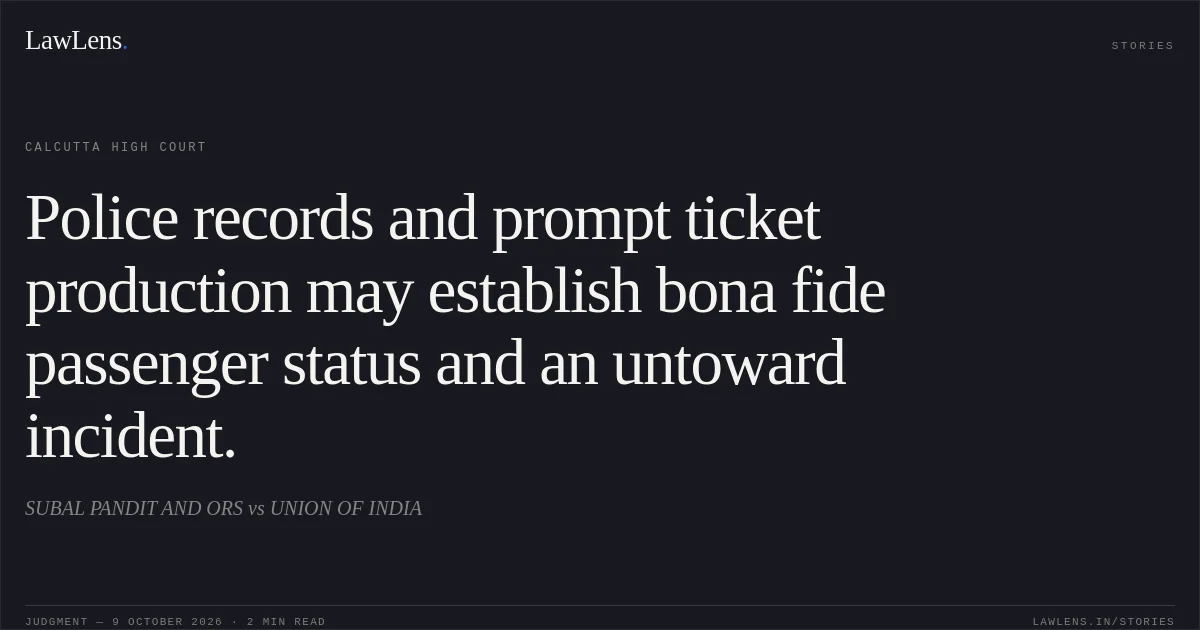
Source reference: pp. 5–7It found that the ticket had been handed to the police on the day of the incident and that the husband’s evidence about the ticket being kept in the daughter’s bag was not shaken in cross-examination; the allegation that the ticket was planted was therefore not accepted.
Source reference: pp. 6–7The Court also faulted the railway enquiry for not properly considering the police report and the husband’s account.
Source reference: pp. 5–7Taken together, the evidence established the incident and the deceased’s bona fide passenger status on a preponderance of probabilities.
Source reference: pp. 5–7Holding
The Court allowed the appeal and set aside the Tribunal’s dismissal.
It held the applicants entitled to compensation of ₹8,00,000, with interest at 6% per annum from the date of filing the claim until the date of judgment.
Source reference: p. 8The Railway Authority was directed to deposit the amount and interest with the Registrar General of the High Court within eight weeks of communication of the order, after which the applicants could withdraw it upon completing the necessary formalities.
Source reference: p. 8Acts & Sections Cited
1 provisions across 1 statute referred to in this judgment. Each provision opens on LawLens.
Code of Criminal Procedure, 19731
Original Court PDF
SUBAL PANDIT AND ORSvsUNION OF INDIA
Click to open original judgment
Original judgment, available to read, download and summarize on LawLens.in