Facts
The appellant claimed title to the suit property under a Will dated 5 December 2003 allegedly executed by Deivanayagam Naidu.
Source reference: no citationIn two suits, he sought declaration of title and permanent injunction; a competing claimant relied on an earlier Will dated 20 January 1992.
Source reference: no citationA tenant separately sought an injunction against interference with his possession.
Source reference: no citationAfter a joint trial, the trial court dismissed the appellant’s title suits and decreed the tenant’s injunction suit; the first appellate court affirmed those decrees.
Source reference: no citationThe appellant brought three second appeals.
Source reference: p. 4–13The High Court dismissed the appeals, while setting aside the lower courts’ findings on the 1992 Will as unnecessary in the absence of all legal representatives.
Source reference: p. 23–25Issues
1. Whether the appellant proved the Will dated 5 December 2003 and thereby established his entitlement to declaration of title and consequential injunction.
Source reference: p. 18–232. Whether the courts below’ concurrent findings in the title suits disclosed a substantial question of law warranting interference under Section 100 CPC.
Source reference: p. 19–253. Whether the tenant, whose tenancy and possession were admitted, was entitled to protection against eviction otherwise than through due process of law.
Source reference: p. 24Law Applied
Under Section 100 CPC, a second appeal lies only where a substantial question of law is involved; concurrent factual findings supported by the record are not ordinarily disturbed absent such a question.
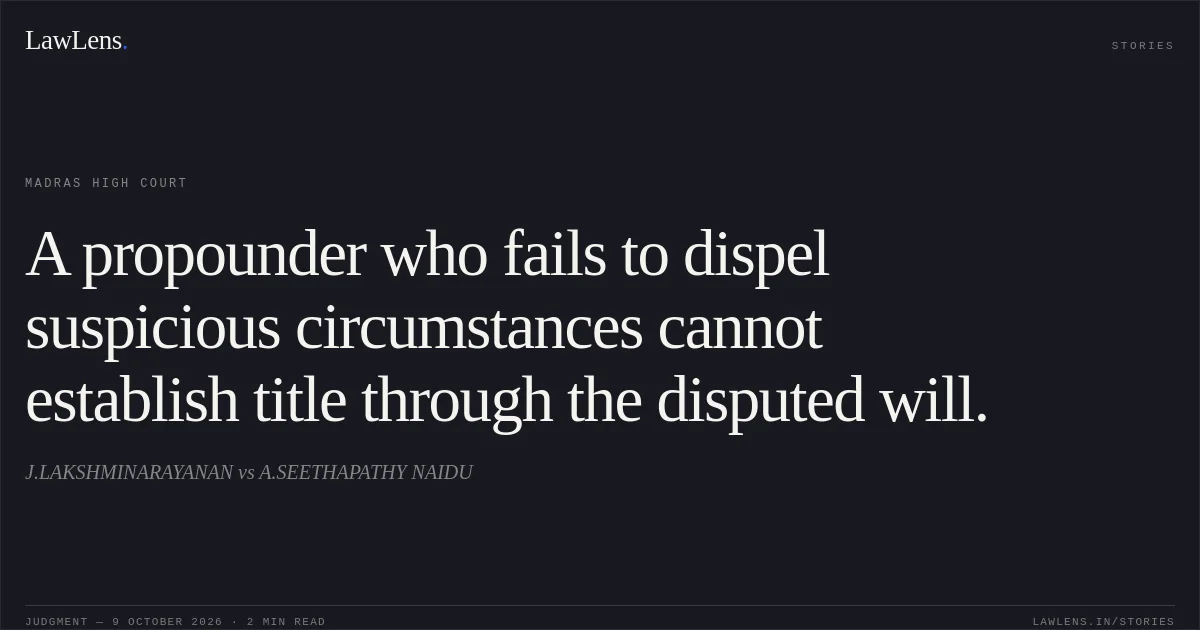
Source reference: no citationThe Court stated that a Will’s propounder must prove it by examining an attesting witness and dispelling suspicious circumstances.
Source reference: p. 22The judgment does not cite the specific statutory provisions governing execution and proof of Wills or any precedents.
Source reference: no citationIt also applied the principle that a tenant in possession cannot be evicted except through due process of law.
Source reference: p. 24Reasoning
The Court found that the 2003 Will was surrounded by unresolved suspicious circumstances: the attestors were close to the appellant but could not speak to the testator’s family background; no adequate explanation was given for the Will’s non-registration; the appellant failed to prove the family relationship on which his claim partly rested; and the pleadings and Will differed as to the testator’s son.
Source reference: p. 19–22, 24–25The evidence also did not establish that the appellant had cared for the testator.
Source reference: p. 19–22, 24–25These deficiencies meant the appellant had not proved the Will, and the concurrent findings against his title claim disclosed no substantial question of law.
Source reference: p. 19–22, 24–25The Court declined to determine the validity of the 1992 Will because all the testator’s legal representatives were not before it.
Source reference: p. 23–24As the tenant’s possession and tenancy were admitted, the Court upheld protection against eviction without due process.
Source reference: p. 24Holding
The High Court dismissed all three second appeals and made no order as to costs.
It left intact the dismissal of the appellant’s declaration suits and the decree protecting the tenant from eviction without due process, but set aside the lower courts’ findings on the validity of the 20 January 1992 Will.
Source reference: p. 23–25Acts & Sections Cited
1 provisions across 1 statute referred to in this judgment. Each provision opens on LawLens.
Code of Civil Procedure, 19081
Original Court PDF
J.LAKSHMINARAYANANvsA.SEETHAPATHY NAIDU
Click to open original judgment
Original judgment, available to read, download and summarize on LawLens.in