Facts
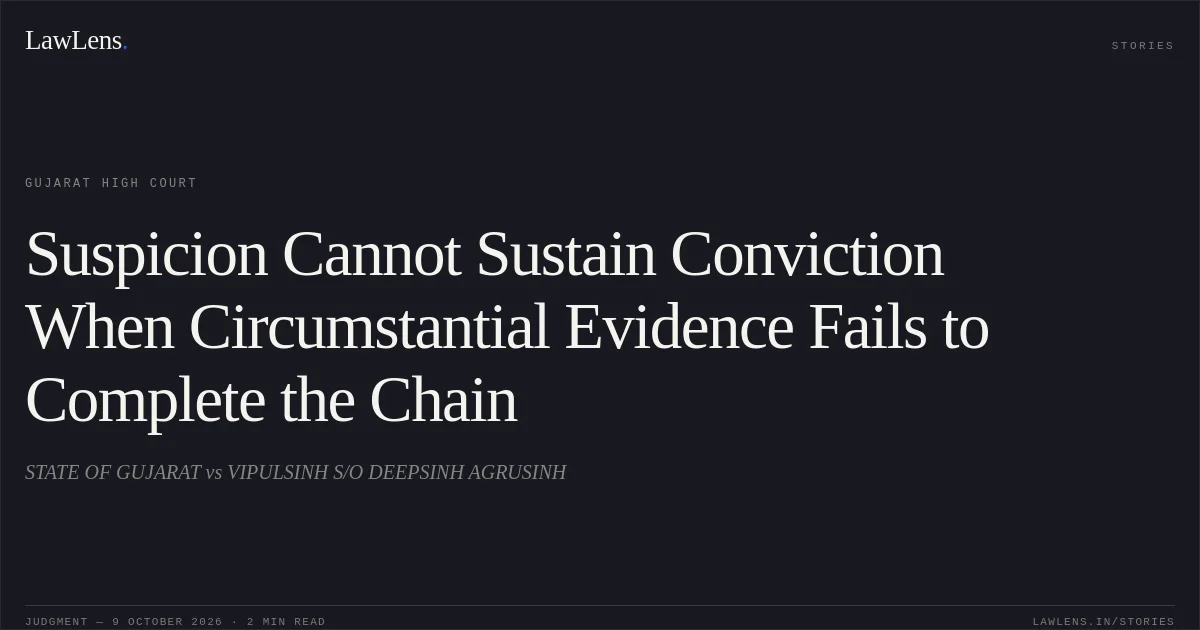
The accused was tried for the rape and murder of his minor fiancée, whose body was found in a farm on 9 July 2022. The prosecution relied principally on call-detail records, forensic evidence, the accused’s alleged pointing out of the place of occurrence, and a history he allegedly gave to a doctor while in police custody.
Source reference: pp. 1–2, 9–10The Sessions Court acquitted the accused, finding that the circumstantial evidence did not establish a complete chain pointing to his guilt. The State appealed under Section 419 of the BNSS, corresponding to Section 378 of the CrPC.
Source reference: pp. 1, 3–4Issues
Whether the prosecution evidence established a complete chain of circumstances proving that the accused committed the rape and murder.
Source reference: pp. 5, 8–10Whether the Trial Court’s acquittal was perverse or otherwise warranted appellate interference.
Source reference: pp. 5–6, 11Law Applied
Section 419 of the BNSS (corresponding to Section 378 of the CrPC) permits an appeal against acquittal, but an appellate court should respect the reinforced presumption of innocence and interfere where compelling circumstances show that the acquittal is perverse; it should not interfere merely because another view is possible.
Source reference: p. 6Under Sharad Birdhichand Sarda v. State of Maharashtra, the circumstances relied upon must be fully established, consistent only with guilt, conclusive, exclude every reasonable hypothesis of innocence, and form a complete chain showing that the accused committed the act.
Source reference: pp. 6–7Suspicion, however strong, cannot substitute for proof beyond reasonable doubt.
Source reference: p. 7Section 27 of the Evidence Act makes admissible only the portion of information that distinctly relates to a fact discovered, while Sections 25 and 26 bar proof of a confession made to police or while in police custody, subject to the statutory discovery exception.
Source reference: pp. 9–10Reasoning
The Court found no reliable evidence of the alleged motive: the deceased’s relatives described the relationship as cordial and expressed no suspicion of the accused.
Source reference: p. 8The call records established contact between the accused and deceased but did not show that he summoned her to the scene or establish a motive.
Source reference: p. 9The forensic material, without DNA analysis, did not reliably establish that the accused had intercourse with the deceased.
Source reference: p. 9The alleged discovery was also unreliable: the panch and investigating officer did not establish a qualifying disclosure, and police had already visited the scene, so no relevant fact was discovered as a consequence of the statement.
Source reference: pp. 9–10Finally, the alleged admission to the doctor was recorded in police presence, after the police yadi had attributed a role to the accused, and was therefore not admissible as a voluntary confession. These deficiencies left gaps in the circumstantial chain; the Trial Court’s view was consequently plausible and not perverse.
Source reference: pp. 10–11Holding
The Court held that the prosecution had not proved the circumstances necessary to establish the accused’s guilt beyond reasonable doubt and that the Trial Court was justified in acquitting him.
Finding no perversity warranting interference, the High Court dismissed the State’s appeal at the admission stage.
Source reference: p. 11Acts & Sections Cited
8 provisions across 4 statutes referred to in this judgment. Each provision opens on LawLens.
Bharatiya Nagarik Suraksha Sanhita, 20231
Code of Criminal Procedure, 19732
Indian Penal Code, 18602
Original Court PDF
STATE OF GUJARATvsVIPULSINH S/O DEEPSINH AGRUSINH
Click to open original judgment
Original judgment, available to read, download and summarize on LawLens.in