Facts
A land dispute between the complainant’s family and Jawahar Gopal and Sheela Gopal led to a civil suit in which the trial court granted a temporary injunction and directed police implementation.
Source reference: para. 3The order was later affirmed in an appeal before the High Court.
Source reference: para. 3In connected writ petitions, the High Court directed the police to ensure obedience to the civil court’s order and, if they encountered difficulty, to follow the procedure in the DGP’s Circular dated 14 November 2018, including seeking the Director of Prosecution’s opinion and placing it before the civil court.
Source reference: para. 3The complainant alleged that the Whitefield Police Inspector had wilfully disobeyed that direction by allowing interference with his possession.
Source reference: para. 3The Inspector filed an affidavit describing steps taken to implement the civil court’s order and to obtain legal opinions.
Source reference: paras. 5–6Issues
Whether the Police Inspector wilfully disobeyed the High Court’s order dated 25 September 2025, so as to constitute civil contempt under Section 2(b) of the Contempt of Courts Act, 1971.
Source reference: paras. 4, 9Whether the complainant established entitlement to the further reliefs sought, including police protection and action against alleged trespassers.
Source reference: para. 8Law Applied
Section 2(b) of the Contempt of Courts Act, 1971 defines civil contempt as wilful disobedience of a court’s judgment, decree, direction, order, writ or other process, or wilful breach of an undertaking to a court.
Source reference: para. 4The writ court’s direction required the police to ensure obedience to the civil court’s order and, if they faced difficulty enforcing it, to follow the procedure in the DGP’s Circular dated 14 November 2018, including seeking the Director of Prosecution’s opinion and placing it before the civil court.
Source reference: para. 3Contempt therefore required proof of wilful disobedience, assessed in light of the alleged contemnor’s conduct and compliance with the court’s direction.
Source reference: paras. 4, 9Reasoning
The Court considered the Inspector’s affidavit and supporting documents, which recorded his inspection of the property, service of the civil court’s order on a security supervisor, and subsequent steps to obtain legal opinions through the prescribed channels.
Source reference: paras. 5–6The complainant did not dispute the affidavit’s contents or annexures, although he argued that the reported compliance was merely a pretext.
Source reference: para. 7The Court found that the Inspector had exercised due diligence and followed the procedure contemplated by the 2018 Circular after encountering difficulty in enforcing the civil court’s order; the complainant’s reliance on the trial court’s observations did not establish wilful disobedience of the writ court’s order.
Source reference: paras. 6, 8–9The Court also considered Prayer No. 2 vague.
Source reference: para. 8Holding
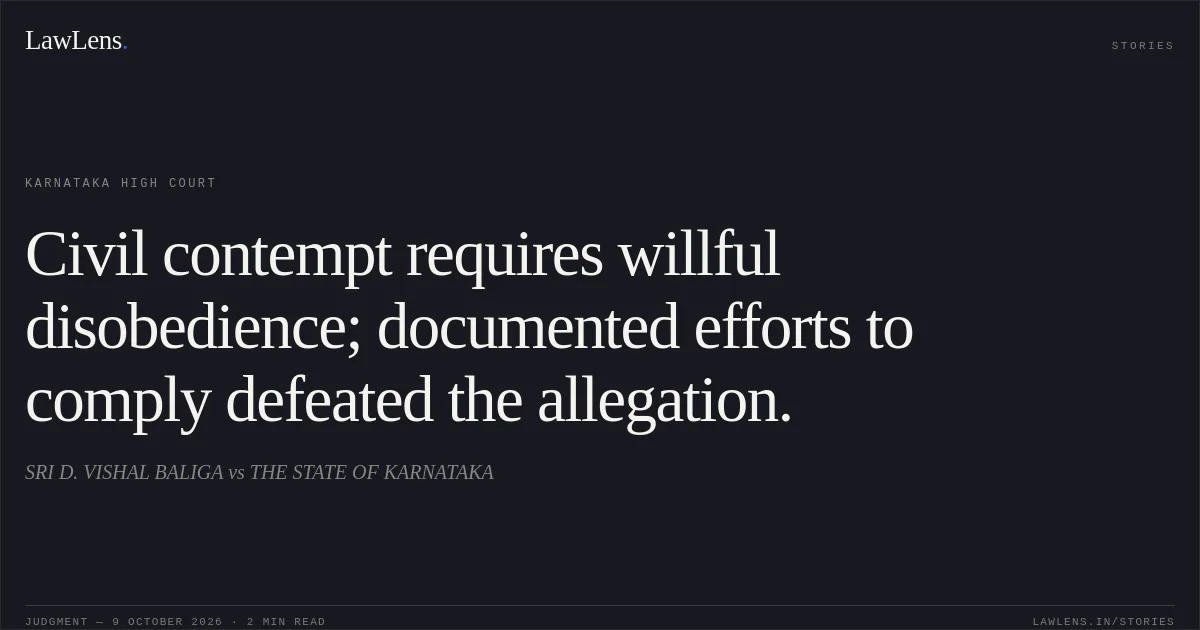
The Court held that the complainant had failed to establish wilful disobedience by the Inspector and therefore had not made out a case of civil contempt.
The contempt petition was consigned; the requested reliefs were not granted.
Source reference: paras. 8, 10Acts & Sections Cited
3 provisions across 1 statute referred to in this judgment. Each provision opens on LawLens.
Contempt of Courts Act, 19713
Original Court PDF
SRI D. VISHAL BALIGAvsTHE STATE OF KARNATAKA
Click to open original judgment
Original judgment, available to read, download and summarize on LawLens.in