Facts
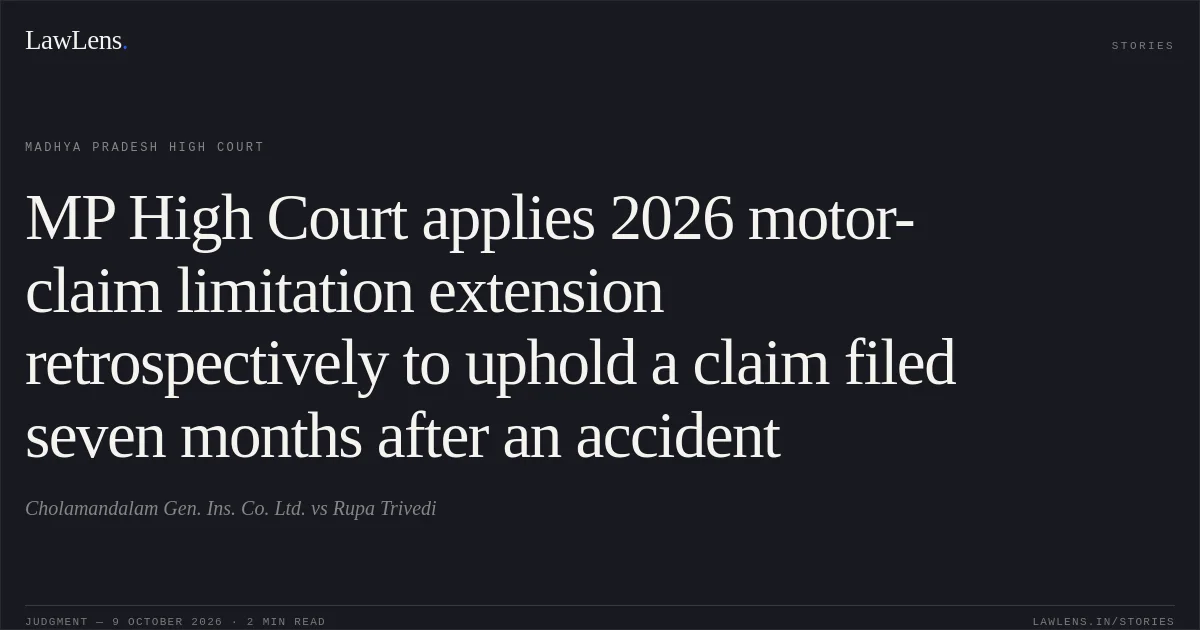
The claimant’s accident occurred on 7 November 2022, and she filed her compensation claim on 12 June 2023.
Source reference: para. 1The First Additional Motor Accident Claims Tribunal, Sehore, allowed the claim by award dated 10 February 2024.
Source reference: para. 1The insurer appealed under Section 173(1) of the Motor Vehicles Act, 1988, arguing that the claim was filed more than six months after the accident and was therefore time-barred under Section 166(3).
Source reference: para. 1During the appeal, the Court considered a Gazette notification dated 24 July 2026 providing that a Claims Tribunal may entertain a claim filed after six months, but within a further period not exceeding twelve months, where sufficient cause prevented timely filing.
Source reference: para. 2Issues
Whether the Tribunal could entertain the claim filed more than six months after the accident, given the subsequent amendment permitting an extension in specified circumstances.
Source reference: para. 1–3Whether the amendment could apply retrospectively to a claim filed before the notification was issued.
Source reference: para. 3, 5Law Applied
Section 166(3) of the Motor Vehicles Act prescribes a six-month period for filing a claim, subject to the proviso in the Gazette notification of 24 July 2026, which permits the Tribunal to entertain a claim after that period but within a further period not exceeding twelve months if sufficient cause is shown.
Source reference: para. 1–2The Court treated the amendment as beneficial legislation capable of retrospective application.
Source reference: para. 3, 5It relied on New India Assurance Co. Ltd. v. C. Padma, (2003) 7 SCC 713, which held that motor-accident compensation legislation is beneficial and that limitation rules should not defeat genuine claims contrary to legislative intent; that decision also discussed Section 6-A of the General Clauses Act and Article 137 of the Limitation Act.
Source reference: para. 4The Court also referred to Dhannalal v. D.P. Vijayvargiya, (1996) 4 SCC 652, concerning the legislative purpose behind removing the limitation bar in Section 166(3).
Source reference: para. 4Reasoning
The Court held that the 2026 amendment was beneficial and should apply to the pending matter.
Source reference: para. 3, 5Since the claim was filed within one year of the accident, it fell within the additional period contemplated by the proviso; the Court therefore found that the Tribunal’s award could not be characterised as arbitrary or illegal.
Source reference: para. 3, 5Applying the reasoning in C. Padma, it considered that genuine claims should not fail on technical grounds of limitation.
Source reference: para. 4–5The Court did not separately record a finding on sufficient cause, but left the outcome subject to any contrary determination by the Supreme Court in a matter stated to be pending before it.
Source reference: para. 6Holding
The High Court disposed of the insurer’s appeal and directed that the Claims Tribunal’s record be returned.
It observed that if the Supreme Court were to hold that the six-month limitation is mandatory, the insurer would be at liberty to apply for revival of the appeal.
Source reference: para. 6Acts & Sections Cited
4 provisions across 3 statutes referred to in this judgment. Each provision opens on LawLens.
Motor Vehicles Act, 19882
General Clauses Act, 18971
Limitation Act, 19631
Original Court PDF
Cholamandalam Gen. Ins. Co. Ltd.vsRupa Trivedi
Click to open original judgment
Original judgment, available to read, download and summarize on LawLens.in