Facts
The prosecutrix alleged that, during the night of 13–14 January 2007, her neighbour Rajesh Kumar entered her room and raped her.
Source reference: pp. 1–4; paras. 2–5, 12–15, 20–27Her police statement identified the appellant; she also identified him and described the assault in her examination-in-chief.
Source reference: pp. 1–4; paras. 2–5, 12–15, 20–27In cross-examination, however, she denied the prosecution’s account and alleged that her police statement had been made under pressure. Her mother-in-law and husband likewise resiled from their earlier accounts.
Source reference: pp. 1–4; paras. 2–5, 12–15, 20–27The prosecution relied on medical evidence recording injuries to the prosecutrix and an abrasion on the appellant, broken bangles and blood at the scene, and forensic evidence detecting semen on the prosecutrix’s clothing and vaginal slides; the semen on her clothing was reported as Group A, as was the appellant’s blood group.
Source reference: pp. 1–4; 5–8; paras. 2–5, 12–15, 20–27The Trial Court convicted the appellant under Section 376 IPC and sentenced him to seven years’ rigorous imprisonment and a fine. He appealed, principally arguing that the public witnesses’ retraction required acquittal.
Source reference: pp. 2–3; paras. 5–6Issues
1. Whether the prosecution proved that the charged incident of rape took place.
Source reference: p. 4; para. 11(i)2. Whether the appellant was the person who committed the offence.
Source reference: p. 4; para. 11(ii)Law Applied
The appellant was convicted under Section 376 of the Indian Penal Code, 1860; Section 428 of the Code of Criminal Procedure, 1973, was applied to the sentence for set-off.
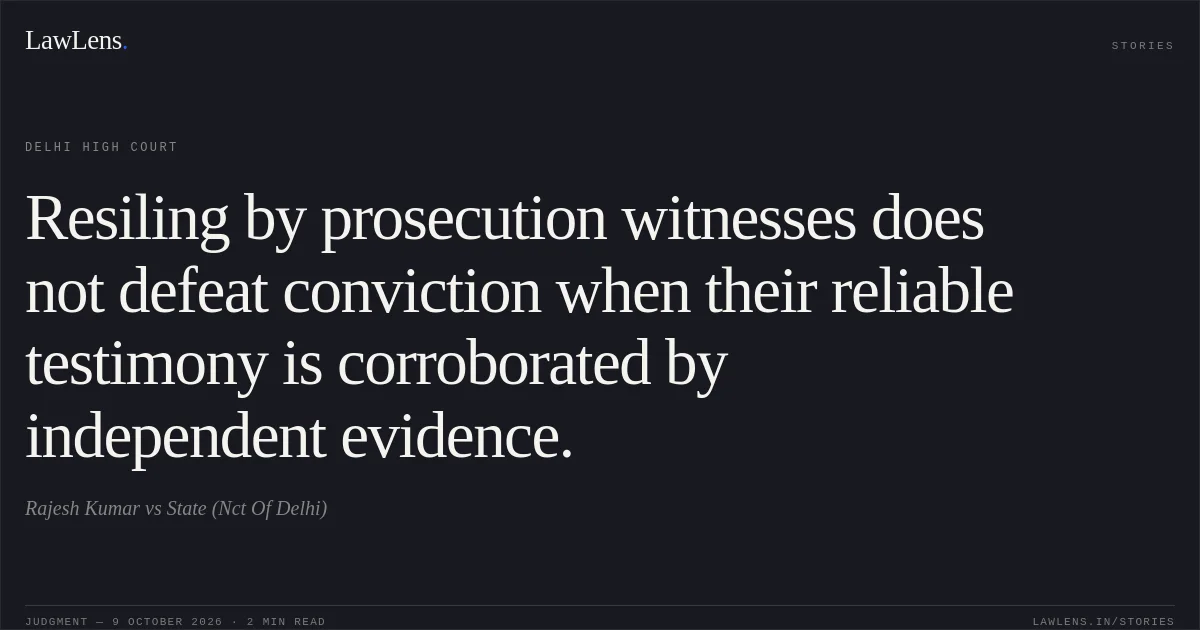
Source reference: pp. 2–3, 11; paras. 5, 35The Court applied the principles that a prosecutrix’s credible and reliable testimony may, by itself, sustain a conviction, and that a hostile witness’s evidence is not erased from the record: the court may rely on the portion that is credible and corroborated.
Source reference: pp. 5, 9–10; paras. 16–17, 29–30The maxim falsus in uno, falsus in omnibus is not a rigid rule in Indian criminal law; the court must separate reliable evidence from unreliable evidence and assess whether the reliable residue proves guilt.
Source reference: pp. 5, 9–10; paras. 16–17, 29–30The Court referred to Bhajju v. State of Madhya Pradesh, (2012) 4 SCC 327, K.P. Tamilmaran v. State, 2025 SCC OnLine SC 958, and Selvamani v. State, 2024 19 SCC 112, on evaluating hostile-witness testimony and the effect of a gap between examination-in-chief and cross-examination.
Source reference: pp. 9–11; paras. 30, 32–34Reasoning
The Court treated the prosecutrix’s examination-in-chief—where she named and identified the appellant and described the assault—as the reliable core of her evidence.
Source reference: pp. 5–6; paras. 12–15It regarded her later retraction, including the allegation of police pressure first raised in cross-examination after a gap of about three months, as insufficient to displace that account.
Source reference: pp. 5–6; paras. 12–15The Court found corroboration in the mother-in-law’s evidence that she heard cries and went to the room, the husband’s initial account of the disclosure and the condition of the clothes and bangles, and the medical, forensic and scene evidence.
Source reference: pp. 6–8; paras. 19–27Considering these circumstances cumulatively, rather than treating the witnesses’ retractions as automatically nullifying their earlier testimony, the Court held that the reliable evidence proved the prosecution case beyond reasonable doubt.
Source reference: pp. 8–11; paras. 28–34Holding
The Court answered both issues in the prosecution’s favour, upheld the conviction and dismissed the appeal as meritless.
It directed the appellant to surrender forthwith to serve the remainder of his sentence and confirmed his entitlement to set-off under Section 428 CrPC.
Source reference: p. 11; para. 35Acts & Sections Cited
5 provisions across 2 statutes referred to in this judgment. Each provision opens on LawLens.
Indian Penal Code, 18601
Code of Criminal Procedure, 19734
Original Court PDF
Rajesh KumarvsState (Nct Of Delhi)
Click to open original judgment
Original judgment, available to read, download and summarize on LawLens.in