Facts
The petitioner challenged the punishment order dated 02.05.2015, by which the same punishment imposed upon similarly situated employees was imposed on him, and sought restoration of increments, salary and allowances for the suspension period, and consequential revision of pay and pension.
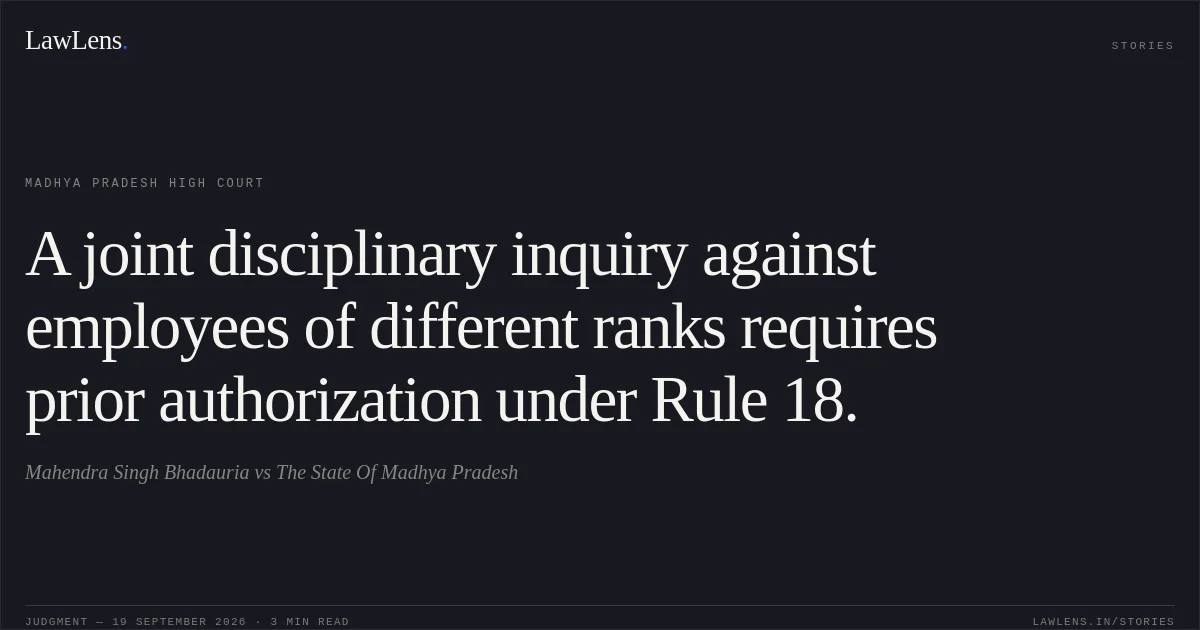
Source reference: para. 2He submitted that the controversy was covered by the judgment dated 06.08.2026 in Dinesh Chandra Mudiya v. State of Madhya Pradesh, W.P. No. 45799 of 2025, where an identical punishment order had been quashed because a joint departmental enquiry was conducted without compliance with Rule 18 of the Madhya Pradesh Civil Services (Classification, Control and Appeal) Rules, 1966 (“CCA Rules”).
Source reference: para. 2The State opposed the petition but was unable to distinguish the petitioner’s case from Dinesh Chandra Mudiya.
Source reference: para. 3The Court accordingly considered the present case on the basis that its facts and circumstances were similar to that precedent.
Source reference: paras. 4–6Issues
Whether the petitioner’s punishment order dated 02.05.2015 was legally sustainable when it arose from a joint departmental enquiry allegedly conducted without an order under Rule 18 of the CCA Rules.
Source reference: paras. 5–7Whether the writ petition was liable to be dismissed on the ground of delay and laches, notwithstanding the continuing effect of withholding increments with cumulative effect on the petitioner’s salary and pension.
Source reference: paras. 8–9Whether the petitioner was entitled to consequential service, monetary and retiral benefits upon quashing of the punishment order.
Source reference: paras. 10–11Law Applied
Rule 18 of the Madhya Pradesh Civil Services (Classification, Control and Appeal) Rules, 1966 requires the Governor or the competent authority empowered to impose the penalty of dismissal on all concerned employees to pass an order authorising common proceedings where two or more Government servants are proceeded against jointly.
Source reference: para. 6A joint enquiry involving employees holding different ranks without such statutory authorisation is vitiated, and the punishment imposed pursuant to it cannot be sustained.
Source reference: para. 6The Court further relied on Pankaj Yadav v. State of Madhya Pradesh, W.A. No. 117 of 2015, for the principle that withholding increments with cumulative effect produces continuing consequences in salary and pension and therefore gives rise to a recurring cause of action, limiting the objection of delay and laches.
Source reference: para. 8The doctrine of mutatis mutandis application permits the relief granted in an identical case to be extended to a similarly situated petitioner.
Source reference: paras. 5–6Reasoning
The Court found that the petitioner’s case was indistinguishable from Dinesh Chandra Mudiya, in which the punishment imposed pursuant to a common departmental enquiry had been quashed for non-compliance with Rule 18 of the CCA Rules.
Source reference: paras. 5–7The underlying judgments in C.M. Mishra and Arun Kumar Dixit established that, where employees of different ranks are proceeded against jointly, a specific order authorising common proceedings is mandatory; failure to obtain such authorisation vitiates the enquiry and the consequential punishment.
Source reference: paras. 6–7Since the State could not distinguish the petitioner’s case or show compliance with Rule 18, the Court applied the earlier judgment mutatis mutandis.
Source reference: paras. 5–6The Court also rejected the objection of delay and laches because the cumulative withholding of increments continued to affect the petitioner’s salary and pension, constituting a recurring cause of action.
Source reference: paras. 8–9Holding
The Court disposed of the petition in terms of the judgment dated 06.08.2026 in Dinesh Chandra Mudiya, applying that decision mutatis mutandis.
Consequently, the punishment order dated 02.05.2015, insofar as it concerned the petitioner, and the appellate order affirming it were quashed and set aside.
Source reference: para. 10The respondents were directed to extend all consequential service and monetary benefits, issue a revised PPO/GPO, and revise the petitioner’s pension and other retiral benefits within four months of receiving the certified copy of the order.
Source reference: para. 11If the exercise was not completed within that period, interest at 6% per annum on the delayed monetary benefits would be payable from the date of filing of the petition until actual payment.
Source reference: para. 11Acts & Sections Cited
1 provisions across 1 statute referred to in this judgment. Linked provisions open on LawLens.
M.P. Uchcha Nyayalaya (Khand Nyayapeeth Ko Appeal) Adhiniyam, 20051
Original Court PDF
Mahendra Singh BhadauriavsThe State Of Madhya Pradesh
Click to open original judgment
Original judgment, available to read, download and summarize on LawLens.in