Facts
The Plaintiff, a proprietorship involved in the iron trade, filed a suit for recovery of ₹4,50,38,414.75/- against the Defendant for goods supplied between 2016 and 2017
Source reference: p. 1-2After failing to resolve the matter through Pre-Litigation Mediation under Section 12A of the Commercial Courts Act, the Plaintiff filed the suit in the Delhi High Court on July 13, 2022
Source reference: p. 2The Defendant filed an application under Order VII Rule 11 of the CPC (interpreted by the court as Order VII Rule 10) seeking rejection or return of the plaint.
Source reference: p. 3The Defendant argued that the Delhi High Court lacks territorial jurisdiction because the invoices raised by the Plaintiff explicitly stated "subject to the Faridabad jurisdiction"
Source reference: p. 3Issues
1. Whether the inclusion of a jurisdiction clause in invoices ("subject to Faridabad jurisdiction"), without the use of words like "only" or "exclusive," results in the exclusion of the jurisdiction of other courts
Source reference: p. 7 / para. 112. Whether the plaint should be returned to the Plaintiff for filing before the competent court under Order VII Rule 10 of the CPC due to lack of territorial jurisdiction
Source reference: p. 8 / para. 12Law Applied
While parties cannot confer jurisdiction on a court that inherently lacks it, they may by agreement confine disputes to one of multiple courts that possesses concurrent jurisdiction
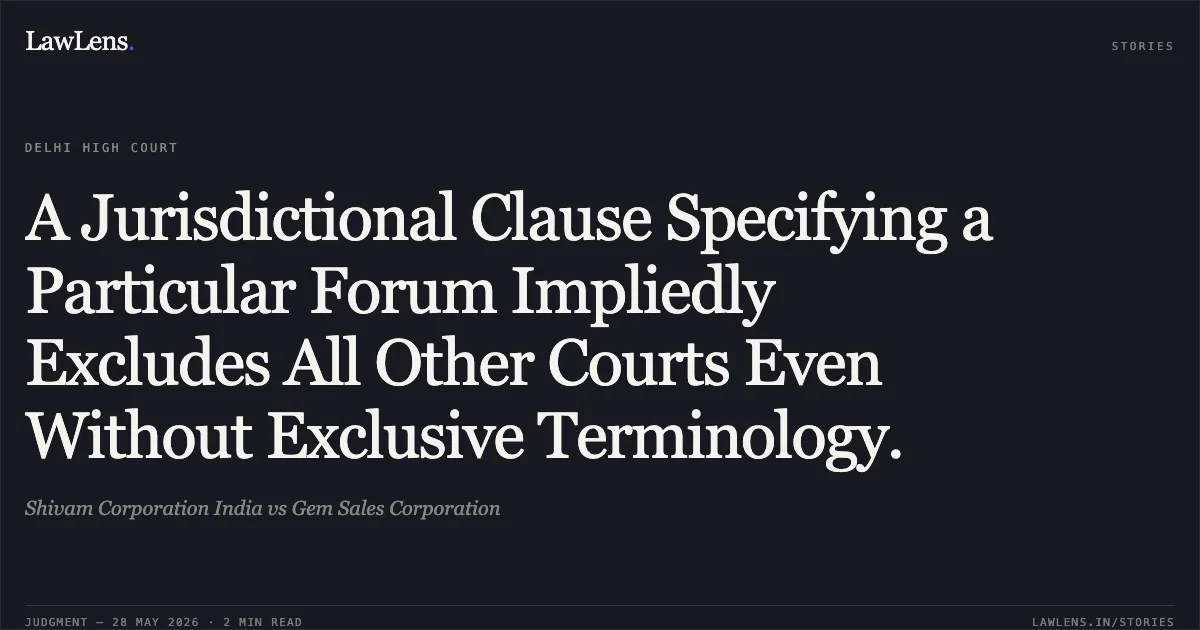
Source reference: p. 3-4The doctrine of expressio unius est exclusio alterius (the expression of one is the exclusion of another) as established in Swastik Gases (P) Ltd. v. Indian Oil Corpn. Ltd. and reaffirmed in EXL Careers v. Frankfinn Aviation Services (P) Ltd., which holds that specifying a particular jurisdiction in a contract implies the exclusion of all other courts, even in the absence of words like "exclusive" or "only"
Source reference: p. 5-7Reasoning
The Court observed that the Defendant raised the jurisdictional objection at the earliest opportunity in the Written Statement
Source reference: p. 3Upon reviewing the invoices, the Court found that the parties had mutually agreed to the jurisdiction of the Faridabad courts
Source reference: p. 3Applying the precedent from Swastik Gases, the Court rejected the Plaintiff's argument that the absence of terms like "exclusive" or "alone" left the jurisdiction open to Delhi
Source reference: p. 7The Court reasoned that since Faridabad courts inherently possessed jurisdiction to entertain the suit, the contractual stipulation served to restrict the adjudication to that specific forum
Source reference: p. 7Holding
The Court held that it lacked territorial jurisdiction to entertain the suit as the parties had restricted jurisdiction to Faridabad via the invoices
The Court ordered the return of the plaint to the Plaintiff for filing before the court of competent jurisdiction in Faridabad and disposed of the suit and all pending applications accordingly
Source reference: p. 8Acts & Sections Cited
4 provisions across 3 statutes referred to in this judgment. Each provision opens on LawLens.
Code of Civil Procedure, 19081
Suits Valuation Act, 18871
Indian Contract Act, 18722
Original Court PDF
Shivam Corporation IndiavsGem Sales Corporation
Click to open original judgment
Original judgment, available to read, download and summarize on LawLens.in