Facts
The juvenile applicant was apprehended with a co-accused while transporting 23.300 kg of ganja on a scooty and was charged under Section 20(b) of the Narcotic Drugs and Psychotropic Substances Act, 1985.
Source reference: para. 2The Juvenile Justice Board rejected his bail application under Section 12 of the Juvenile Justice (Care and Protection of Children) Act, 2015 (“JJ Act”), and the appellate court affirmed that decision.
Source reference: paras. 1–2In revision, the applicant relied on his first involvement in conflict with law, the absence of any contraband seized from his possession, and the potential adverse effect of continued placement in the Observation Home; the State opposed release but accepted that the social status report was not adverse.
Source reference: paras. 3–4Issues
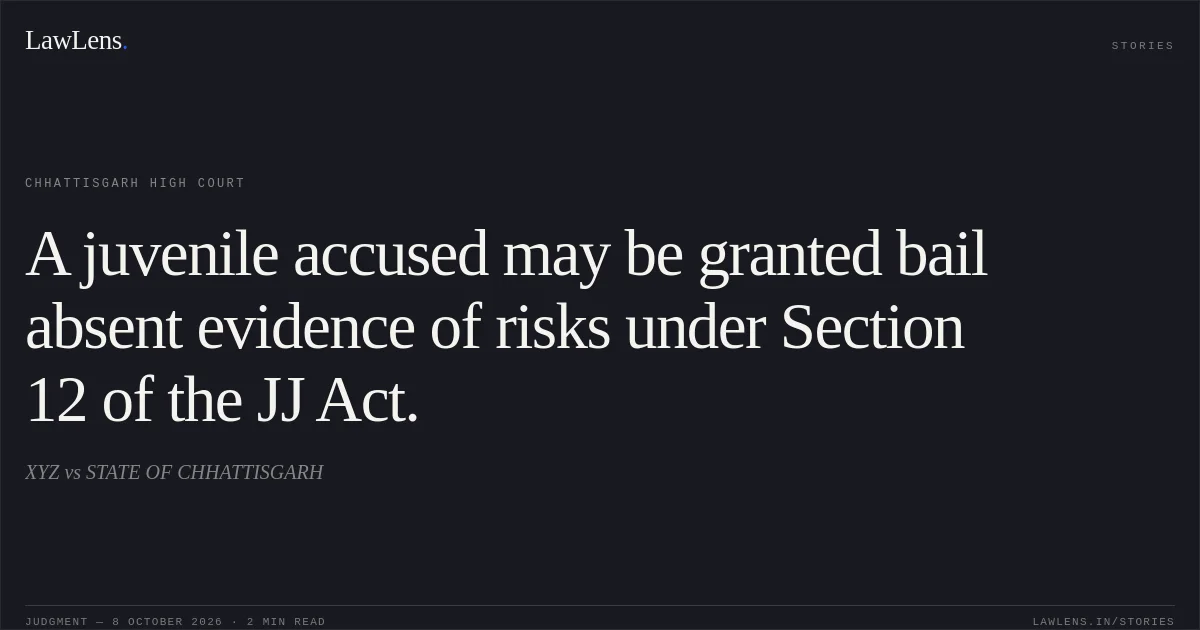
1. Whether the applicant’s release on bail was barred by the exceptions to the general rule under Section 12 of the JJ Act.
Source reference: paras. 1, 62. Whether the orders refusing bail should be set aside in revision under Section 102 of the JJ Act.
Source reference: paras. 1, 7Law Applied
Section 12 of the JJ Act governs bail for a child alleged to be in conflict with law. The court’s reasoning reflects the statutory rule that bail should be granted unless there are reasonable grounds for believing that release would bring the child into association with a known criminal, expose the child to moral, physical or psychological danger, or defeat the ends of justice.
Source reference: paras. 1, 6Section 102 of the JJ Act provides the revisional jurisdiction invoked to challenge the appellate order.
Source reference: para. 1The alleged offence was under Section 20(b) of the NDPS Act.
Source reference: para. 2The judgment cites no precedent.
Source reference: no citationReasoning
The Court considered the social status report, which showed that this was the applicant’s first conflict with law, that his conduct in the Observation Home was good, and that he was a regular Class 11 student.
Source reference: para. 6The prosecution had produced no material indicating that release would expose him to any of the risks relevant under Section 12. In those circumstances, the Court found the refusal of bail unwarranted, notwithstanding the allegation that he had been transporting a commercial quantity of ganja.
Source reference: paras. 4, 6Holding
The Court allowed the revision and set aside both the appellate order dated 4 June 2026 and the Juvenile Justice Board’s order dated 11 May 2026.
It directed that the applicant be released into his parents’ custody if either parent furnishes a personal bail bond of ₹25,000 and one surety for the like amount to the satisfaction of the Juvenile Justice Board, securing his appearance as directed.
Source reference: para. 8Acts & Sections Cited
3 provisions across 2 statutes referred to in this judgment. Each provision opens on LawLens.
Juvenile Justice (Care and Protection of Children) Act, 2015.2
Narcotic Drugs and Psychotropic Substances Act, 19851
Original Court PDF
XYZvsSTATE OF CHHATTISGARH
Click to open original judgment
Original judgment, available to read, download and summarize on LawLens.in