Facts
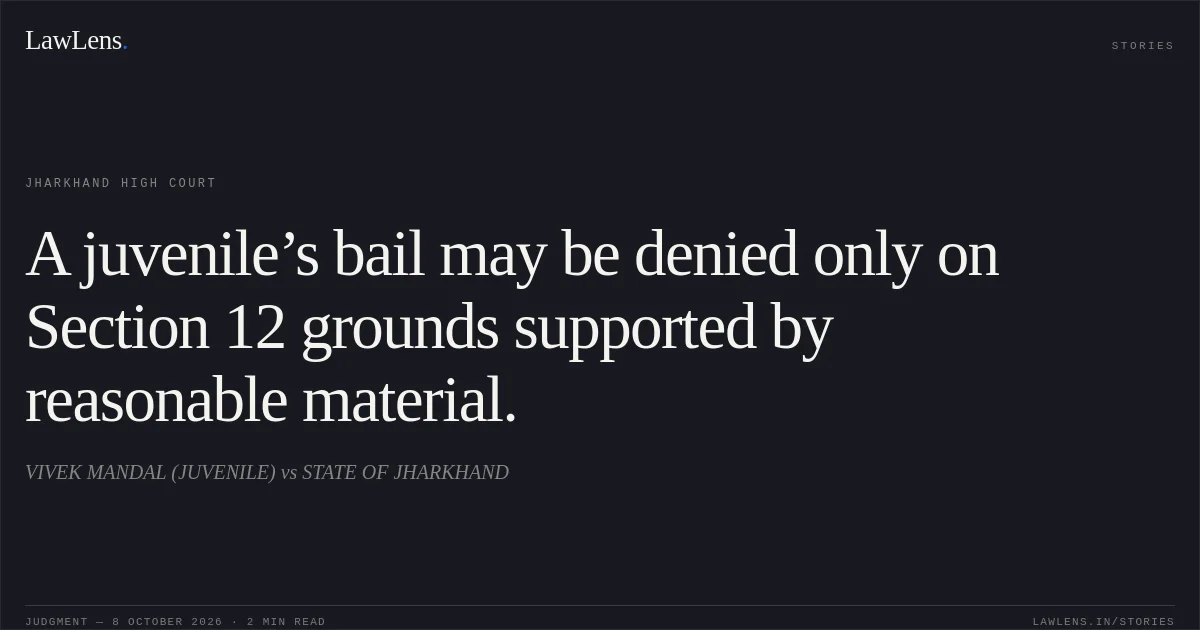
Vivek Mandal, aged about 15 at the time of the alleged offence, was in a remand home from 3 May 2026.
Source reference: p.1–2He faced charges under Sections 304(2), 317(4), 317(5) and 3(5) of the Bharatiya Nyaya Sanhita, 2023, arising from an allegation that a woman’s bag was snatched from a moving train.
Source reference: p.1–2The Juvenile Justice Board rejected his bail application, and the Special Judge, Children Court, Dhanbad, upheld that decision on appeal.
Source reference: p.1–2The juvenile sought revision, relying on the social investigation report’s assessment of his behaviour as normal and his mother’s willingness to supervise him and keep him away from known criminals and danger.
Source reference: p.1–2Issues
1. Whether the courts below properly applied Section 12 of the Juvenile Justice (Care and Protection of Children) Act, 2015, in refusing bail to the juvenile.
Source reference: p.2–32. Whether the stated concern that the juvenile might associate with known criminals provided reasonable grounds to refuse bail in the circumstances of this case.
Source reference: p.2–3Law Applied
Section 12 of the Juvenile Justice (Care and Protection of Children) Act, 2015, governs bail for a child alleged to be in conflict with law and, as stated by the Court, overrides bail provisions under the Code of Criminal Procedure, 1973, or other laws.
Source reference: p.3Bail is the rule and refusal is the exception.
Source reference: p.3Bail may be refused only where there are reasonable grounds to believe that release is likely to bring the child into association with a known criminal, expose the child to moral, physical or psychological danger, or defeat the ends of justice.
Source reference: p.3The Act’s rehabilitative approach requires that a child be reformed and rehabilitated rather than punished.
Source reference: p.3Reasoning
The courts below had refused bail principally on the concern that the juvenile might come into contact with known criminals.
Source reference: p.2–3The High Court found that this conclusion was not supported by reasonable grounds, particularly in light of the mother’s undertaking to supervise him and prevent such association and exposure to danger.
Source reference: p.2–3It also found that the lower courts had not adequately reasoned their conclusions by reference to the statutory grounds for refusal under Section 12.
Source reference: p.2–3In the absence of material showing that any statutory exception applied—including that release would defeat the ends of justice—the refusal of bail could not stand.
Source reference: p.3Holding
The High Court allowed the revision and set aside both the Juvenile Justice Board’s order dated 14 July 2026 and the appellate order dated 10 August 2026.
It directed the juvenile’s release on bail upon his mother furnishing a personal bond and two sureties from her relatives, to the satisfaction of the Juvenile Justice Board, subject to conditions concerning supervision, education and constructive activities, monthly reporting to the Probation Officer, and periodic social investigation reports.
Source reference: p.3–4Acts & Sections Cited
4 provisions across 2 statutes referred to in this judgment. Each provision opens on LawLens.
Bharatiya Nyaya Sanhita, 20233
Juvenile Justice (Care and Protection of Children) Act, 2015.1
Original Court PDF
VIVEK MANDAL (JUVENILE)vsSTATE OF JHARKHAND
Click to open original judgment
Original judgment, available to read, download and summarize on LawLens.in