Facts
The juvenile appellant was accused of sexually assaulting the informant in 2022 and later threatening to circulate a video and sending nude photographs; the informant lodged the report in 2025
Source reference: p.2The Children Court rejected the appellant’s application for regular bail under Section 12 of the Juvenile Justice (Care and Protection of Children) Act, 2015.
Source reference: pp.3–5The appellant appealed, submitting that the Social Investigation Report disclosed no criminal antecedents or other circumstances justifying refusal of bail, and that his parents could support his rehabilitation.
Source reference: pp.3–5The State and informant opposed release, citing the seriousness of the allegation and potential risks to the appellant.
Source reference: p.5Issues
1. Whether the Children Court’s refusal of bail was sustainable under Section 12 of the Juvenile Justice Act, 2015, in the absence of material establishing a statutory ground for refusal
Source reference: pp.6–7, 20–212. Whether the seriousness of the alleged offence, or the appellant’s being tried by the Children Court, could independently justify refusal of bail under Section 12
Source reference: pp.9–11, 19Law Applied
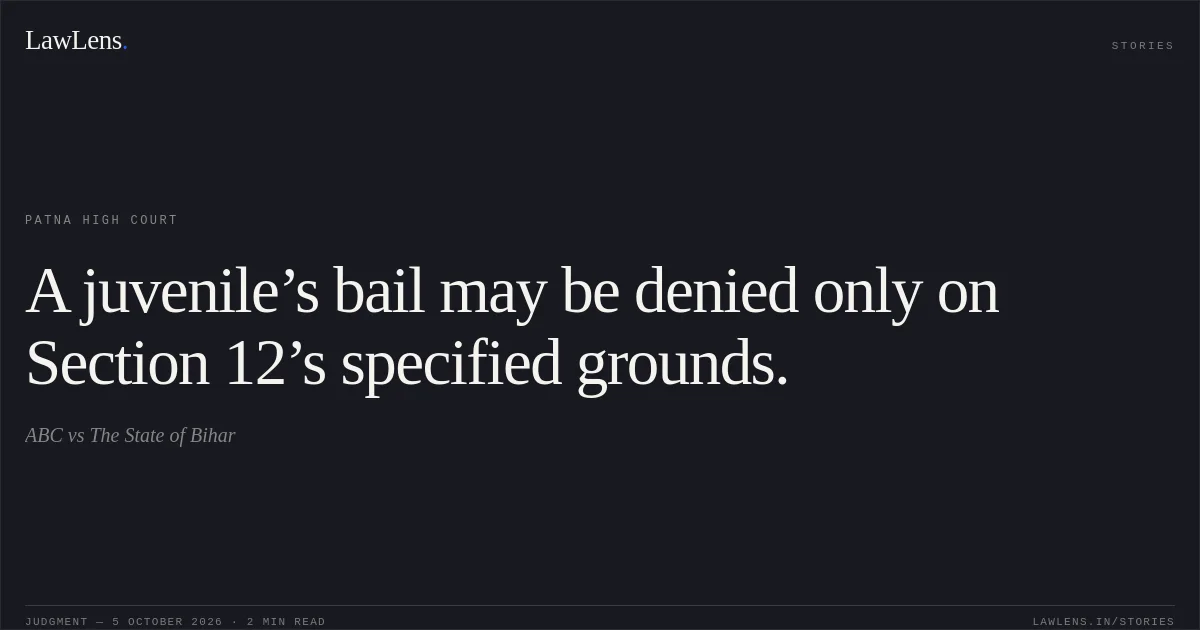
Section 12(1) of the Juvenile Justice Act, 2015, overrides the general bail provisions and requires a child alleged to be in conflict with law to be released on bail, with or without surety, or placed under supervision or the care of a fit person.
Source reference: pp.6–7Bail may be refused only where there are reasonable grounds to believe release would bring the child into association with a known criminal, expose the child to moral, physical or psychological danger, or defeat the ends of justice; the reasons and supporting circumstances must be recorded.
Source reference: pp.6–7The nature or seriousness of the alleged offence does not itself constitute a ground for refusal, and Section 12 applies even where a child is being tried as an adult.
Source reference: pp.9–10Sections 3 and 15(2) require child-centred decision-making, consideration of the Social Investigation Report and the child’s welfare, rehabilitation and family circumstances; institutionalisation is a last resort.
Source reference: pp.14–17, 19–20The Court relied, among other authorities, on Juvenile in Conflict with Law v. State of Rajasthan, In Re-Exploitation of Children in Orphanages in the State of T.N. v. Union of India, and Lalu Kumar @ Lal Babu v. State of Bihar.
Source reference: pp.7–10Reasoning
The Court accepted that the allegation was serious but held that seriousness was not a permissible independent basis for denying bail under Section 12.
Source reference: pp.19–20The Social Investigation Report disclosed no association with known criminals or other material indicating that release would expose the appellant to danger; he had no antecedents apart from the present case.
Source reference: p.21Given that both parents were teachers and the family could support his studies and development, the Court found that release to parental care would promote, rather than defeat, the Act’s rehabilitative purpose.
Source reference: p.21The Children Court’s refusal was therefore unsustainable.
Source reference: p.22Holding
The High Court allowed the appeal and set aside the Children Court’s order.
It directed the appellant’s release on bail on a bond of Rs. 10,000, subject to his father filing an affidavit undertaking to supervise him, prevent contact with criminal persons, support his developmental needs and continued studies, and ensure his attendance when required.
Source reference: p.22Acts & Sections Cited
9 provisions across 3 statutes referred to in this judgment. Each provision opens on LawLens.
Bharatiya Nyaya Sanhita, 20233
Protection of Children from Sexual Offences Act, 20121
Juvenile Justice (Care and Protection of Children) Act, 2015.5
Original Court PDF
ABCvsThe State of Bihar
Click to open original judgment
Original judgment, available to read, download and summarize on LawLens.in