Facts
Renukaiah received six items of land in a family partition, including Survey Nos. 186/1 and 186/2A, which constituted the suit properties.
Source reference: para. 6He later sold the suit properties to Ziauddin by a registered sale deed dated 5 August 1993, stating that the lands were difficult to manage and that he was in financial difficulty; the properties were subsequently transferred to Uddegowda and then purchased by H.G. Pattabi during the pendency of the suit.
Source reference: paras. 7–8, 17After Renukaiah’s death, his wife and sons instituted a suit for partition, alleging that the sale was not supported by legal necessity and had been effected without their consent.
Source reference: para. 7The trial court dismissed the suit, holding that the sale consideration had been used to discharge a loan incurred for constructing the family house at Bengaluru.
Source reference: para. 11The High Court reversed that decision, relying principally on the son’s evidence that Renukaiah was addicted to gambling and drinking.
Source reference: para. 12Pattabi challenged the High Court’s judgment before the Supreme Court.
Source reference: no citationIssues
Whether the alienation of the suit properties by Renukaiah was supported by legal necessity or a legitimate family purpose, so as to bind the plaintiffs’ alleged coparcenary interests?
Source reference: paras. 11–12, 22–24, 30Whether the plaintiffs established that the sale was invalid by proving undervaluation, bad vices, absence of necessity, or other circumstances impeaching the alienation?
Source reference: paras. 18–20, 26–27Whether the High Court was justified in reversing the trial court’s reasoned findings on the basis of the evidence on record?
Source reference: paras. 28–30Law Applied
The Court applied the Hindu-law principle that an alienation of joint family or coparcenary property by the person managing the family is sustainable where it is supported by legal necessity, benefit of the estate, or discharge of a legitimate family obligation; the alienation may also bind non-consenting coparceners where the purchaser makes the enquiry expected of a prudent transferee.
Source reference: paras. 14(D), 15(B)–(C), 22–24The party impeaching the alienation bears the burden of pleading and proving the facts establishing its invalidity, including alleged undervaluation, absence of necessity, or improper purpose.
Source reference: paras. 14(B)–(C), 18–20The Court further applied the evidentiary principle that failure to examine a material witness possessing direct knowledge may justify an adverse inference.
Source reference: paras. 24, 27It also held that absence of a prayer for cancellation of the sale deed was not independently decisive, but could assume significance cumulatively with other circumstances.
Source reference: para. 28Reasoning
The Supreme Court found that the plaintiffs failed to prove that the consideration of ₹1,45,000 was inadequate: the alleged market value of ₹5 lakhs rested only on hearsay, without documentary, official, or reliable oral evidence.
Source reference: paras. 18–19The allegation that Renukaiah was addicted to gambling and drinking was an improvement beyond the pleadings and remained unsupported by independent evidence.
Source reference: para. 26The son, who was a minor when the sale occurred, lacked personal knowledge of the family’s finances, while his mother—who was aware of the relevant family affairs—was not examined, justifying an adverse inference.
Source reference: paras. 20, 24, 27The evidence that a house had been constructed in Bengaluru in 1991–1992, together with the defendants’ case that the sale proceeds were used to repay the construction loan, provided a plausible basis for finding legal necessity.
Source reference: paras. 22–23, 30The plaintiffs’ selective challenge to only two of the six properties, their failure to explain the alienation of the remaining properties, and the absence of a challenge to the original sale deed further weakened the bona fides of their claim.
Source reference: paras. 21, 25, 28Accordingly, the High Court had erred in disregarding the trial court’s reasoned and plausible assessment of the evidence.
Source reference: para. 30Holding
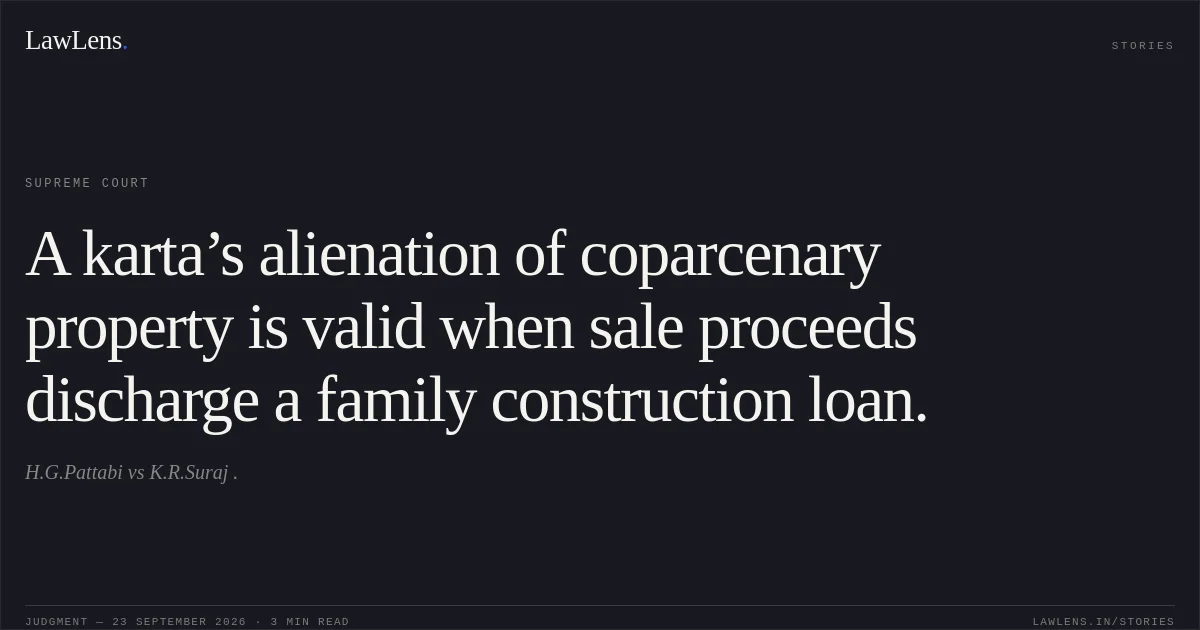
The Supreme Court held that the plaintiffs failed to establish that Renukaiah’s sale of the suit properties was unsupported by legal necessity or otherwise invalid.
The trial court’s finding that the sale proceeds were used toward repayment of the loan incurred for construction of the Bengaluru house was a plausible and reasoned conclusion.
Source reference: para. 31The appeal was therefore allowed; the High Court’s judgment dated 23 April 2010 was set aside, and the trial court’s judgment and decree dated 14 March 2002 dismissing the partition suit were restored.
Source reference: para. 31Original Court PDF
H.G.PattabivsK.R.Suraj .
Click to open original judgment
Original judgment, available to read, download and summarize on LawLens.in