Facts
On 01.09.2014 at approximately 11:45 p.m., the appellant allegedly entered PW3’s ice-cream godown at Darya Ganj, Delhi, during the night, rummaged through his belongings, and took his mobile phone.
Source reference: pp. 9–12, paras. 15–17When confronted, he allegedly threatened PW3 with a button-operated knife and twisted his wrist, causing pain and swelling.
Source reference: pp. 9–12, paras. 15–17PW3 and his son, PW6, apprehended the appellant, recovered the mobile phone from his shirt pocket, and handed over the knife and the appellant to the police.
Source reference: pp. 9–12, paras. 15–17The appellant was charged under Sections 394, 397 and 457 IPC and Sections 25, 27, 54 and 59 of the Arms Act.
Source reference: pp. 3–6, paras. 5–10The Sessions Court convicted him under Sections 394, 397 and 457 IPC and Sections 25 and 27 of the Arms Act, sentencing him principally to seven years’ rigorous imprisonment under Sections 394/397 IPC, with concurrent sentences for the other offences.
Source reference: pp. 3–6, paras. 5–10In appeal, the appellant challenged, inter alia, the classification of the knife as a deadly weapon, the finding of hurt, the conviction under Section 457 IPC, and the Arms Act convictions.
Source reference: pp. 6–9, paras. 11–12Issues
1. Whether the appellant’s entry into the godown during the night constituted lurking house-trespass or house-breaking by night with the intention of committing an imprisonable offence under Section 457 IPC.
Source reference: pp. 13–15, para. 182. Whether twisting PW3’s wrist and causing pain and tenderness, despite the absence of a visible external injury, constituted voluntarily causing hurt during the commission of robbery under Section 394 IPC.
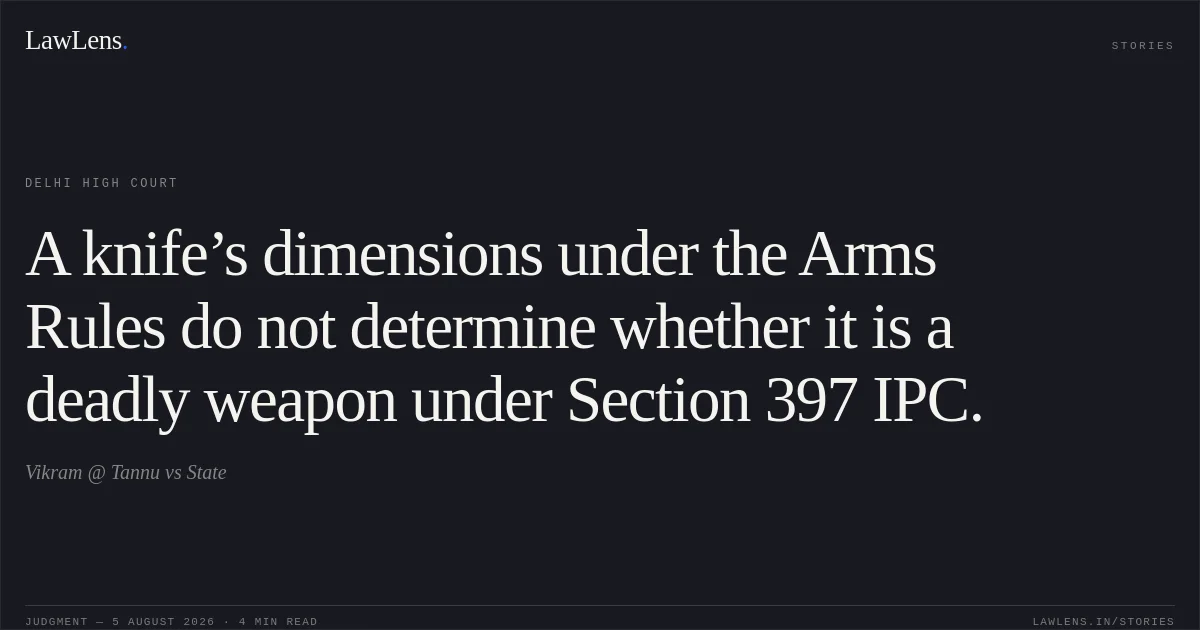
Source reference: pp. 15–17, paras. 19–223. Whether the button-operated knife, notwithstanding its dimensions and the absence of a statutory definition of “deadly weapon” in the IPC, attracted Section 397 IPC.
Source reference: pp. 17–20, paras. 23–254. Whether possession of the button-operated knife violated the applicable Delhi notification and attracted Section 25 of the Arms Act.
Source reference: pp. 20–23, paras. 26–285. Whether the prosecution proved the necessary contravention of Sections 5 or 7 of the Arms Act to sustain conviction under Section 27.
Source reference: p. 23, para. 29Law Applied
The Court applied Section 457 IPC, which requires proof of lurking house-trespass or house-breaking by night and entry with the intention of committing an offence punishable with imprisonment.
Source reference: pp. 13–14, para. 18Under Sections 394 and 319 IPC, “hurt” includes bodily pain, disease or infirmity; therefore, visible external injury is not essential where bodily pain is voluntarily caused during robbery or its attempt.
Source reference: pp. 15–16, paras. 19–20Section 397 IPC applies where, during robbery or dacoity, the offender uses a deadly weapon; the expression is not governed by the dimensional standards in the Arms Rules.
Source reference: pp. 17–20, paras. 23–25Relying on Phool Kumar v. Delhi Administration, (1975) 1 SCC 797, and Salim v. State (Delhi Administration), 1987 SCC OnLine Del 408, the Court held that a knife may constitute a deadly weapon depending on its nature and the manner of its use.
Source reference: pp. 17–20, paras. 23–25For Section 25(1B)(b) of the Arms Act, possession or carrying of regulated arms in a notified area without authority is punishable.
Source reference: pp. 20–23, paras. 26–28The Delhi notification dated 17.02.1979 regulates possession and carrying in public places of buttondar knives, including those with blades measuring at least 7.62 cm in length and 1.72 cm in breadth.
Source reference: pp. 20–23, paras. 26–28Section 27 requires proof that the weapon was used in contravention of Section 5 or Section 7 of the Arms Act.
Source reference: p. 23, para. 29Reasoning
The appellant’s presence inside the godown at night was undisputed, including through his Section 313 CrPC explanation that he had entered without the owner’s permission.
Source reference: p. 14, para. 18The consistent testimony of PW3 and PW6 established that he was found searching PW3’s bag and had entered with the intention of committing theft; the ingredients of Section 457 were therefore satisfied.
Source reference: p. 14, para. 18PW3’s account that the appellant twisted his wrist and caused pain was corroborated by the MLC recording tenderness over the right forearm and wrist, notwithstanding the absence of deformity or visible injury.
Source reference: pp. 15–17, paras. 19–22Since bodily pain falls within “hurt” under Section 319 IPC, Section 394 was established.
Source reference: pp. 15–17, paras. 19–22The knife was produced, seized and identified, and was brandished to threaten PW3 and facilitate the robbery.
Source reference: pp. 17–20, paras. 23–25Its dimensions under the Arms Rules were irrelevant to the IPC inquiry into whether it was a deadly weapon; the manner of use made it sufficient to attract Section 397.
Source reference: pp. 17–20, paras. 23–25The knife’s blade measured 7.8 cm by 2.4 cm and, being a button-operated knife carried in Delhi without licence, fell within the 1979 notification, sustaining Section 25.
Source reference: pp. 20–23, paras. 26–28However, the prosecution neither alleged nor proved any violation of Sections 5 or 7, an essential requirement for Section 27; that conviction could not therefore stand.
Source reference: p. 23, para. 29Holding
The appeal was partly allowed.
The convictions and sentences under Sections 394, 397 and 457 IPC and Section 25 of the Arms Act were affirmed, and the sentences were left undisturbed, including the principal sentence of seven years’ rigorous imprisonment, with concurrent sentences as ordered by the trial court.
Source reference: p. 24, paras. 30–31The conviction and sentence under Section 27 of the Arms Act were set aside, and the appellant was acquitted of that charge under Section 235(1) CrPC.
Source reference: p. 24, para. 31Original Court PDF
Vikram @ TannuvsState
Click to open original judgment
Original judgment, available to read, download and summarize on LawLens.in