Facts
The applicant, Geeta Singh, filed a revision under Sections 438 and 442 of the Bharatiya Nagarik Suraksha Sanhita, 2023, challenging the dismissal of her application under Section 12 of the Protection of Women from Domestic Violence Act, 2005 (“DV Act”).
Source reference: para. 2The Judicial Magistrate First Class, Surajpur, had rejected her application, and the Second Additional Sessions Judge affirmed that decision in Criminal Appeal No. 17/2024.
Source reference: para. 2The applicant alleged that she and the respondent had performed a marriage in a temple and thereafter lived together in a relationship in the nature of marriage.
Source reference: para. 3She contended that this constituted a “domestic relationship” under Section 2(f) of the DV Act.
Source reference: para. 3The respondent opposed the revision, asserting that he was already married to Anant Kunwar since 2000, that they had two children, and that the applicant was aware of the subsisting marriage.
Source reference: para. 4He further contended that the parties were within the prohibited degrees of relationship under the Hindu Marriage Act, 1955.
Source reference: para. 4In her cross-examination, the applicant admitted that the respondent was the real elder brother of her mother and that his first wife was alive.
Source reference: para. 9The Court also noted that the respondent’s first marriage had produced two children.
Source reference: para. 9Issues
Whether the alleged relationship between the applicant and the respondent constituted a “domestic relationship” or a “relationship in the nature of marriage” under Section 2(f) of the DV Act, notwithstanding the respondent’s subsisting first marriage?
Source reference: paras. 6–10Whether the relationship or alleged marriage between the parties was legally impermissible because they fell within the prohibited degrees of relationship under Sections 3(g) and 5(iv) of the Hindu Marriage Act, 1955?
Source reference: paras. 11–13Whether the applicant was an “aggrieved person” entitled to maintain an application under Section 12 of the DV Act against the respondent?
Source reference: paras. 7, 10, 14Law Applied
The Court applied Sections 2(a), 2(f), and 2(q) of the Protection of Women from Domestic Violence Act, 2005, under which an “aggrieved person” must be a woman who is or has been in a “domestic relationship” with the respondent; a domestic relationship includes persons who live or have lived together in a shared household and are related by marriage or through a relationship in the nature of marriage; and a respondent must be an adult male person in such a relationship.
Source reference: para. 6Relying on Indra Sarma v. V.K.V. Sarma, (2013) 15 SCC 755, the Court held that the existence of a domestic relationship is foundational to relief under the DV Act and that whether a live-in relationship is “in the nature of marriage” depends on the nature and circumstances of the relationship.
Source reference: para. 8The Court also applied Sections 3(g) and 5(iv) of the Hindu Marriage Act, 1955, concerning prohibited degrees of relationship and the invalidity of a marriage between persons within those degrees unless an applicable custom permits it.
Source reference: paras. 11–13Reasoning
The Court held that the applicant knew that the respondent was already married and that his first wife was living.
Source reference: para. 10Consequently, she had not entered the alleged relationship under the belief that the respondent was a legally available unmarried person.
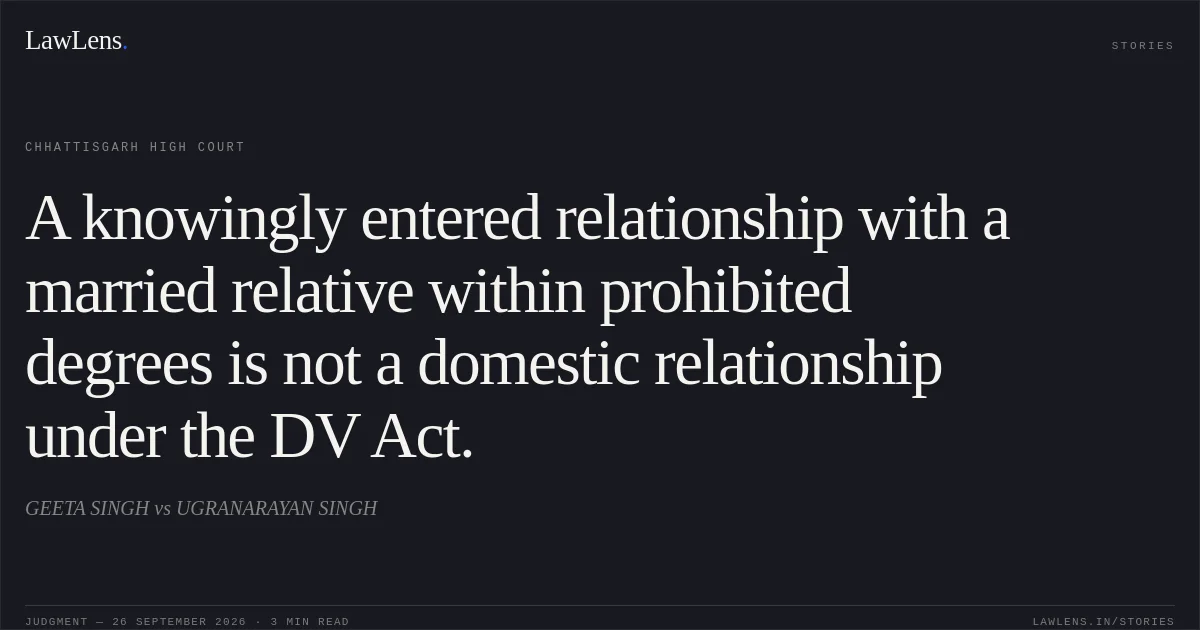
Source reference: para. 10In light of this knowledge and the respondent’s subsisting marriage, the relationship could not be treated as a “relationship in the nature of marriage” for purposes of Section 2(f) of the DV Act.
Source reference: para. 10The Court further found that the parties were within a prohibited relationship under the Hindu Marriage Act and that the applicant had failed to establish any custom permitting such a marriage.
Source reference: paras. 11–13Therefore, the alleged temple marriage could not create a legally valid marital or domestic relationship.
Source reference: paras. 11–13Since the foundational domestic relationship was absent, the applicant was neither an “aggrieved person” under Section 2(a) nor entitled to proceed against the respondent as a “respondent” under Section 2(q).
Source reference: para. 14Holding
The Court answered the issues against the applicant.
It held that the alleged relationship did not constitute a domestic relationship or a relationship in the nature of marriage under the DV Act, and that the applicant could not maintain an application under Section 12 of the Act against the respondent.
Source reference: para. 14The revision was dismissed at the motion stage, and the concurrent orders of the Magistrate and the Appellate Court were affirmed.
Source reference: para. 15Any pending applications were disposed of.
Source reference: para. 16Acts & Sections Cited
6 provisions across 3 statutes referred to in this judgment. Each provision opens on LawLens.
Bharatiya Nagarik Suraksha Sanhita, 20232
Protection of Women from Domestic Violence Act, 20052
Original Court PDF
GEETA SINGHvsUGRANARAYAN SINGH
Click to open original judgment
Original judgment, available to read, download and summarize on LawLens.in