Facts
Ramesh C. Ank(ad), employed as a Junior Sales Assistant, was dismissed following disciplinary proceedings arising from an alleged shortage of seven zari sarees and his alleged failure to lodge a police complaint.
Source reference: paras. 2–6He challenged the dismissal under Section 10(4-A) of the Industrial Disputes Act, 1947.
Source reference: no citationThe Labour Court held the domestic enquiry unfair and invalid, but subsequently rejected his application after considering evidence led afresh by both parties.
Source reference: paras. 7, 17–19After Ramesh’s death, his wife and son pursued the writ petition challenging that decision.
Source reference: no citationIssues
1. Whether the Labour Court’s decision was perverse for want of legal evidence.
Source reference: para. 162. Whether dismissal was a disproportionate penalty warranting interference.
Source reference: paras. 12–16Law Applied
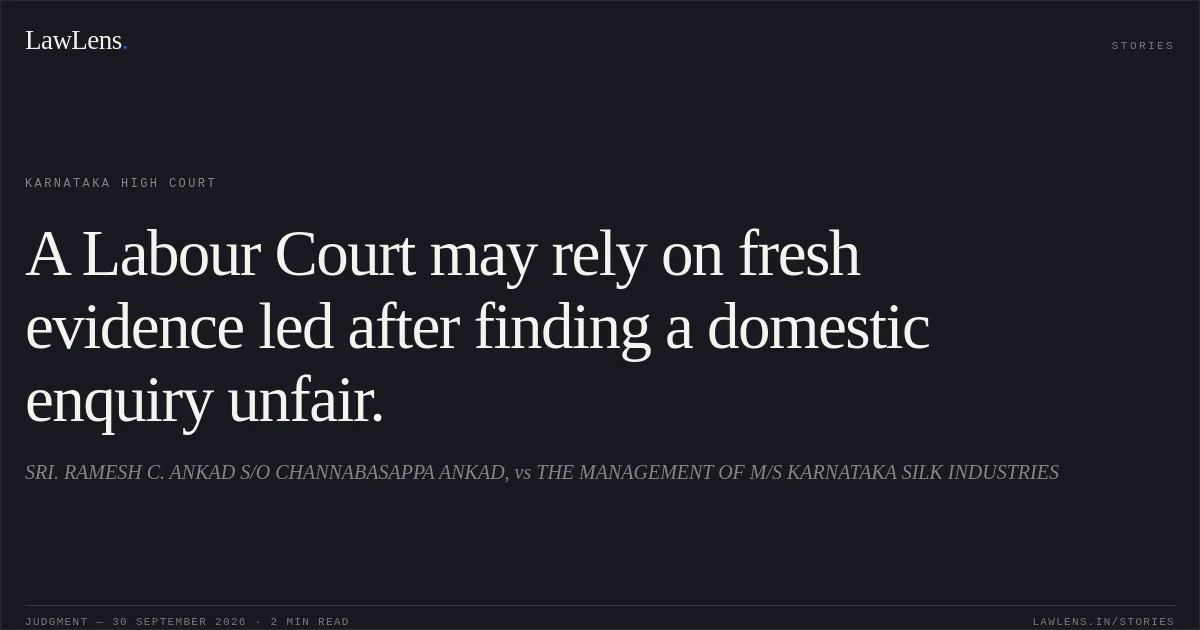
Under the Industrial Disputes Act, 1947, the Labour Court may consider evidence adduced before it on the merits after finding the domestic enquiry unfair; its decision need not rest solely on the enquiry record.
Source reference: paras. 17–19Neeta Kaplish v. Presiding Officer, Labour Court, (1999) 1 SCC 517, and North-East Karnataka Road Transport Corporation v. C.K. Dyamappa, ILR 2007 KAR 590, were treated as addressing circumstances where no fresh evidence was led after the enquiry was found invalid.
Source reference: para. 17Under Rajindra Kumar Kindra v. Delhi Administration, (1984) 4 SCC 635, findings based on no legal evidence, conjecture, or surmise may be set aside as perverse.
Source reference: para. 20The Labour Court’s assessment of penalty proportionality was also considered.
Source reference: paras. 12–13, 24–25Reasoning
The High Court found that, unlike the circumstances in Neeta Kaplish and C.K. Dyamappa, both parties had adduced evidence before the Labour Court after the domestic enquiry was held invalid: the workman and two management witnesses were examined and cross-examined.
Source reference: paras. 18–19The Labour Court’s decision referred to and assessed that evidence, including the workman’s account of the attempted complaint and the involvement of H.H. Goundi; it was therefore not based on conjecture or an evidentiary vacuum.
Source reference: paras. 21–23The Labour Court had also considered proportionality, including the alleged association with Goundi and the failure to take action against him, and the High Court found no basis to interfere with that assessment.
Source reference: paras. 24–25Holding
The High Court answered the challenges against the workman, finding neither perversity for want of evidence nor disproportionality warranting interference.
It dismissed the writ petition, leaving the Labour Court’s rejection of the workman’s application undisturbed.
Source reference: paras. 25–26Acts & Sections Cited
2 provisions across 1 statute referred to in this judgment. Linked provisions open on LawLens.
Industrial Disputes Act, 19472
Original Court PDF
SRI. RAMESH C. ANKAD S/O CHANNABASAPPA ANKAD,vsTHE MANAGEMENT OF M/S KARNATAKA SILK INDUSTRIES
Click to open original judgment
Original judgment, available to read, download and summarize on LawLens.in