Facts
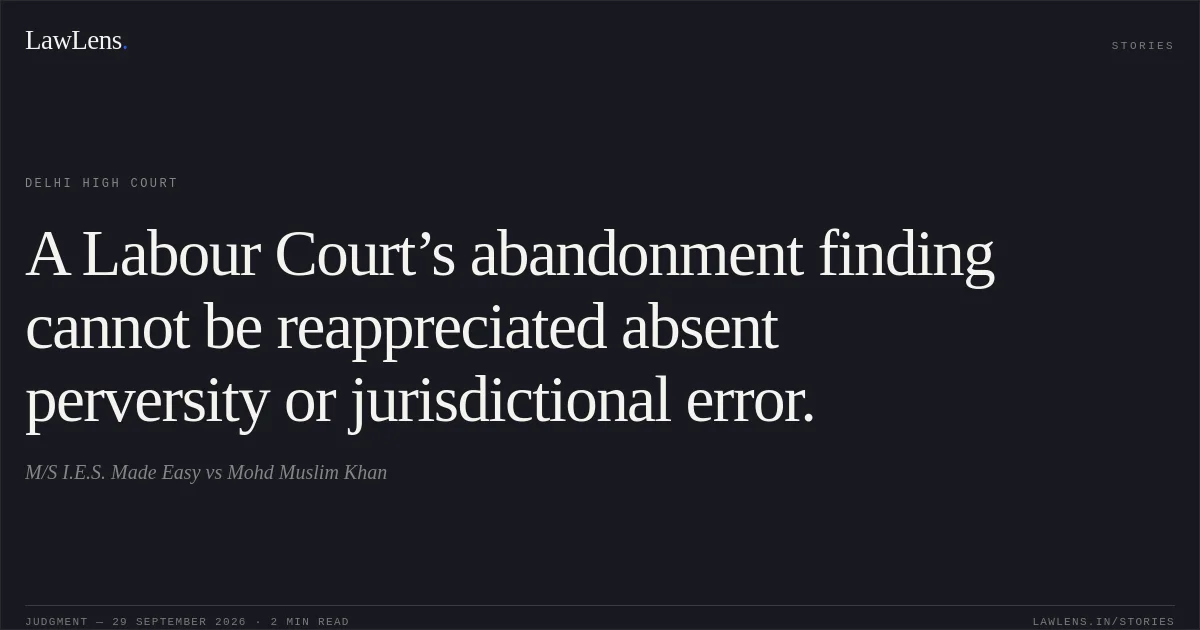
The workman was appointed as a Driver-cum-Field Worker on 4 January 2005 and alleged that the management illegally terminated his services on 23 May 2014; the management contended that he had stopped reporting for work and abandoned his employment.
Source reference: para. 4–5The Labour Court found that the management had not established abandonment and awarded the workman ₹75,000 in compensation.
Source reference: para. 1, 5The management challenged the award under Articles 226 and 227 of the Constitution, arguing that the Labour Court’s findings were contrary to the evidence.
Source reference: para. 1, 6Issues
1. Whether the management established that the workman voluntarily abandoned his employment, rather than having his services terminated.
Source reference: para. 5, 82. Whether the Labour Court’s finding of illegal termination warranted interference under Articles 226 and 227 of the Constitution.
Source reference: para. 10–11Law Applied
Under G.T. Lad & Ors. v. Chemicals & Fibres of India Ltd., abandonment of service turns on the employee’s intention, which ordinarily cannot be inferred without adequate evidence and must be assessed in light of the surrounding circumstances.
Source reference: para. 9Under Syed Yakoob v. K.S. Radhakrishnan, the High Court’s jurisdiction under Articles 226 and 227 is supervisory, not appellate; it does not ordinarily reappreciate evidence or substitute its view for the fact-finder’s, absent perversity, patent illegality, or a finding unsupported by evidence.
Source reference: para. 11Reasoning
The Labour Court’s finding that abandonment was not proved rested on the management’s failure to produce attendance records and its failure to produce the domestic-enquiry proceedings or examine the Enquiry Officers.
Source reference: para. 8Applying G.T. Lad, the Court considered that the management had not supplied adequate evidence of the workman’s intention to abandon employment.
Source reference: para. 8–10The management did not demonstrate that the Labour Court’s factual finding was perverse, unsupported by evidence, or affected by jurisdictional error; the High Court therefore declined to reassess the evidence under its supervisory jurisdiction.
Source reference: para. 10–11Holding
The Court held that no ground for interference with the Labour Court’s award was made out and dismissed the petition and any pending applications.
It directed that the deposited ₹75,000 be released to the workman with accrued interest, if any; if the amount had not been deposited, the management was to pay it with accrued interest within four weeks.
Source reference: para. 13Original Court PDF
M/S I.E.S. Made EasyvsMohd Muslim Khan
Click to open original judgment
Original judgment, available to read, download and summarize on LawLens.in