Facts
The appellants-landlords instituted a suit under the West Bengal Premises Tenancy Act, 1956, seeking recovery of possession from the respondent-tenant, who occupied the premises at a monthly rent of ₹556 payable according to the English calendar month.
Source reference: p.1The tenancy was determined by a notice to quit on the grounds of default in payment of rent and reasonable requirement of the premises for the landlords’ own use and occupation.
Source reference: p.1The tenant did not vacate after service of notice, leading to Title Suit No. 139 of 1996.
Source reference: p.1The Trial Court held that the notice had been duly served and that the tenant had deposited the arrears of rent; although the first deposit was delayed, the delay was condoned.
Source reference: p.1However, it found that the landlords had failed to establish reasonable requirement and dismissed the suit.
Source reference: p.1The First Appellate Court affirmed the dismissal, holding that the landlords had not proved reasonable requirement and that the court possessed jurisdiction to condone the delay under Section 17(1) of the Act.
Source reference: p.2The Second Appeal was admitted for hearing on Ground VIII, namely, whether the courts below had failed to appreciate the genuine and bona fide requirement of Appellant No. 3, a married daughter.
Source reference: p.2The respondent did not appear despite repeated calls.
Source reference: p.2Issues
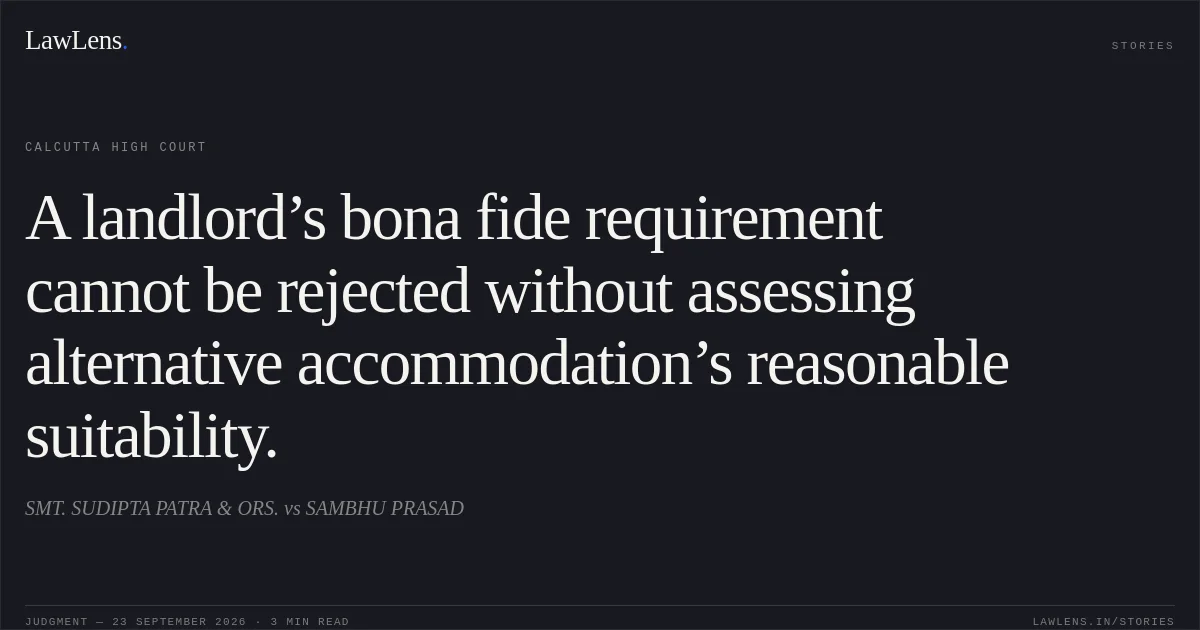
Whether the courts below erred in law in rejecting the landlords’ claim of reasonable and bona fide requirement of the suit premises, including the requirement asserted for the married daughter of the family?
Source reference: p.2Whether the existence of alternative accommodation was sufficient to defeat the landlords’ claim without determining whether such accommodation was reasonably suitable for their needs?
Source reference: p.3Whether the concurrent findings of the courts below warranted interference in second appeal on account of misapplication of the legal principles governing reasonable requirement?
Source reference: p.4Law Applied
The Court applied the provisions of the West Bengal Premises Tenancy Act, 1956 governing eviction for the landlord’s reasonable requirement and Section 17(1) concerning deposit of rent and the court’s power to condone delay.
Source reference: pp.1–2Relying on Prativa Devi v. T.V. Krishnan, (1996) 5 SCC 353, the Court held that the landlord is ordinarily the best judge of his or her residential requirements and enjoys considerable freedom in determining those requirements.
Source reference: p.3It further relied on Shiv Sarup Gupta v. Dr. Mahesh Chand Gupta, (1999) 6 SCC 222, which recognises that the convenience and safety of the landlord and family members, their profession or vocation, style of living, habits and background are relevant in assessing reasonable suitability and bona fide requirement.
Source reference: p.3Although concurrent findings are generally not disturbed in second appeal, interference is permissible where the courts below commit an error of law by applying incorrect legal principles.
Source reference: p.4Reasoning
The High Court held that both courts below had improperly assessed the landlords’ requirement by effectively dictating how the landlords should organise their residential needs, rather than determining whether the asserted requirement was bona fide and reasonably suitable.
Source reference: p.3The requirement was not confined to a personal need that would necessarily terminate upon the landlord’s death; the needs of the landlord’s family members were also relevant.
Source reference: p.3The First Appellate Court noted the existence of alternative accommodation but failed to examine whether that accommodation was reasonably suitable, instead treating its mere availability as conclusive.
Source reference: p.3Applying the principles in Prativa Devi and Shiv Sarup Gupta, the Court concluded that this approach constituted an error of law and fact warranting interference despite the concurrent decisions of the courts below.
Source reference: pp.3–4Holding
The Second Appeal was allowed.
The High Court set aside the judgment and decree dated 24 April 2001 passed by the District Judge, Howrah, in Title Appeal No. 96 of 2000.
Source reference: p.4Holding that the courts below had erred in applying the law relating to reasonable requirement, the Court directed the respondent to hand over possession of the suit premises within 15 days from the drawing up of the decree; upon failure, the appellants were permitted to initiate execution proceedings.
Source reference: p.4The appellants were also granted liberty to institute a separate suit for mesne profits.
Source reference: p.4Acts & Sections Cited
1 provisions across 1 statute referred to in this judgment. Each provision opens on LawLens.
west bengal premises tenancy act, 19561
Original Court PDF
SMT. SUDIPTA PATRA & ORS.vsSAMBHU PRASAD
Click to open original judgment
Original judgment, available to read, download and summarize on LawLens.in