Facts
The Appellant-mother and Respondent-father married on 17 January 2012, and their daughter, Mihika, was born on 13 October 2012. The daughter remained in the mother’s custody from birth. The parties divorced by consent on 18 January 2017 under the Special Marriage Act, 1954. Their consent terms provided that custody would remain with the mother until the daughter attained majority, while the father was granted visitation rights.
Source reference: pp. 2–3, paras. 2.1–2.3In 2019, the father sought modification of the divorce decree and custody of the daughter; the mother also sought modification of the access arrangements. These applications were decided by a composite order of the Family Court, Pune dated 1 July 2026.
Source reference: p. 3, para. 2.4; p. 4, para. 3The mother had remarried on 16 March 2026 and moved with the daughter to her husband’s residence. The Family Court directed her to hand over custody of the then fourteen-year-old daughter to the biological father within two months, principally on the basis of perceived emotional and relational difficulties in the mother’s new family.
Source reference: pp. 3–4, para. 2.6; pp. 9–10, para. 9During an interaction in chambers, the High Court found the daughter mature and articulate; she expressed a clear wish to remain with her mother and new family while continuing to meet her father.
Source reference: p. 12, para. 11Issues
1. Whether the Family Court was justified in modifying the existing custody arrangement and directing the mother to hand over custody to the biological father under Section 38 of the Special Marriage Act, 1954?
Source reference: pp. 8–11, paras. 7–102. Whether the impugned custody order was consistent with the welfare and wishes of the fourteen-year-old minor child?
Source reference: pp. 8, 11–12, paras. 7, 10–113. Whether the mother’s remarriage and the child’s relocation to the mother’s new household constituted a substantial change in circumstances warranting transfer of custody?
Source reference: p. 11, para. 10Law Applied
The Court applied Section 38 of the Special Marriage Act, 1954, which empowers the court to make, revoke, suspend or vary orders concerning the custody, maintenance and education of minor children, with the child’s welfare and wishes being the governing considerations wherever possible.
Source reference: pp. 8–9, para. 7The Court held that the paramount consideration in custody matters is the welfare and best interests of the child, rather than the biological status of either parent.
Source reference: no citationIt further applied the principle that post-divorce modification of custody requires a substantial change in circumstances sufficient to justify altering the existing arrangement.
Source reference: p. 11, para. 10The wishes of a mature adolescent child are a significant consideration when they are expressed clearly and appear voluntary and informed.
Source reference: pp. 8, 11–12, paras. 7, 11Reasoning
The High Court found that the Family Court had correctly identified the child’s welfare as the controlling consideration but had not applied that principle rationally.
Source reference: pp. 9–10, paras. 9–10Its conclusion that the daughter would necessarily suffer insecurity, jealousy, divided loyalties or inadequate affection in the mother’s remarried household was based on speculation, stereotypes and conjecture, rather than evidence of actual harm or maladjustment.
Source reference: pp. 9–10, paras. 9–10The biological relationship between the father and daughter could not, by itself, justify transferring custody, nor could the mother’s remarriage be treated as determinative.
Source reference: pp. 9–10, paras. 9–10The High Court also noted that the impugned order did not demonstrate any substantial change in circumstances requiring alteration of the arrangement established under the consent terms, particularly since the father already had adequate access and visitation rights.
Source reference: p. 11, para. 10After independently interacting with the daughter, the Court found her mature and articulate and accepted her clear preference to remain with her mother and new family while maintaining contact with her father.
Source reference: p. 12, para. 11This preference was consistent with her welfare and therefore reinforced the continuation of existing custody.
Source reference: no citationHolding
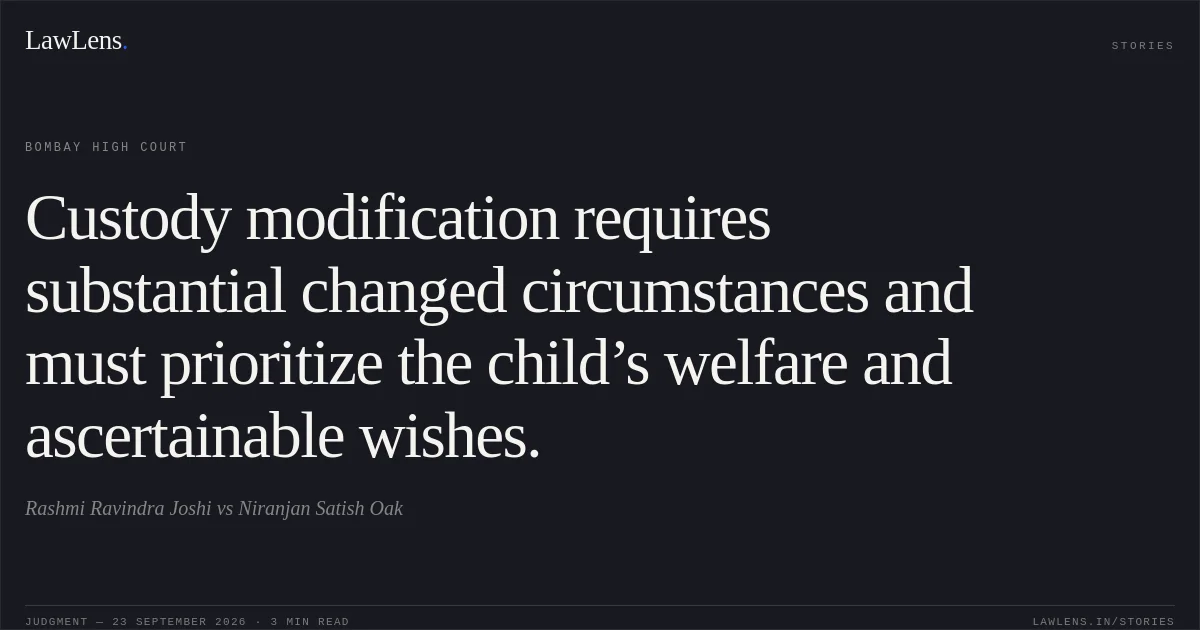
The High Court held that the Family Court’s direction transferring custody to the father was unsupported by cogent evidence, inconsistent with the child’s welfare and wishes, and not justified by any substantial change in circumstances.
The appeal was allowed, and Clauses 1 and 4 of the Family Court’s order dated 1 July 2026 were set aside.
Source reference: p. 12, para. 13(i)The mother was permitted to retain custody of Mihika.
Source reference: no citationThe father was granted overnight access and access during school or college vacations, subject to the child’s convenience, and the mother was directed to continue providing access in accordance with the consent terms dated 15 December 2016.
Source reference: p. 12, para. 13(ii)–(iii)Acts & Sections Cited
3 provisions across 2 statutes referred to in this judgment. Each provision opens on LawLens.
Special Marriage Act, 19542
Code of Criminal Procedure, 19731
Original Court PDF
Rashmi Ravindra JoshivsNiranjan Satish Oak
Click to open original judgment
Original judgment, available to read, download and summarize on LawLens.in