Facts
The petitioners were selected by the School Management and Development Committees for appointment to vacant posts of Peon after consideration of the reservation roster and applicable rules. Pursuant to the Committees’ recommendations dated 31 December 2012, the Principals of the concerned schools appointed them on Collector Rate basis in January 2013, and they thereafter continued to work without interruption.
Source reference: paras. 2–2.1The State Government’s circular dated 7 October 2016 extended the benefit of “Sthayi Karmi” status to eligible daily-wage employees in specified categories. After completing ten years of service, the petitioners submitted representations seeking the benefit of the circular.
Source reference: paras. 2.1–2.2In earlier proceedings, W.P. No. 11074 of 2023, the High Court directed the respondents to consider their claims. The Commissioner, Public Instructions, rejected the claim on 16 August 2023, and the District Education Officer consequentially rejected it on 26 September 2023, principally on the ground that the petitioners were paid at Collector Rate and were not daily-wage employees.
Source reference: paras. 2.3–2.5Issues
Whether the petitioners, appointed pursuant to the School Management and Development Committee’s selection process and continuously engaged thereafter, qualified as daily-wage employees under Clause 1.8 of the circular dated 7 October 2016 and were entitled to “Sthayi Karmi” status?
Source reference: paras. 6.2–7.4Whether the respondents’ rejection of the petitioners’ claim, without recording adequate reasons and merely relying on their payment at Collector Rate, was legally sustainable?
Source reference: paras. 6.1, 8Whether the petitioners’ appointments after 16 May 2007 could satisfy Clause 1.8 where they were made by the competent authorities pursuant to the departmental instructions and selection process?
Source reference: paras. 4–4.1, 7–7.4Law Applied
Clause 1.8 of the State Government circular dated 7 October 2016 extends the scheme to daily-wage employees who were working on 16 May 2007 and continued to work on 1 September 2016, and also to persons appointed after 16 May 2007 as daily-wage employees by the competent authority with Government permission or approval; contractual, part-time and outsourced employees are excluded under the clause.
Source reference: para. 6.2An administrative decision affecting legal rights must disclose reasons and cannot rest on a bare or conclusory rejection.
Source reference: para. 6.1Radheshyam Verma v. State of Madhya Pradesh treated long and continuous engagement by the State as relevant to entitlement to the benefits of the 7 October 2016 circular.
Source reference: para. 7.3Ajay Kumar Soni v. State of Madhya Pradesh interpreted Clause 1.8 as covering eligible categories of daily-wage employees, including those appointed after 16 May 2007 with competent approval.
Source reference: para. 7.4State of Madhya Pradesh v. Bhupendra Singh Sikarwar concerned permission or ratification by the competent authority under Clause 1.8, and Ram Naresh Rawat v. Ashwini Ray, (2017) 3 SCC 436, concerned benefits available to long-serving daily-wage employees.
Source reference: paras. 7.4–7.5Reasoning
The Court found that the respondents had failed to provide any reasoned basis for treating the petitioners as outside the scope of the circular merely because their remuneration was described as being at Collector Rate.
Source reference: para. 6.1The record showed that vacant posts were identified, the matter was referred to the School Management and Development Committees for compliance with the reservation roster and applicable rules, the petitioners were selected, and the recommendations were forwarded to the Principals, who were the competent appointing authorities.
Source reference: paras. 7.1–7.2The appointment orders also specifically referred to the Commissioner, Public Instructions’ instructions dated 11 June 2012, indicating that the appointments were made pursuant to departmental authority and not through an unauthorised or private arrangement.
Source reference: para. 7.3On that basis, the Court held that the requirements of Clause 1.8 were satisfied and that the respondents had adopted an unduly restrictive interpretation of the circular.
Source reference: para. 7.4The absence of adequate reasoning in the Commissioner’s order, coupled with the contrary material showing regular and continuous engagement, rendered both the Commissioner’s order and the consequential rejection order unsustainable.
Source reference: paras. 6.1, 7.4, 8Holding
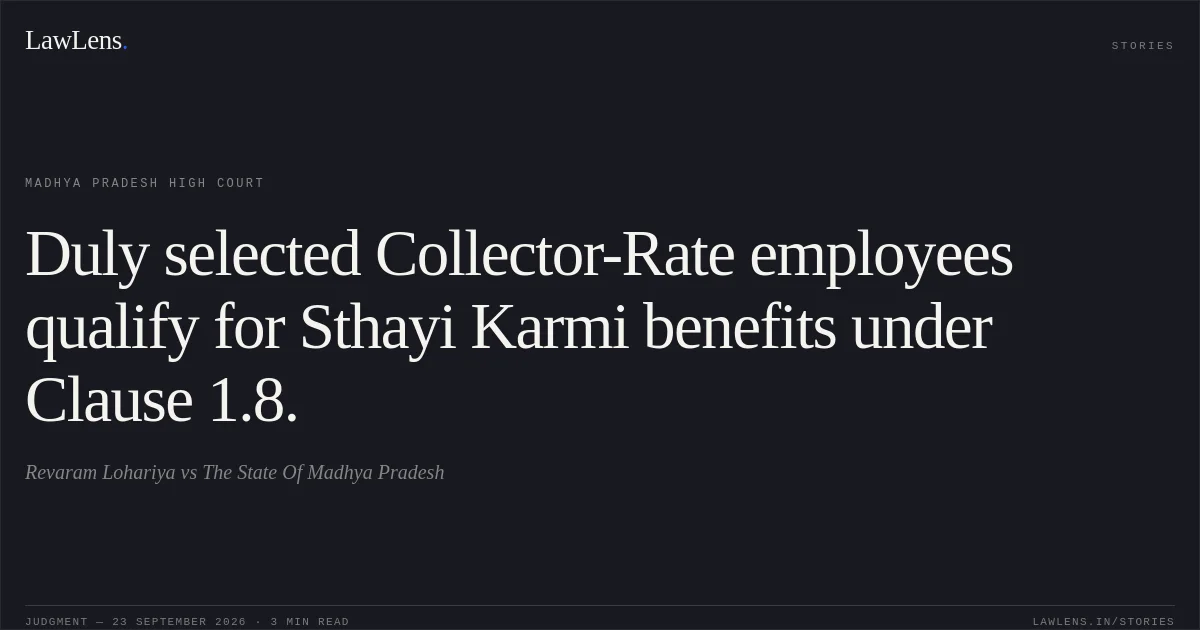
The High Court held that the petitioners fulfilled the requirements of Clause 1.8 of the circular dated 7 October 2016 and were entitled to the benefit of “Sthayi Karmi” status.
The orders dated 16 August 2023 and 26 September 2023 were quashed for being unreasoned and contrary to the circular.
Source reference: para. 8The respondents were directed to declare the petitioners as “Sthayi Karmi” and extend all consequential benefits, completing the exercise within three months from communication of the judgment.
Source reference: para. 8.1The writ petition was accordingly disposed of.
Source reference: para. 9Original Court PDF
Revaram LohariyavsThe State Of Madhya Pradesh
Click to open original judgment
Original judgment, available to read, download and summarize on LawLens.in