Facts
The appellant, Biju, was the sole accused in S.C. No. 179 of 2011 before the Sessions Court, Thodupuzha.
Source reference: no citationThe prosecution alleged that on 3 July 2010, at approximately 5:30 p.m., the accused entered the house of PW1, who was alone, allegedly carrying a knife, assaulted her, attempted to remove her clothes, touched and kissed her, and attempted to commit rape; the attempt allegedly failed when PW1 resisted and escaped
Source reference: p.2The prosecution examined PW1 to PW8 and produced documentary and material evidence, including the first information statement, scene mahazar, potency certificate, sketch, and the victim’s clothes.
Source reference: pp.2–4, 15–16The Sessions Court acquitted the accused of the alleged offence under Section 511 read with Section 376 IPC but convicted him under Sections 323, 354 and 452 IPC, sentencing him to concurrent terms of imprisonment, the maximum being four years under Section 452 IPC.
Source reference: pp.3–4In appeal, the accused challenged the findings under Sections 323, 354 and 452 IPC.
Source reference: p.4The State contended that the evidence disclosed an attempt to commit rape under Section 511 read with Section 376 IPC, but conceded that no appeal or revision had been filed by the prosecution against the Sessions Court’s findings.
Source reference: p.4Issues
1. Whether the Sessions Court was correct in holding that the accused committed an offence under Section 323 IPC?
Source reference: para. 11(i), p.112. Whether the Sessions Court was correct in convicting the accused under Section 354 IPC?
Source reference: para. 11(ii), p.113. Whether the conviction under Section 452 IPC was legally sustainable?
Source reference: para. 11(iii), p.114. Whether the evidence disclosed any other offence, particularly an attempt to commit rape under Section 511 read with Section 376 IPC, which the Sessions Court had failed to consider?
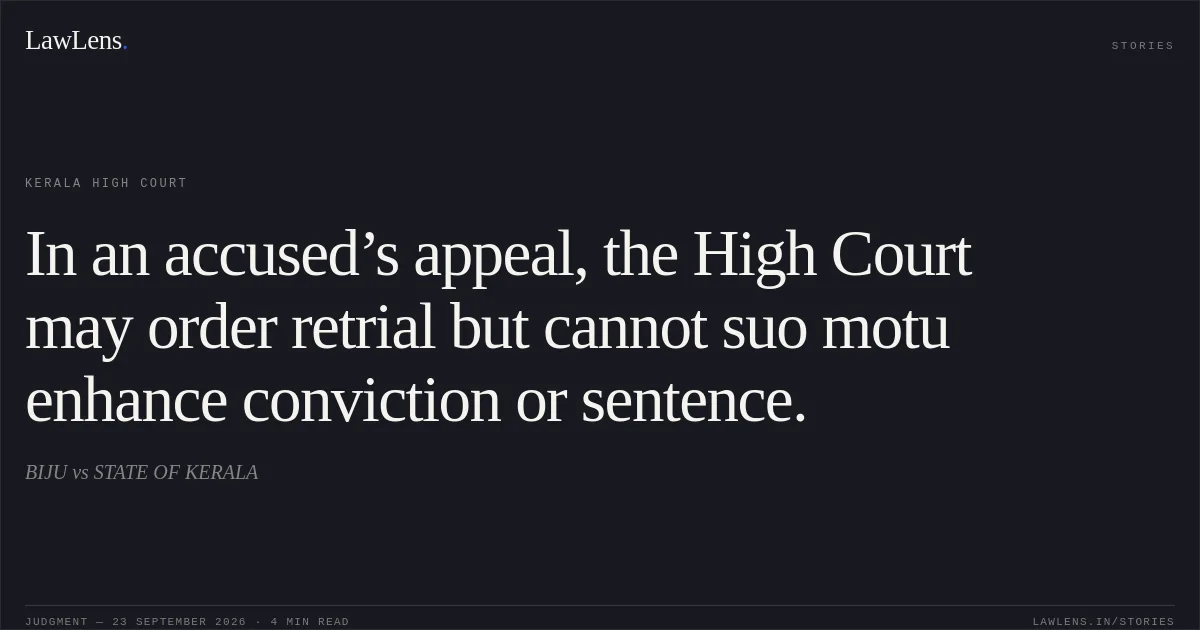
Source reference: para. 11(iv), p.11; pp.4–5, 17–215. Whether, in an appeal filed only by the accused, the High Court could exercise suo motu revisional jurisdiction to convict the accused for another or more serious offence, enhance the sentence, or order a retrial?
Source reference: paras. 20–23, pp.23–25Law Applied
The Court applied Sections 323, 354, 376, 452 and 511 IPC.
Source reference: no citationSection 511 criminalises an attempt to commit an offence where the accused has moved beyond preparation and performed an act towards commission of the substantive offence; under Aman Kumar v. State of Haryana, an attempt to rape requires conduct demonstrating an intention to have sexual intercourse despite resistance, whereas conduct amounting only to indecent assault may attract Section 354 IPC.
Source reference: pp.17–21The Court also relied on the principle that the credible and sterling testimony of a victim of sexual assault can, by itself, sustain conviction.
Source reference: para. 19, p.23Regarding appellate and revisional limits, Nagarajan v. State of Tamil Nadu, 2025 INSC 802, was applied for the rule that, in an appeal filed solely by the accused, the High Court cannot suo motu enhance the sentence or convict the accused for another charge; however, it may set aside the conviction, order a retrial, or reduce the sentence.
Source reference: paras. 7–9, pp.4–7, 23–24The Court also considered Praban Kumar Mitra v. State of West Bengal, Honnaiah T.H. v. State of Karnataka and Syed Shahnawaz Ali v. State of Madhya Pradesh for the principle that revisional jurisdiction under Sections 397 and 401 CrPC is discretionary, may be exercised suo motu in appropriate cases, and is directed towards supervising the legality, correctness and propriety of subordinate criminal proceedings.
Source reference: paras. 10, 21, pp.7–11, 24Reasoning
The High Court found that PW1 gave a detailed account of the accused’s entry into the house, physical restraint, attempted removal of her clothes, sexual touching, kissing, assault and the presence of a knife; despite cross-examination, nothing material was elicited to discredit her testimony.
Source reference: paras. 12–13, pp.12–14The Sessions Court had relied substantially on PW2’s limited account of what PW1 initially narrated and on PW3’s evidence to reject parts of PW1’s testimony.
Source reference: paras. 14–19, pp.14–23The High Court held that this approach was unsustainable because PW1’s evidence, if found reliable, could be acted upon as the sole basis of conviction, and the omission to narrate every detail immediately after the incident did not necessarily contradict her courtroom testimony.
Source reference: paras. 14–19, pp.14–23The Court considered that the evidence potentially established conduct going beyond a mere indecent assault and disclosed an attempt to commit rape under Section 511 read with Section 376 IPC.
Source reference: pp.17–21Nevertheless, because the appeal was filed only by the accused and the State had not challenged the Sessions Court’s failure to record the more serious offence, the High Court could not itself convert the finding into a conviction for the additional offence or enhance the sentence.
Source reference: paras. 20–23, pp.23–25Applying Nagarajan, the Court held that setting aside the impugned conviction and directing reconsideration on the basis of the evidence was permissible, while preserving the completed stages of the earlier trial.
Source reference: paras. 20–23, pp.23–25Holding
The appeal was allowed.
The convictions and sentences imposed under Sections 323, 354 and 452 IPC were set aside.
Source reference: para. 24, p.25The Sessions Court, Thodupuzha, was directed to hear both sides and determine, on the evidence already recorded, what offences had been committed by the accused, including any offence disclosed by the evidence, and to render an appropriate judgment in accordance with law.
Source reference: paras. 22–24, pp.24–25The matter was not remanded for a completely fresh trial; the proceedings were reverted to the stage of hearing and decision on merits.
Source reference: paras. 22–24, pp.24–25The appellant was directed to surrender before the Sessions Court on 22 October 2026; the interim bail order was to remain in force until 11:00 a.m. that day, after which the appellant could seek regular bail.
Source reference: para. 25, p.25The Sessions Court was directed to decide the matter within six weeks of receiving the High Court’s judgment.
Source reference: para. 26, p.26Acts & Sections Cited
8 provisions across 2 statutes referred to in this judgment. Each provision opens on LawLens.
Indian Penal Code, 18606
Code of Criminal Procedure, 19732
Original Court PDF
BIJUvsSTATE OF KERALA
Click to open original judgment
Original judgment, available to read, download and summarize on LawLens.in