Facts
The respondent-plaintiff instituted O.S. No. 1705/2021 seeking a declaration of absolute ownership and possession over the suit property under a registered sale deed dated 15 February 1962, a declaration that the sale deed dated 2 September 2020 executed by defendants 1 and 2 in favour of defendant 3 was not binding on him, and a permanent injunction.
Source reference: p.2, para.2The plaintiff pleaded that he discovered adverse revenue entries in 2012, challenged them before the revenue authorities, pursued a revision petition, and thereafter filed W.P. No. 24001/2014.
Source reference: pp.3–5, paras.3–4He had also instituted an earlier injunction suit, O.S. No. 219/2014, which was decreed ex parte.
Source reference: pp.23–24, paras.14–15The defendants sought rejection of the plaint under Order VII Rule 11(d) CPC, contending that the suit was barred by limitation because the plaintiff’s right to sue first accrued when he became aware of the adverse claim in 2012 or, at the latest, during the contested revenue proceedings in 2014.
Source reference: p.6, para.5The trial court dismissed the application, holding that limitation was a matter for trial and that the plaint did not expressly disclose a bar by limitation.
Source reference: pp.5–6, para.4The defendant-petitioner challenged that order under Section 115 CPC.
Source reference: no citationIssues
Whether the plaint itself disclosed that the plaintiff’s right to seek a declaration first accrued in 2012 or, at the latest, in 2014, thereby rendering the 2021 suit barred under Article 58 of the Limitation Act?
Source reference: p.21, para.11(1)Whether the plaintiff’s proceedings before the revenue authorities could be considered for determining when he became aware of the defendants’ adverse claim, notwithstanding that revenue authorities could not finally adjudicate title?
Source reference: p.21, para.11(2)Whether the 2020 sale deed and the alleged interference in 2021 constituted a fresh cause of action, and whether rejecting the plaint on that basis would amount to impermissible partial rejection under Order VII Rule 11 CPC?
Source reference: p.22, para.11(3)Law Applied
The Court applied Order VII Rule 11(d) CPC, under which a plaint must be rejected where, on a meaningful and complete reading of its averments, the suit appears to be barred by law; the court ordinarily considers the plaint and its documents, not the defence.
Source reference: p.22, para.12Article 58 of the Limitation Act prescribes three years for a declaratory suit, commencing when the right to sue first accrues, and subsequent events ordinarily do not restart limitation.
Source reference: pp.22–23, paras.13–14The Court relied on Nikhila Divyang Mehta v. Hitesh P. Sanghvi, 2025 SCC OnLine SC 779, for the mandatory application of limitation and the principle that limitation runs from the first accrual of the cause of action.
Source reference: pp.7–9, para.5The Court relied on T. Arivandandam v. T.V. Satyapal, (1977) 4 SCC 467, and Madanuri Sri Rama Chandra Murthy v. Syed Jalal, (2017) 13 SCC 174, for rejecting vexatious suits or suits rendered maintainable only through clever drafting.
Source reference: pp.9–14, paras.5–6The Court relied on Shri Mukund Bhavan Trust v. Shrimant Chhatrapati Udayan Raje Pratapsinh Maharaj Bhonsle, (2024) 15 SCC 675, for the proposition that an ex facie time-barred suit may be rejected at the threshold.
Source reference: pp.15–17, paras.7–8Although partial rejection of a plaint is ordinarily impermissible, the Court held that where ancillary prayers are founded on the same time-barred declaratory claim and do not disclose an independent cause of action, rejection of the plaint as a whole is permissible.
Source reference: pp.29–32, paras.20–22Reasoning
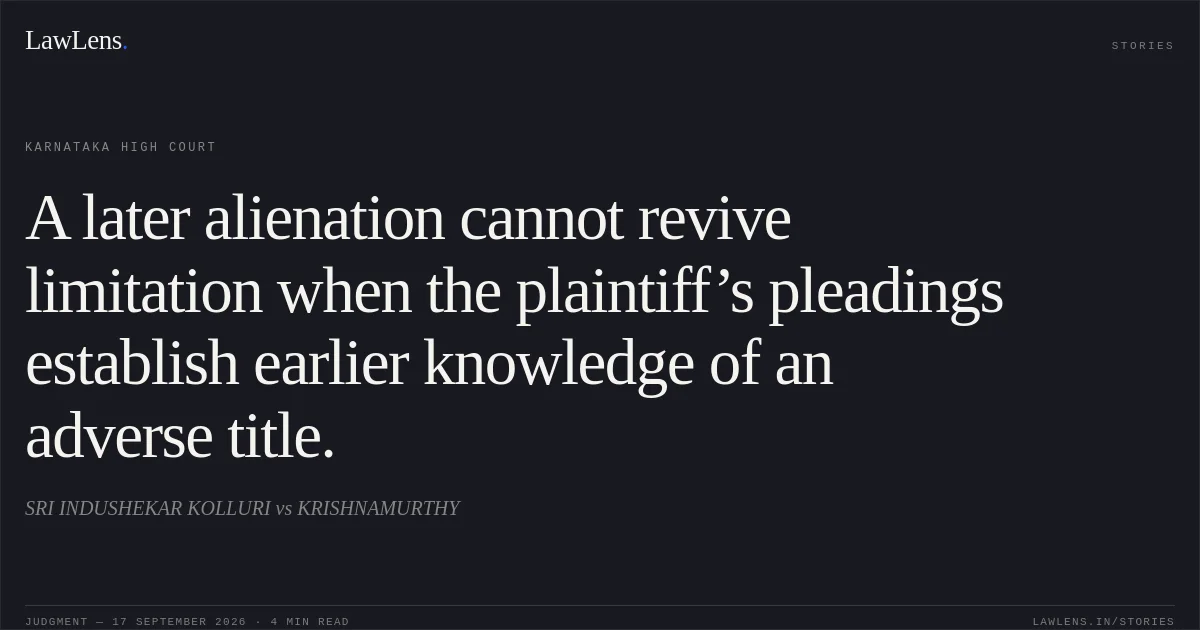
The Court found that the plaintiff’s own pleadings established knowledge of the competing claim in 2012, when he discovered the adverse mutation entries, obtained relevant records, challenged the entries before the revenue authorities, pursued revision proceedings, and filed a writ petition in 2014.
Source reference: pp.23–27, paras.14–17Although revenue entries do not create or extinguish title and revenue authorities cannot conclusively determine ownership, the proceedings were relevant to show that the plaintiff was aware of a serious and adverse assertion of title.
Source reference: pp.25–27, paras.16–17The pendency of the writ petition and the subsequent ex parte injunction decree did not suspend or restart limitation for the declaratory relief.
Source reference: p.28, para.18Similarly, the 2020 sale deed was only a subsequent transaction based on the pre-existing adverse claim; it did not create a fresh starting point under Article 58.
Source reference: pp.28–29, para.19The challenge to that sale deed and the injunction prayer were dependent upon the plaintiff’s primary assertion of title and therefore did not constitute independent causes of action capable of surviving rejection of the declaratory claim.
Source reference: pp.30–32, paras.20–22Holding
The Court held that the plaintiff’s right to seek declaration first accrued no later than the contested proceedings of 2014, and that the suit filed in 2021 was barred by the three-year limitation period under Article 58 of the Limitation Act.
The 2020 sale deed, the 2021 alleged interference, the pending writ petition, and the earlier injunction decree did not revive or extend limitation.
Source reference: no citationThe Civil Revision Petition was allowed; the trial court’s order dated 6 April 2026 was set aside; the application under Order VII Rule 11(d) CPC was allowed; and the plaint in O.S. No. 1705/2021 was rejected.
Source reference: pp.32–33, operative orderActs & Sections Cited
6 provisions across 4 statutes referred to in this judgment. Each provision opens on LawLens.
Code of Civil Procedure, 19081
Limitation Act, 19632
Transfer of Property Act, 18821
Securitisation and Reconstruction of Financial Assets and Enforcement of Security Interest Act, 20022
Original Court PDF
SRI INDUSHEKAR KOLLURIvsKRISHNAMURTHY
Click to open original judgment
Original judgment, available to read, download and summarize on LawLens.in