Facts
The appellant was prosecuted for allegedly dragging the victim, then stated to be 12 years old, into a paddy field and committing penetrative sexual assault upon her on 18 November 2020.
Source reference: paras. 6–8The incident was reported by the victim’s father, leading to registration of Sipajhar P.S. Case No. 843/2020 under Section 376 IPC read with Section 4 of the POCSO Act.
Source reference: paras. 6–8The Trial Court convicted the appellant under Section 8 read with Section 4(2) of the POCSO Act and sentenced him to 20 years’ rigorous imprisonment with a fine of ₹20,000.
Source reference: paras. 2, 9–10In appeal, the appellant challenged the proof of the victim’s age, the reliability of her testimony in view of alleged mental illness, and the absence of dock identification.
Source reference: para. 3The victim’s birth certificate, although allegedly seized during investigation, was not exhibited, while the radiological examination assessed her age at 12–14 years.
Source reference: paras. 17–18, 22Issues
1. Whether the prosecution proved beyond reasonable doubt that the victim was below 16 years of age so as to attract Section 4(2) of the POCSO Act.
Source reference: paras. 21–262. Whether the alleged unsoundness of mind of the victim rendered her testimony unreliable or required corroboration before conviction.
Source reference: paras. 27–28, 333. Whether the absence of a formal dock identification by the victim vitiated the conviction.
Source reference: para. 294. What offence and sentence were legally attracted if the victim was below 18 but her age below 16 was not proved.
Source reference: paras. 26, 32–34Law Applied
The Court applied Sections 4(1) and 4(2) of the POCSO Act, distinguishing the punishment for penetrative sexual assault against a child below 18 years from the aggravated punishment applicable where the child is below 16 years.
Source reference: paras. 26, 32Section 94 of the Juvenile Justice (Care and Protection of Children) Act, 2015 was relied upon for age determination, with the Court holding that, where documentary age proof is not proved, an ossification or radiological examination may be considered, but its assessment must receive a margin of error.
Source reference: para. 22Relying on Jaya Mala v. Home Secretary, Government of J&K, (1982) 2 SCC 538, and Rajak Mohammad v. State of Himachal Pradesh, (2018) 9 SCC 248, the Court held that radiological age determination is not exact and a margin of approximately two years on either side must be allowed.
Source reference: paras. 23–24Yuvaprakash v. State of T.N., (2024) 17 SCC 684, was relied upon for the proposition that, in the absence of proved documentary age records, age may be established through ossification testing, subject to the benefit of doubt.
Source reference: para. 25Section 36 of the POCSO Act was also applied regarding the manner in which a child’s evidence may be recorded without direct exposure to the accused, including through video conferencing.
Source reference: para. 29Reasoning
The Court accepted the victim’s account of penetrative sexual assault because it was corroborated by PW-3, who saw the victim and the appellant naked in the field, and by the medical evidence showing a torn hymen and a reddish stretch mark.
Source reference: paras. 12–13, 17, 21The allegation of mental illness was not established: the doctor’s opinion was based only on the history supplied by the guardian, while the other witnesses and the Magistrate who recorded the victim’s Section 164 Cr.P.C. statement found no indication that she was mentally incapable of narrating the incident.
Source reference: paras. 27–28The Court further held that the victim had effectively identified the appellant during her testimony, as the appellant was present through video conferencing and she denied the suggestion that he had not assaulted her.
Source reference: para. 29However, the birth certificate and seizure list were not exhibited, leaving the radiological assessment of 12–14 years as the only reliable age evidence.
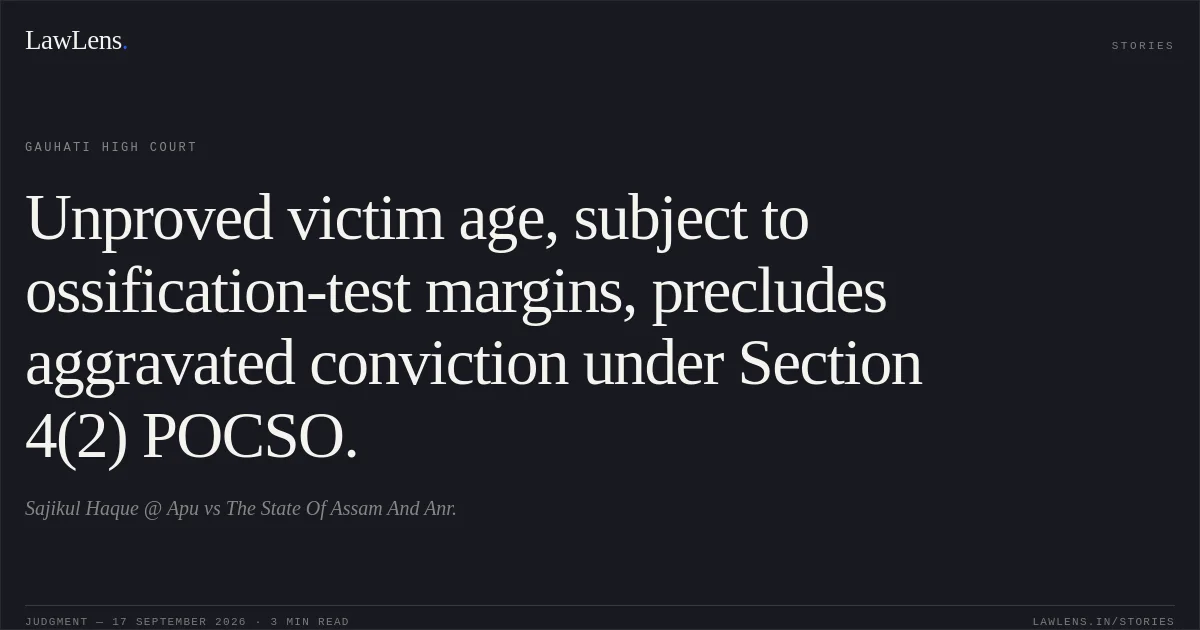
Source reference: para. 22Applying the permissible margin of error of two years, the Court held that the prosecution had not proved that the victim was below 16 years; nevertheless, she remained below 18 years, making Section 4(1), rather than Section 4(2), applicable.
Source reference: paras. 25–26, 32Holding
The appeal was partly allowed.
The conviction and sentence under Section 4(2) of the POCSO Act were set aside because the prosecution failed to prove that the victim was below 16 years of age.
Source reference: para. 34The appellant was instead convicted under Section 4(1) of the POCSO Act and sentenced to 11 years’ rigorous imprisonment with a fine of ₹20,000, with six months’ rigorous imprisonment in default of payment.
Source reference: para. 34The appeal was accordingly disposed of and the Trial Court Record was directed to be returned.
Source reference: paras. 35–36Acts & Sections Cited
7 provisions across 4 statutes referred to in this judgment. Each provision opens on LawLens.
Indian Penal Code, 18601
Code of Criminal Procedure, 19732
Protection of Children from Sexual Offences Act, 20123
Juvenile Justice (Care and Protection of Children) Act, 2015.1
Original Court PDF
Sajikul Haque @ ApuvsThe State Of Assam And Anr.
Click to open original judgment
Original judgment, available to read, download and summarize on LawLens.in