01Facts
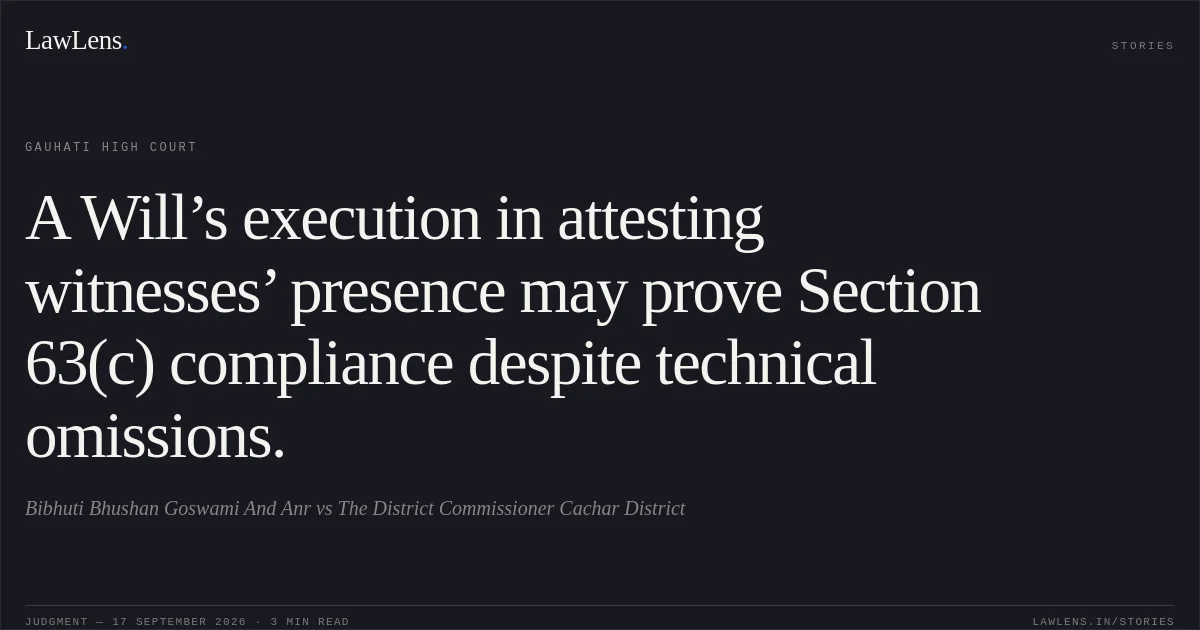
The appellants, Bibhuti Bhushan Goswami and Prasenjit Sharma, filed an application under Section 276 of the Indian Succession Act, 1925, seeking probate of an unregistered Will dated 10.12.2022 executed by Late Chaya Bhattacharjee.
pp. 2–3The Will bequeathed a 520 sq. ft. flat and the corresponding undivided interest in the land to the appellants, who were also named as executors. It was allegedly attested by Ninmoy Sharma and Maya Rani Das, both of whom were examined as witnesses. Notices were served, no objections were filed, and the property valuation was accepted.
pp. 2–3The District Judge, Cachar, nevertheless rejected the probate application by order dated 19.08.2025, holding that due attestation under Section 63(c) of the Indian Succession Act had not been sufficiently proved.
p. 3The appellants challenged that order under Section 384 of the Act.
pp. 2–302Issues
i.1. Whether the attestation and execution of the Will were duly proved under Section 63(c) of the Indian Succession Act, 1925, despite the attesting witnesses not reproducing every statutory requirement in precise terms in their evidence?
pp. 4–7 · ¶ 10–13ii.2. Whether the appellants were entitled to probate of the Will dated 10.12.2022?
pp. 7–8 · ¶ 14–1503Law Applied
The Court applied Section 276 of the Indian Succession Act, 1925, under which probate may be sought by petition, and Section 63, particularly Section 63(c), which requires an unprivileged Will to be attested by at least two witnesses, each having seen the testator sign or acknowledge the signature and each signing the Will in the testator’s presence; no particular form of attestation is required.
pp. 5–6 · ¶ 10The Court held that proof of execution need not reproduce the statutory language with mathematical or technical precision where the evidence, read fairly, establishes compliance with Section 63.
pp. 4–5, 7 · ¶ 5–8, 11–13It also relied on Meena Pradhan v. Kamla Pradhan, (2023) 9 SCC 734, cited in support of a non-technical approach to proof of testamentary execution.
p. 4 · ¶ 8Provisions in the judgment · 4 · Linked ones open on LawLens
Indian Succession Act, 1925 Section 384Section 276Section 63Section 317
04Reasoning
The attesting witnesses deposed that the deceased had made and published her last Will, that it was executed in their presence, and that they signed it as attesting witnesses. Their evidence remained uncontroverted because they were not cross-examined, and the Probate Court did not put questions to them.
p. 7 · ¶ 12The High Court construed the statement that the Will was “executed in their presence” as meaning that the testator signed the Will in their presence and that the witnesses attested it accordingly.
p. 7 · ¶ 13Since Section 63(c) does not prescribe any particular form of attestation, the omission to narrate each step under clauses (a), (b), and (c) in exact words was treated as insufficient justification for rejecting otherwise clear and unrebutted testimony.
p. 7 · ¶ 13The Court therefore concluded that execution and attestation of the Will had been duly proved.
05Holding
The appeal was allowed, and the District Judge’s order dated 19.08.2025 rejecting probate was set aside.
pp. 7–8 · ¶ 14The High Court held that the Will dated 10.12.2022 was the last Will of Late Chaya Bhattacharjee and had been duly executed, attested, and proved.
p. 8 · ¶ 15The District Judge was directed to grant probate in favour of the appellants upon payment of the requisite stamp duty, with a certified copy of the Will annexed to the grant.
p. 8 · ¶ 15The appellants were further directed to file a full and true inventory of the deceased’s property, credits, and debts within six months of the grant, in accordance with Section 317 of the Indian Succession Act.
p. 8 · ¶ 15Original Court PDF
Bibhuti Bhushan Goswami And AnrvsThe District Commissioner Cachar District
Click to open original judgment
Original judgment, available to read, download and summarize on LawLens.in