Facts
On 16 January 2004, Precious Finance and Investment Private Limited executed a Development Agreement in favour of Kalpataru Construction Overseas Private Limited, subsequently renamed Kalpataru Properties Private Limited, granting development rights over the property and containing a covenant for its ultimate transfer to the developer.
Source reference: paras. 2–3The Development Agreement was adjudicated under Section 31 of the Maharashtra Stamp Act, and stamp duty of ₹10,31,000 was paid under Article 5(g-a), with an endorsement under Section 41 dated 3 January 2004; the Agreement was thereafter registered.
Source reference: paras. 2–3In 2007, the parties proposed and executed a separate Conveyance Deed for the same consideration. The Collector adjudicated stamp duty at ₹51,55,000, calculated at 5% under Article 25(b), which was paid on 18 May 2007. The Conveyance Deed was executed on 11 June 2007 and registered.
Source reference: paras. 3–4, 16Following an audit objection, the Revenue authorities contended that the Development Agreement was, in substance, an agreement to sell with possession and was deemed to be a conveyance under Explanation I to Article 25.
Source reference: para. 5The Chief Controlling Revenue Authority issued notices under Section 53A, beginning on 1 July 2011, and ultimately passed an order dated 18 June 2016 directing payment of ₹41,24,000.
Source reference: paras. 6–8Issues
Whether the proceedings under Section 53A, though formally relating to the 2007 Conveyance Deed, were in substance proceedings to reopen the stamp-duty adjudication of the Development Agreement dated 16 January 2004?
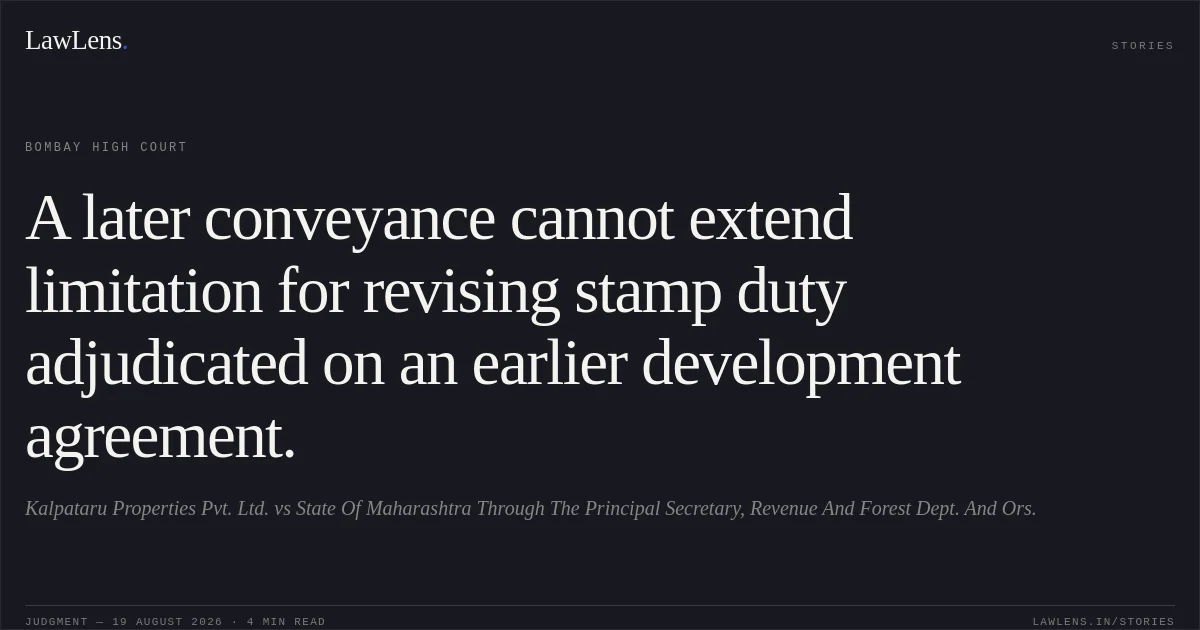
Source reference: paras. 14, 18–23, 29–30Whether the Revenue authorities could rely on the subsequent Conveyance Deed to create a fresh limitation period for revising the earlier stamp-duty determination and Section 41 certificate relating to the Development Agreement?
Source reference: paras. 34–38, 40–42Whether the impugned order directing payment of ₹41,24,000 towards alleged short levy of stamp duty was legally sustainable?
Source reference: paras. 42–44Law Applied
The Court applied Sections 31 and 41 of the Maharashtra Stamp Act, under which an instrument may be adjudicated for proper stamp duty and certified upon payment; Section 53A, which permits revision of an order or certificate within the prescribed six-year period; and Section 4, which governs situations involving several instruments employed to complete a single transaction by identifying the principal instrument and charging the other instruments accordingly.
Source reference: paras. 24–26, 32–34The Court also considered Article 5(g-a), which prescribed stamp duty on an instrument granting development or similar rights to a developer, and Article 25, including Explanation I, under which an agreement to sell involving transfer or delivery of possession may be deemed to be a conveyance and charged accordingly, subject to adjustment of duty upon execution of a subsequent conveyance.
Source reference: paras. 21–25The governing principle was that the substance and legal effect of an instrument, rather than its nomenclature, determines stamp liability; however, a statutory revisional power must be exercised within the prescribed limitation period and cannot be indirectly exercised against an earlier adjudication through proceedings concerning a later instrument.
Source reference: paras. 28, 40–41Reasoning
The Court found that the alleged short levy was not independently based on the 2007 Conveyance Deed. The calculation began by treating the transaction as having attracted 10% stamp duty in 2004, based on the proposition that the Development Agreement was effectively an agreement to sell deemed to be a conveyance. The Revenue then deducted the amounts paid on the Development Agreement and the later Conveyance Deed.
Source reference: paras. 21–23, 29–31Thus, the demand necessarily depended upon reopening the legal character and stamp-duty treatment of the Development Agreement, which had already been voluntarily submitted for adjudication, assessed, certified under Section 41, and registered.
Source reference: paras. 25–26, 35The subsequent Conveyance Deed could be relevant evidence regarding the nature of the overall transaction, but it could not alter the date of the earlier certificate or revive limitation for revising the Development Agreement.
Source reference: paras. 38, 40–41The six-year period had expired before the first notice dated 1 July 2011, calculated from the certificate dated 3 January 2004.
Source reference: paras. 38, 40–41The authority could not treat the proceeding as relating only to the Conveyance Deed for limitation purposes while relying on the 2004 Development Agreement to impose the 10% rate for calculating the alleged deficit.
Source reference: para. 38The Court also noted that, if the Revenue considered both instruments part of one transaction, it should have properly examined Section 4 and determined the principal instrument; the impugned order did not undertake that exercise.
Source reference: paras. 32–34The Court expressly left open the substantive question whether the Development Agreement was in fact an agreement to sell deemed to be a conveyance, holding that the demand failed independently on limitation.
Source reference: paras. 39–40Holding
The Court held that the demand for ₹41,24,000 was, in substance, founded on reopening the stamp-duty adjudication of the Development Agreement dated 16 January 2004.
Since the Section 53A proceedings were initiated after expiry of the six-year limitation period from the Section 41 certificate dated 3 January 2004, the Revenue could not use the subsequent Conveyance Deed to create a fresh starting point for limitation.
Source reference: paras. 40–43The writ petition was allowed; the impugned order dated 18 June 2016 was quashed and set aside insofar as it found a short levy of ₹41,24,000 and directed its payment.
Source reference: para. 44The consequential recovery demand was also quashed, with no order as to costs.
Source reference: para. 44Acts & Sections Cited
5 provisions across 1 statute referred to in this judgment. Each provision opens on LawLens.
Maharashtra Stamp Act5
Original Court PDF
Kalpataru Properties Pvt. Ltd.vsState Of Maharashtra Through The Principal Secretary, Revenue And Forest Dept. And Ors.
Click to open original judgment
Original judgment, available to read, download and summarize on LawLens.in