01Facts
The appellant–plaintiff and her mother executed a registered sale deed in 1999 in favour of the respondent–defendant concerning Survey No. 1401 paiki 1, admeasuring 1-41-49 hectares, situated at Vav, Banaskantha.
¶ 3In 2013, approximately fourteen years after the transaction, the plaintiff instituted Civil Suit No. 5 of 2013 seeking cancellation of the sale deed on the grounds that it was forged, fabricated and obtained by fraud.
¶ 3.1–3.2The Trial Court held that the plaintiff failed to prove fraud, accepted that the defendant had purchased the property for consideration, and dismissed the suit as barred by limitation. The First Appellate Court affirmed the decree on 3 May 2025. The plaintiff thereafter preferred the present second appeal under Section 100 CPC.
¶ 3.2, 3.402Issues
i.1. Whether the plaintiff established that the registered sale deed executed in 1999 was forged, fabricated or obtained by fraud?
¶ 3.2, 8–9ii.2. Whether the suit instituted in 2013 to challenge the 1999 sale deed was barred by limitation?
¶ 3.3, 10iii.3. Whether the mutation entry made in 2012 or the alleged redemption of the mortgage gave rise to a fresh cause of action for filing the suit?
¶ 4.1–4.2, 10–11iv.4. Whether the concurrent findings of fact warranted interference in second appeal under Section 100 CPC and raised any substantial question of law?
¶ 8, 12–1303Law Applied
The Court applied Section 100 of the Code of Civil Procedure, 1908, under which a second appeal lies only where a substantial question of law arises; concurrent findings of fact cannot ordinarily be disturbed unless they are perverse, contrary to mandatory or settled law, based on inadmissible evidence, or unsupported by evidence.
¶ 12–12.2A challenge to cancellation of an instrument must be brought within the applicable limitation period, and the Court treated the three-year period as running from the execution/registration of the sale deed, not from a subsequent mutation entry.
¶ 3.3, 10The Court further applied the principle that a registered document carries a presumption of genuineness and that allegations of fraud must be specifically proved by evidence.
¶ 9A mutation entry is fiscal in nature and does not confer title, right or interest.
¶ 10The Court relied on Russi Fisheries (P) Ltd. v. Bhavna Seth, 2026 SCC OnLine SC 555, and Jaichand (Dead) through LRs v. Sahnulal, 2024 SCC OnLine SC 3864, including the principles stated in Kondiba Dagadu Kadam v. Savitribai Sopan Gujar, AIR 1999 SC 2213, regarding the limited scope of interference under Section 100 CPC.
¶ 12.1–12.2Provisions in the judgment · 1 · Linked ones open on LawLens
Code of Civil Procedure, 1908 Section 100
04Reasoning
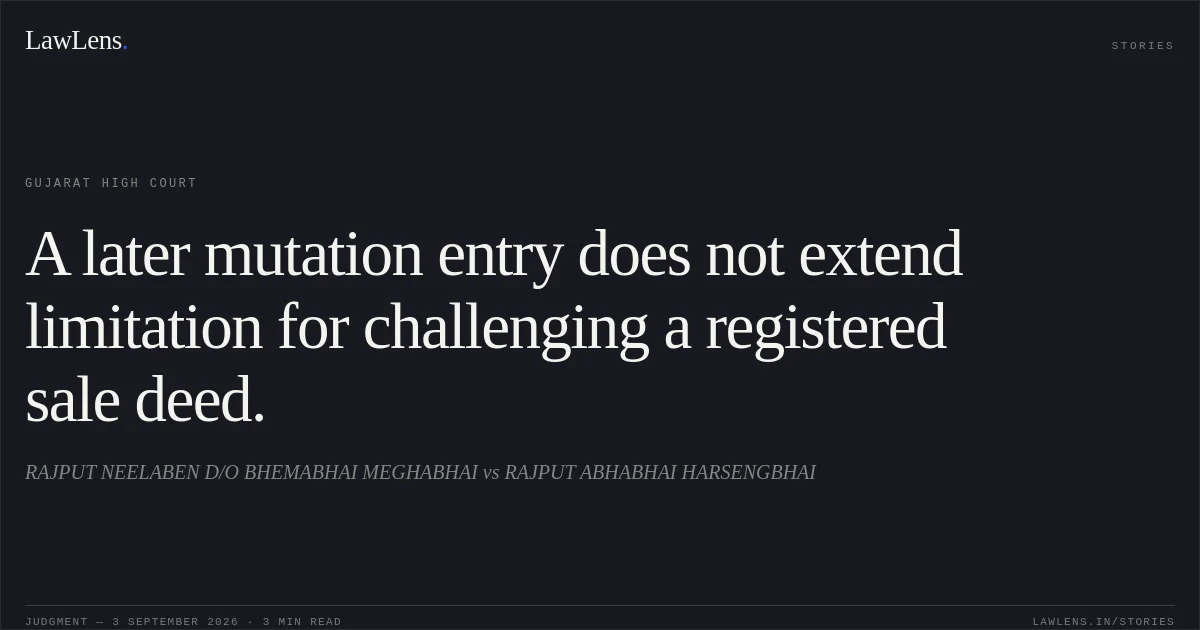
The plaintiff was herself a signatory to the registered sale deed executed in 1999, yet she challenged it only in 2013. The Court held that the cause of action to challenge the deed accrued when it was executed and registered; the later mutation entry in 2012 could not revive or extend limitation because mutation does not create title.
¶ 8, 10The plaintiff produced no sufficient evidence of fraud or fabrication, apart from examining one witness to the sale deed, and therefore failed to rebut the presumption attaching to the registered instrument.
¶ 9The alleged mortgage redemption was also insufficient: apart from the redemption deed, there was no evidence establishing the existence of a mortgage at the time of sale, and the sale deed placed the responsibility of clearing any encumbrance upon the plaintiff.
¶ 11Since both subordinate courts had reached consistent factual findings and those findings were neither perverse nor legally erroneous, no substantial question of law arose for consideration under Section 100 CPC.
¶ 12–1305Holding
The High Court held that the suit was hopelessly barred by limitation, that the plaintiff failed to prove fraud or fabrication of the registered sale deed, and that the mutation entry or alleged mortgage redemption did not create a fresh cause of action.
¶ 9–11Finding no substantial question of law, the Court dismissed the second appeal and affirmed the judgments and decrees of the Trial Court and First Appellate Court.
¶ 16The appellant was directed to pay Rs. 10,000 to the respondent and deposit a further Rs. 10,000 with the District Legal Services Authority, Banaskantha, within one month.
¶ 15All pending applications were disposed of and a decree was directed to be drawn accordingly.
¶ 16Original Court PDF
RAJPUT NEELABEN D/O BHEMABHAI MEGHABHAIvsRAJPUT ABHABHAI HARSENGBHAI
Click to open original judgment
Original judgment, available to read, download and summarize on LawLens.in