Facts
The appellant, claiming to be the tenant of the second floor of property No. 48, Janpath, relied on an agreement dated 1 March 1976, which provided for an initial 11-month lease and, under Clause 16, contemplated execution of a further lease—including a perpetual lease—at the lessee’s option. No further lease deed was executed, though the appellant remained in occupation.
Source reference: para. 5–16In 2002, he sought execution of a perpetual lease deed and asserted that the rent remained Rs.221 per month; the respondents claimed rent of Rs.2,000, later enhanced to Rs.2,200 per month.
Source reference: para. 17–21The appellant filed a suit for specific performance, declaration of the rent and permanent injunction. The Civil Judge rejected the plaint under Order VII Rule 11 CPC, finding the specific-performance claim time-barred and the rent declaration not maintainable; the appellate court affirmed that order. The appellant challenged those decisions in this regular second appeal.
Source reference: para. 32–45Issues
1. Whether the suit for specific performance was barred by limitation.
Source reference: para. 66(i); paras. 67–1262. Whether the Trial Court was justified in rejecting the plaint under Order VII Rule 11 CPC on limitation grounds.
Source reference: para. 66(ii); paras. 122–1263. Whether rejection of the plaint concerning the declaration of rent under Section 50 of the Delhi Rent Control Act, 1958, was proper.
Source reference: para. 66(iii); paras. 127–164Law Applied
Order VII Rule 11 CPC permits rejection where the plaint, read as a whole and taking its averments as true, shows that the suit is barred by law (Hardesh Ores (P) Ltd. v. Hede & Co.).
Source reference: para. 123Article 54 of the Limitation Act, 1963, provides a three-year period for specific performance, running from the date fixed for performance or, if none is fixed, from when the plaintiff has notice of refusal.
Source reference: para. 115Under Section 29 of the Contract Act, 1872, an agreement whose essential terms are uncertain and lack an objective means of determination is unenforceable; a court cannot specifically enforce an agreement to agree (Hitkarini Sabha, Shanti Prasad Devi, Naveen Chand).
Source reference: paras. 74–88A lease exceeding one year must be created by a registered instrument under Section 107 of the Transfer of Property Act, 1882.
Source reference: paras. 89–96Section 34 of the Specific Relief Act, 1963, permits declarations concerning legal character or a right to property, not merely a pecuniary liability; the rate of rent is an incident of tenancy rather than such a character or property right.
Source reference: paras. 129–151Although Section 50 of the Delhi Rent Control Act bars civil-court jurisdiction over matters entrusted to the Rent Controller, the Court held that this provision was not the basis for rejecting the rent declaration in this case.
Source reference: para. 153Reasoning
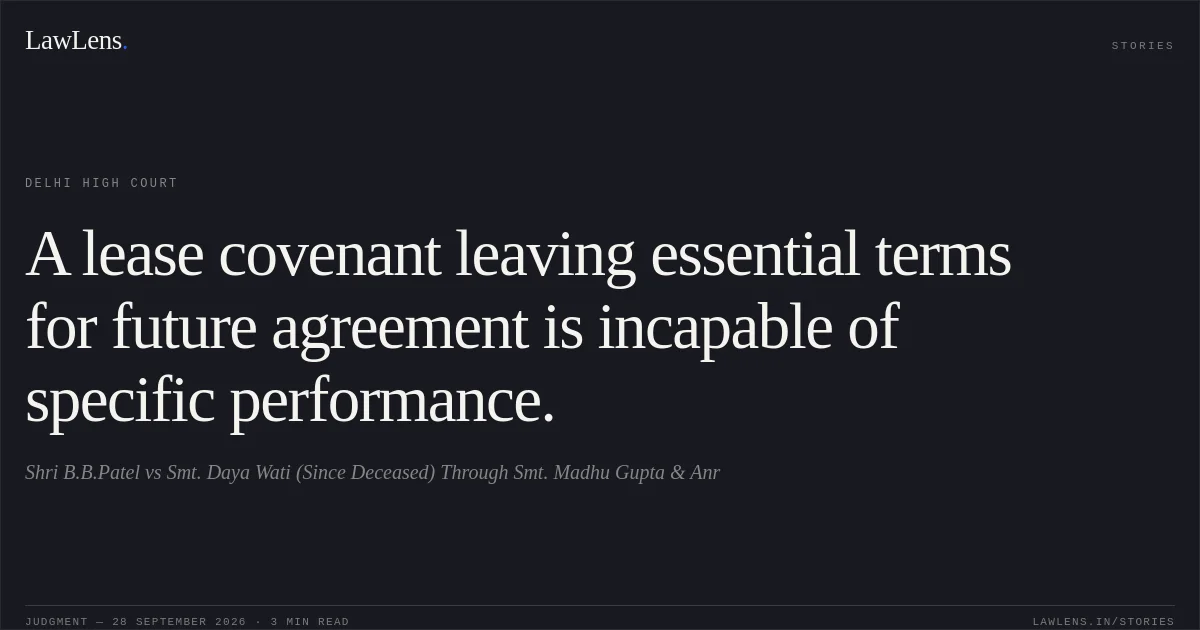
Clause 16 did not settle the duration, rent or other essential terms of the contemplated future lease, nor provide an objective mechanism for fixing them. It therefore amounted to an unenforceable agreement to agree, rather than a concluded contract capable of specific performance.
Source reference: paras. 72–98In any event, the initial lease expired in 1977, and the appellant’s failure to seek execution for more than 25 years meant the option could not remain exercisable indefinitely; the 2002 demand could not revive it or restart limitation.
Source reference: paras. 108–118, 124–125The material dates and terms appeared from the plaint and documents relied upon by the appellant, so no evidence was required to determine the limitation bar at the threshold.
Source reference: paras. 122–126As to rent, the tenant-landlord relationship was admitted and the dispute concerned only the amount payable—a pecuniary obligation, not a legal character or right to property under Section 34. The Court accordingly found the declaration not maintainable, while clarifying that Section 50 of the DRC Act was not the applicable ground.
Source reference: paras. 134–153The injunction was consequential to that declaration and likewise failed; the plaint also acknowledged payment of Rs.2,000 per month and enclosed a cheque calculated at the claimed enhanced rate.
Source reference: paras. 155–164Holding
The High Court answered the limitation issues against the appellant and held that the plaint was rightly rejected under Order VII Rule 11 CPC.
It further held that the rent declaration was not maintainable under Section 34 of the Specific Relief Act, though not because of Section 50 of the DRC Act; the consequential injunction also failed.
Source reference: paras. 153–164The regular second appeal was dismissed, and pending applications were disposed of.
Source reference: paras. 127, 153–168Acts & Sections Cited
11 provisions across 7 statutes referred to in this judgment. Each provision opens on LawLens.
Code of Civil Procedure, 19081
delhi rent control act, 19583
Specific Relief Act, 19633
Limitation Act, 19631
Transfer of Property Act, 18821
Registration Act, 19081
Indian Contract Act, 18721
Original Court PDF
Shri B.B.PatelvsSmt. Daya Wati (Since Deceased) Through Smt. Madhu Gupta & Anr
Click to open original judgment
Original judgment, available to read, download and summarize on LawLens.in